
Manta AI
Your AI agent for autonomous web app testing
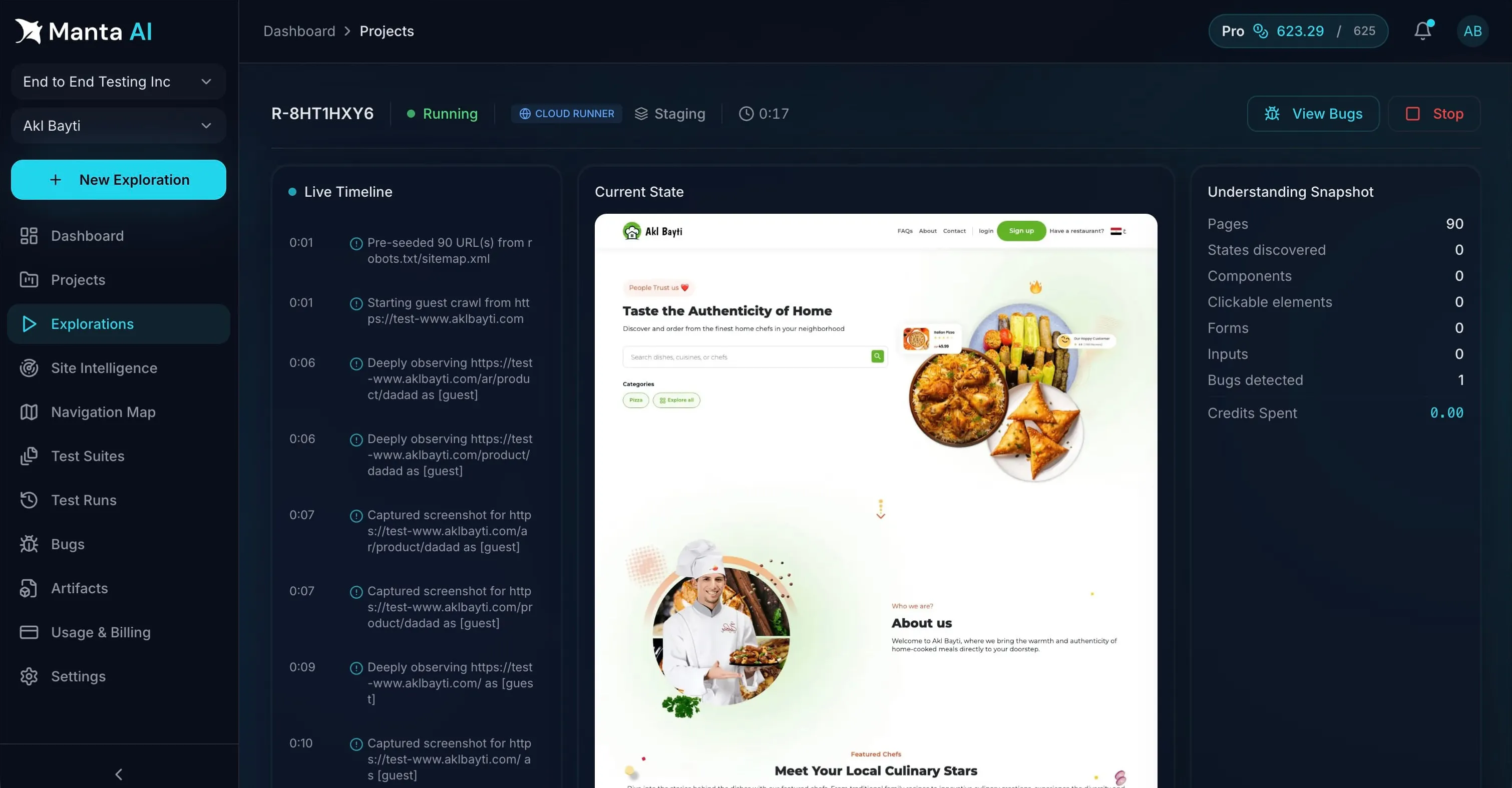
Manta AI is an autonomous testing agent for web applications. Give it a URL and it explores your app the way a real user would — mapping flows, finding bugs, and generating self-healing test cases. Describe a flow in plain English and Manta tests it for you, no script required. When your UI changes, the tests adapt on their own. Run the agent locally on any machine or server — test apps behind a firewall, on a private network, or even on localhost. Free tier open. No card required.
AI Analysis
Manta AI is an autonomous AI testing agent for web apps. Provide a URL and it explores like a real user, mapping flows, detecting bugs, and creating self-healing test cases. Describe flows in plain English for script-free testing; tests automatically adapt to UI changes. Runs locally on any machine for apps behind firewalls, private networks, or localhost. Offers a free tier with no card needed. It addresses key pain points like brittle manual scripts, high maintenance from UI updates, and inability to test non-public apps. The value proposition is effortless, reliable, adaptive testing that boosts developer productivity and ensures quality without traditional QA overhead.
The market timing is favorable for 2025-2026. AI agent and multimodal LLM technologies are reaching maturity, enabling reliable autonomous web interaction. Developer demands are shifting toward AI-native tools for DevOps efficiency amid growing web app complexity and CI/CD adoption. Economic pressures favor tools that reduce QA costs. Policy support for AI innovation in tech sectors is positive. Excellent Timing.
Overall feasibility is High. Core tech (LLM reasoning, browser automation like Playwright, DOM analysis for self-healing) is mature and accessible. Local execution lowers cloud costs and compliance risks for private data. Development costs are manageable for an AI software product. Strong scalability via self-hosted or cloud options. Main challenge is ensuring consistent agent reliability across diverse UIs, but the local-first approach mitigates many operational risks.
Main target segments: Software engineers, QA/automation engineers, and dev teams at startups, scale-ups, and mid-market tech companies. Industries: Software development, SaaS, fintech, e-commerce. Geographic focus: Global, concentrated in US, Europe, and Asia tech hubs. Automated testing market TAM exceeds $15B (2025), with AI testing SAM ~$2-3B; SOM for autonomous/no-code tools ~$500M. Core pains: Flaky tests, script maintenance burden, limited access to test internal/private apps. High willingness to pay for time savings (subscription tiers from free to enterprise).
Competition level: Medium. Direct competitors: 1. Mabl (mabl.com), 2. Functionize (functionize.com), 3. Testim/Tricentis (testim.io), 4. Rainforest QA (rainforestqa.com), 5. Applitools (applitools.com). Advantages: True autonomous exploration from URL alone, natural language flow testing, self-healing that adapts without retraining, unique local execution for air-gapped/private apps, generous free tier. Disadvantages: Newer player may have fewer enterprise integrations and case studies than incumbents; relies heavily on AI accuracy which can vary compared to more scripted hybrid tools.
Upgrade Pro to unlock full AI analysis
Similar Products

Opaline
PostHog for team Claude Code and Codex sessions.
▲ 141 votes

React UI Kit V7
All the chat components you need. None of the complexity
▲ 115 votes

Coarena by Coasty
The arena where agents battle on real-world work
▲ 104 votes

Replay QA Security Scan
Automated Penetration Testing for AI-Built Apps
▲ 102 votes

Audryo
Customer email your agent can operate.
▲ 68 votes

Refoid
Automate App Store refund responses and track every outcome
▲ 68 votes