
memi
The AI agent harness for product design teams
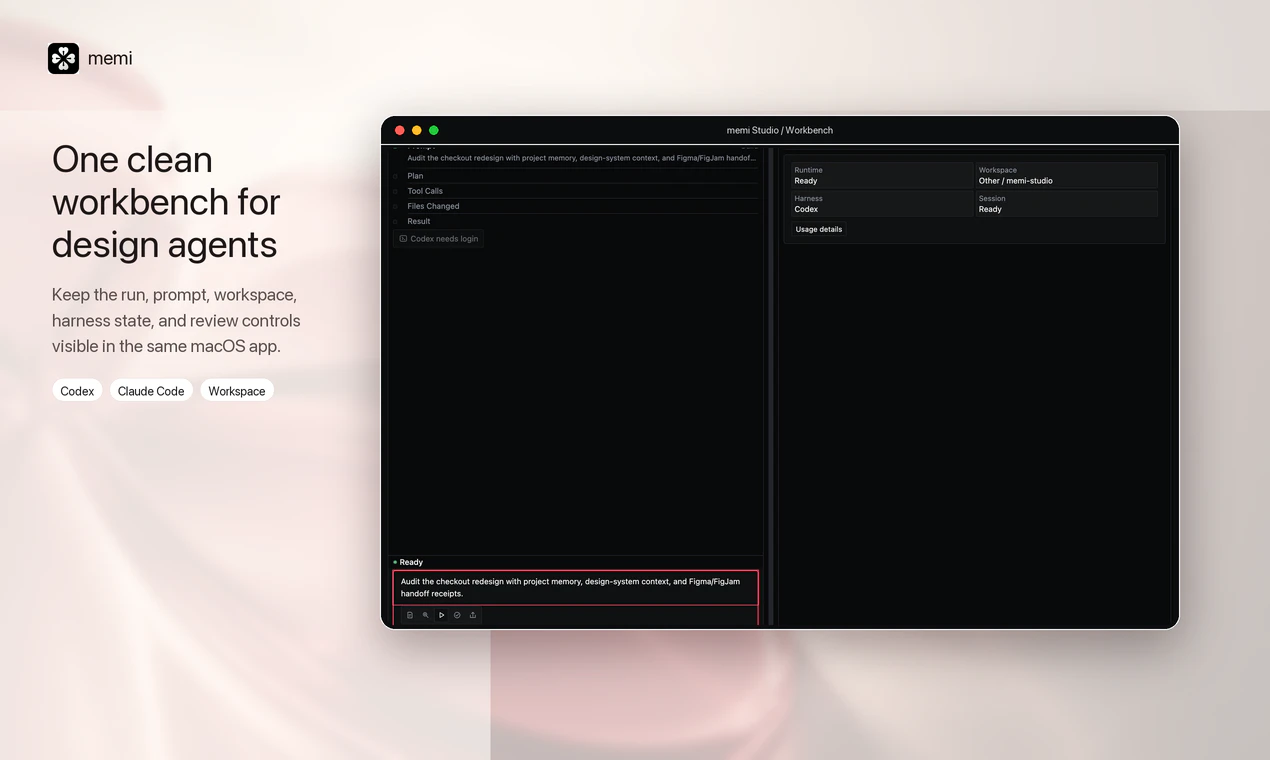
A macOS workbench where Claude, Codex, and Hermes run on your specs, research, and Figma files.
AI Analysis
memi is a macOS workbench acting as an AI agent harness for product design teams. It enables AI models such as Claude, Codex, and Hermes to operate directly on users' product specifications, research documents, and Figma files. Key features include AI-driven analysis, design iteration, and workflow automation within a unified desktop environment. Unique selling points are its specialized focus on design teams, seamless integration with local files and Figma, and multi-model AI support. It addresses pain points like time-consuming manual iterations, inefficient cross-tool research synthesis, and slow design-to-development handoffs. The value proposition is significantly accelerating product design cycles, boosting team productivity and innovation.
The market timing is favorable for 2025-2026. With maturing agentic AI systems (e.g., Claude's capabilities), widespread Figma adoption, and surging demand for AI productivity tools in design, this aligns perfectly with industry trends toward AI-native workflows. Economic pressures for efficiency and tech advancements in multimodal models support adoption. However, API costs and data privacy concerns pose minor risks. Overall: Excellent Timing.
Overall feasibility is Medium. Technical challenges include robust integration of multiple AI APIs with Figma files and local macOS file handling, plus managing context limits and costs. Development and operation costs are moderate to high due to API usage. No significant supply chain issues, but compliance with data privacy (design IP) and AI regulations is essential. Scalability is promising via cloud AI, though desktop app distribution fits smaller teams well. Suitable for experienced AI/desktop dev teams.
Primary users are product design teams, UX/UI designers, and PMs in SaaS/tech companies (ages 25-40). Industries: software development and digital product firms, concentrated in US, Europe, and global tech hubs. Estimated TAM for AI design tools is $1B+, SAM for agent-based design assistants ~$300M, SOM for macOS niche ~$30-50M. Core pain points: fragmented workflows, slow iterations, and research overload. Willingness to pay is high for productivity gains, likely via subscription tiers.
Competition level is Medium. Direct competitors: 1. Galileo AI (galileo.ai), 2. Uizard (uizard.io), 3. v0 by Vercel (v0.dev), 4. Figma AI features, 5. Locofy (locofy.ai). Advantages: Unique 'AI agent harness' approach for running models on personal specs/research/Figma in a dedicated macOS workbench; multi-model flexibility. Disadvantages: macOS-only limits audience, potentially higher ongoing API costs, less mature than established design AI tools, and narrower scope compared to full platforms.
Upgrade Pro to unlock full AI analysis
Similar Products

Auriko
Trading desk for LLM calls
▲ 332 votes
Xirp
The agentic development environment built by Spotify
▲ 224 votes

React UI Kit V7
All the chat components you need. None of the complexity
▲ 115 votes

Replay QA Security Scan
Automated Penetration Testing for AI-Built Apps
▲ 102 votes

CodeBurn
See where your AI coding spend actually goes
▲ 101 votes

Polygram
AI-native design and coding app to build mobile & web apps
▲ 81 votes