
MindReader v1
Read minds (simulated fMRI data, channeled to neuro-metrics)
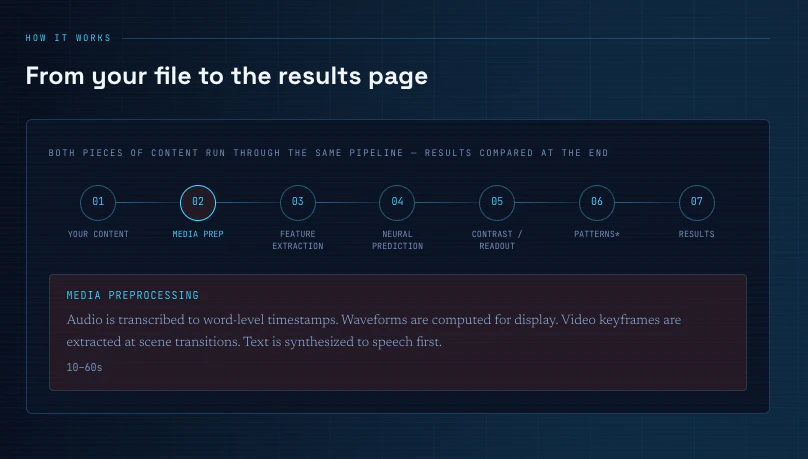
How do you feel? It is the oldest question in art and the newest one we can answer in technology. MindReader takes your content and simulates, region by region, how a brain responds to it. OS. Exploring sales evals, neural evals for datasets and other esoteric product experiments w/ madhat founders. MindReader is built on Meta FAIR's TRIBE v2 + 35yrs of neuro research. Inviting collab from the academics et all.
AI Analysis
MindReader v1 is an open-source AI tool that takes user content and simulates region-by-region brain responses using simulated fMRI data channeled to neuro-metrics. Built on Meta FAIR's TRIBE v2 combined with 35 years of neuro research, it enables neural evaluations for datasets, sales evaluations, UX experiments, and esoteric product tests. It solves the pain point of understanding authentic subconscious human reactions to content without requiring physical brain scans. The unique value proposition lies in bridging advanced neuroscience with accessible AI for academics, researchers, and innovators, while actively inviting collaborations.
The timing is favorable for 2025-2026 as AI integration with cognitive neuroscience accelerates, driven by trends in affective computing, BCI development (e.g. Neuralink progress), and demand for deeper human-AI understanding. Technology maturity of foundation models like TRIBE v2 supports simulation tools, while economic interest in AI innovation remains high despite regulatory scrutiny on neurotech. Excellent Timing.
Technical difficulty is high for accurate brain region simulation, but leveraging established Meta FAIR TRIBE v2 and existing neuro research lowers the barrier. Open-source nature reduces development and operation costs, with strong scalability via cloud APIs. Supply chain risks are minimal (software only), compliance appears low as it uses simulated not real medical data. Team fit seems aligned with 'madhat founders' experimental approach. Overall feasibility is Medium due to validation challenges and need for specialized neuro expertise.
Primary segments: academics, neuroscientists, AI researchers, UX/product teams, and founders experimenting with neural metrics (demographics: tech-savvy professionals 25-45 years old). Industries: higher education, R&D, AI development, digital marketing. Geographic: global, concentrated in US/Europe innovation hubs. Estimated market size: niche neuro-AI evaluation space (TAM for broader affective computing tools large but SAM/SOM limited to experimental users). Core pain points: costly traditional fMRI access and lack of subconscious response metrics. Willingness to pay: moderate for advanced features, supported by open-source entry point.
Low. Direct competitors: 1. Hume.ai (hume.ai) - emotional intelligence AI; 2. Affectiva (affectiva.com) - emotion recognition platform; 3. Emotiv (emotiv.com) - EEG-based brain sensing; 4. Neurable (neurable.com) - passive BCI for experiences. Advantages: unique simulated fMRI region-by-region approach using TRIBE v2, fully open-source, no hardware required, strong academic collaboration focus. Disadvantages: very early v1 stage with limited described features, potentially lower validated accuracy compared to hardware solutions, esoteric positioning may limit broad adoption.
Upgrade Pro to unlock full AI analysis
Similar Products

Auriko
Trading desk for LLM calls
▲ 332 votes

Cohere Parse 5
Turn complex docs, tables & images into AI-ready data
▲ 158 votes

Adapt
The company brain that gets work done
▲ 124 votes

Tapfree for Chrome
Voice dictation that adapts to what’s on your screen
▲ 122 votes

React UI Kit V7
All the chat components you need. None of the complexity
▲ 115 votes

CodeBurn
See where your AI coding spend actually goes
▲ 101 votes