
Minicart
Launch your store. Let AI run the busywork.
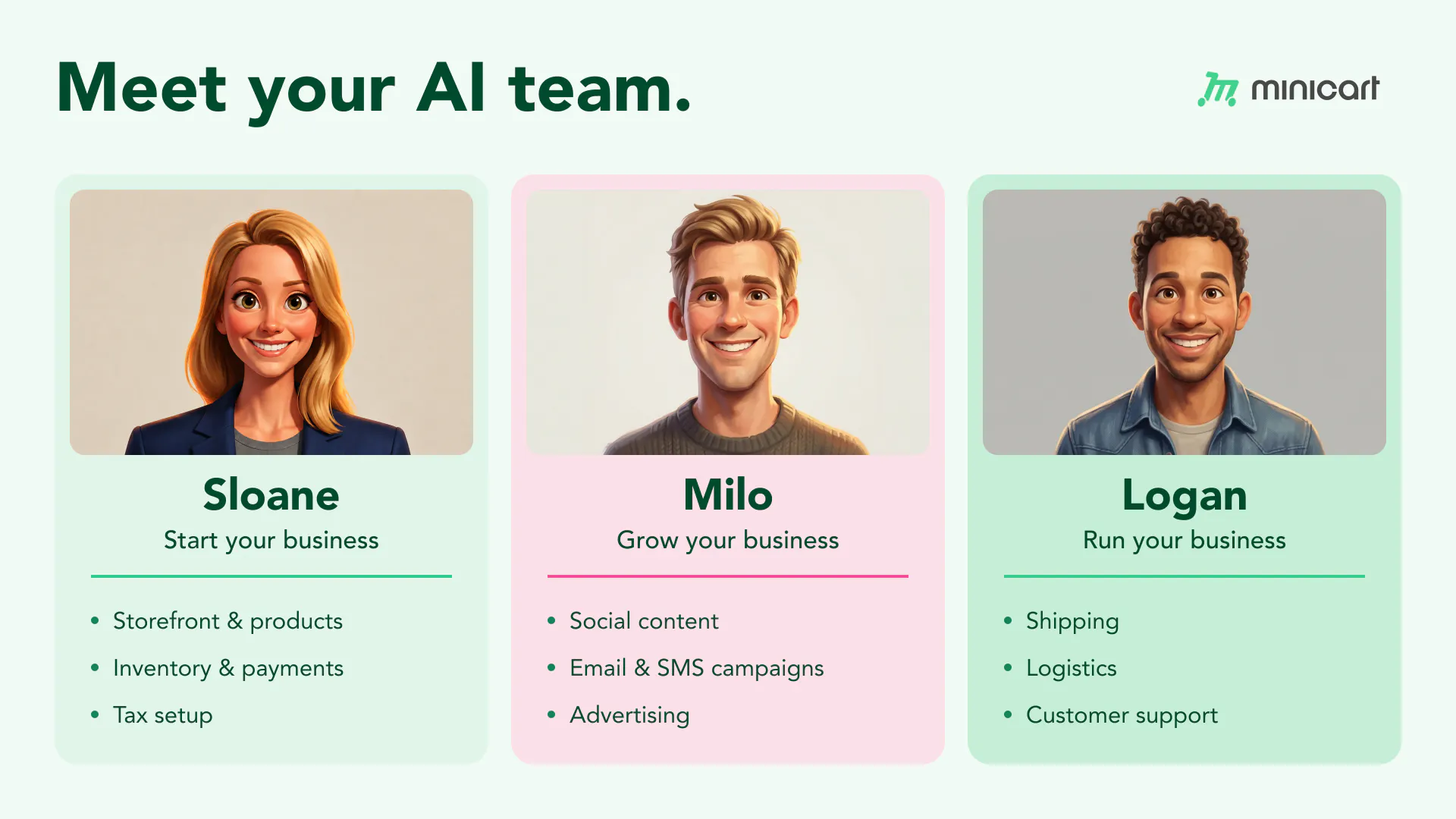
Minicart helps makers, creators, and resellers launch and run an online store without learning ecommerce software. Minicart gives you a store and an AI team to help run it. Sloane manages your storefront, Milo creates marketing, and Logan handles logistics and customer replies. Add products, update inventory, create promotions, ship orders, and more by simply chatting with your team. Just tell your team what you need in plain language, review their work, and keep building your business.
AI Analysis
Minicart enables makers, creators, and resellers to launch and operate an online store without mastering complex ecommerce tools. It provides a ready storefront plus an AI team: Sloane manages the storefront, Milo generates marketing content, and Logan handles logistics, shipping, and customer service. Users simply chat in plain English to add products, update inventory, run promotions, fulfill orders, and respond to inquiries, then review AI outputs. It addresses key pain points like steep learning curves of traditional platforms (e.g. Shopify) and overwhelming operational busywork. The core value proposition is an AI-powered 'team' that automates routine tasks, letting users focus on creative business growth.
In 2025-2026, AI agent technology is reaching practical maturity with improved reliability of LLMs for task automation. The creator economy continues expanding, with rising demand for no-code tools that reduce operational overhead. E-commerce growth remains strong amid digital transformation trends, and economic pressures favor efficient, low-overhead business models. Policy support for small businesses and AI innovation further aids adoption. This aligns perfectly with surging interest in AI-powered business assistants. Excellent Timing.
Technical difficulty is moderate-high: building reliable multi-agent AI systems integrated with payments, shipping carriers, and inventory systems carries risks of AI errors and hallucinations. Development and AI inference costs could be substantial at scale. Compliance risks include data privacy (GDPR/CCPA) and e-commerce regulations. Scalability is promising once core integrations are stable, assuming a skilled AI engineering team. Overall rating: Medium, due to integration complexities and operational AI costs balanced by accessible current LLM APIs.
Primary segments: independent makers, content creators, small-scale resellers, and indie entrepreneurs in the creator economy (ages 25-45, tech-savvy but non-technical). Focus on those selling physical goods, prints, or digital products; mainly English-speaking users in US, Europe, and Australia. The broader e-commerce tools market has strong demand. Core pain points include time lost on admin tasks and complexity of traditional dashboards. Potential willingness to pay is high for subscription models that demonstrably save time and enable business scaling.
Medium. Direct competitors: 1. Shopify (shopify.com) with its AI assistant Sidekick, 2. Wix eCommerce (wix.com) with AI features, 3. BigCommerce (bigcommerce.com), 4. WooCommerce (woocommerce.com), 5. Gumroad (gumroad.com) for creators. Advantages: unique role-based AI team for conversational management reduces learning curve significantly compared to dashboard-heavy platforms; focuses on 'set and forget' automation. Disadvantages: likely fewer mature integrations, potential trust issues with full AI autonomy versus established platforms' reliability and ecosystem.
Upgrade Pro to unlock full AI analysis
Similar Products

Lev8
Find, research, and reach the right people
▲ 451 votes

Auriko
Trading desk for LLM calls
▲ 332 votes

Cohere Parse 5
Turn complex docs, tables & images into AI-ready data
▲ 158 votes

Adapt
The company brain that gets work done
▲ 124 votes

Tapfree for Chrome
Voice dictation that adapts to what’s on your screen
▲ 122 votes

CodeBurn
See where your AI coding spend actually goes
▲ 101 votes