
MiniCPM5-1B
A new SOTA for compact open models on the edge
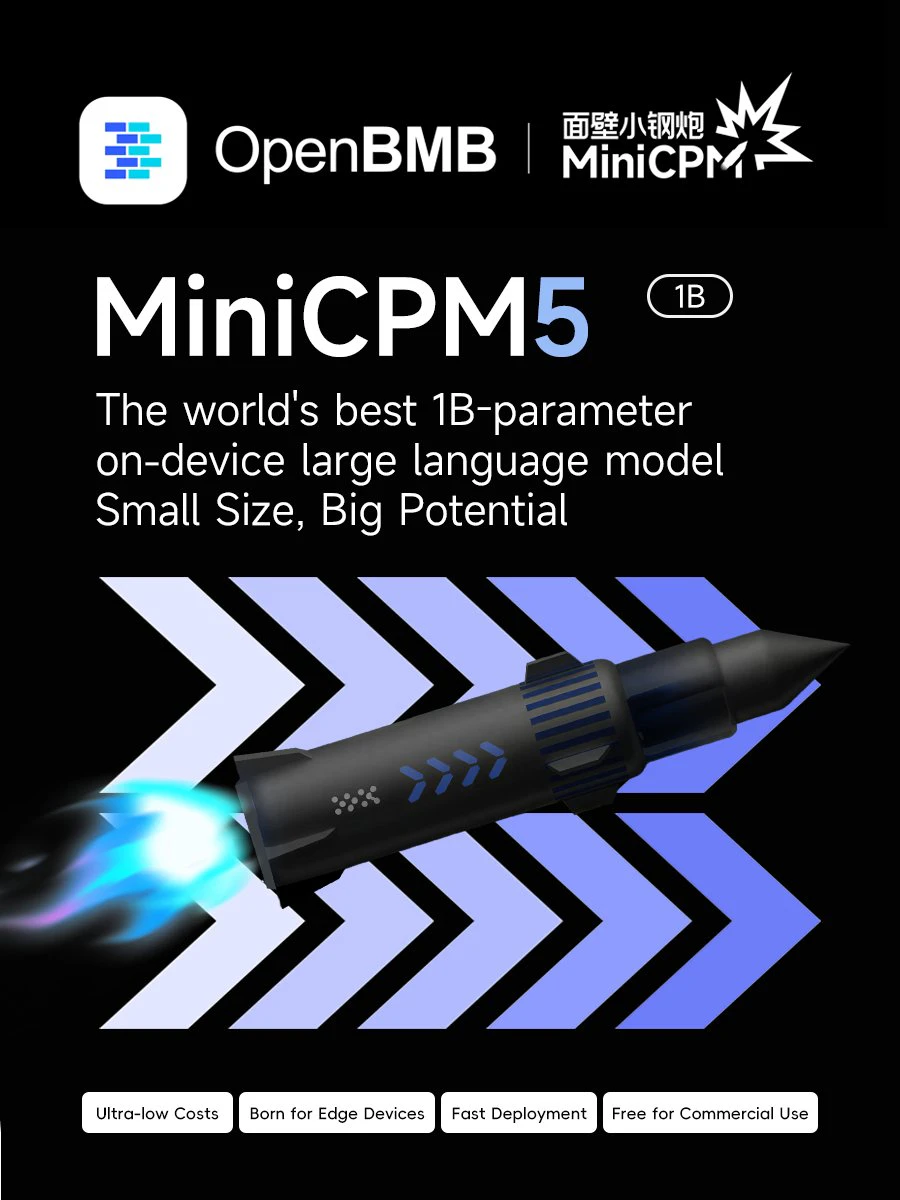
MiniCPM5-1B is a dense 1B open model built for on-device and local deployment. It supports 131K context, Think / No Think modes, tool calling, GGUF and MLX formats, major inference backends, and even powers an offline desktop pet.
AI Analysis
MiniCPM5-1B is a dense 1B parameter open-source model optimized for on-device and local deployment. Core features include 131K context length, Think/No Think modes, tool calling, GGUF/MLX format support, compatibility with major inference backends, and powering an offline desktop pet. It solves critical pain points of cloud dependency, privacy risks, high latency, and costs for edge AI users. Its value proposition is delivering new SOTA performance in a compact, efficient form factor, enabling accessible, private, and fully offline AI capabilities.
Current market timing is favorable for 2025-2026. Industry trends favor edge computing, on-device AI, and privacy-focused solutions amid maturing local inference tech (e.g. MLX, GGUF ecosystems), rising data protection regulations, and user demand for offline/low-cost AI to avoid cloud APIs. Hardware advancements in consumer devices further support compact models. Excellent Timing.
Overall feasibility is High. Technical difficulty is mitigated by using established formats and backends; the model is already developed and open-sourced. Low ongoing operation costs for local deployment, minimal supply chain risks, strong scalability on edge devices, though maintaining SOTA requires continuous R&D. Good team fit for AI/open-source developers.
Primary segments: AI developers, open-source enthusiasts, edge/IoT engineers, and consumers using offline apps (ages 20-40, tech professionals). Industries: AI development, consumer hardware, IoT. Global distribution with focus on US, China, Europe. On-device AI market shows strong demand; core pain points are cloud reliance and insufficient compact model performance. High willingness to adopt free OSS with potential paid support.
Competition level: High. Direct competitors: 1. Microsoft Phi-3-mini (microsoft.com), 2. Google Gemma-2B (ai.google.dev/gemma), 3. Meta Llama-3.2-1B (llama.meta.com), 4. Alibaba Qwen2.5-1.5B (qwenlm.github.io). Advantages: claimed new SOTA for 1B edge models, unique Think/No Think modes, desktop pet integration, broad backend support. Disadvantages: lower brand recognition vs tech giants, smaller ecosystem than larger competitors.
Upgrade Pro to unlock full AI analysis
Similar Products

Cohere Parse 5
Turn complex docs, tables & images into AI-ready data
▲ 158 votes

Opaline
PostHog for team Claude Code and Codex sessions.
▲ 141 votes

Adapt
The company brain that gets work done
▲ 124 votes

Tapfree for Chrome
Voice dictation that adapts to what’s on your screen
▲ 122 votes

CodeBurn
See where your AI coding spend actually goes
▲ 101 votes

WikiFix for Confluence
Find and fix issues in your knowledge base
▲ 86 votes