
MiniCPM5-2B
Small enough for the device, built to act
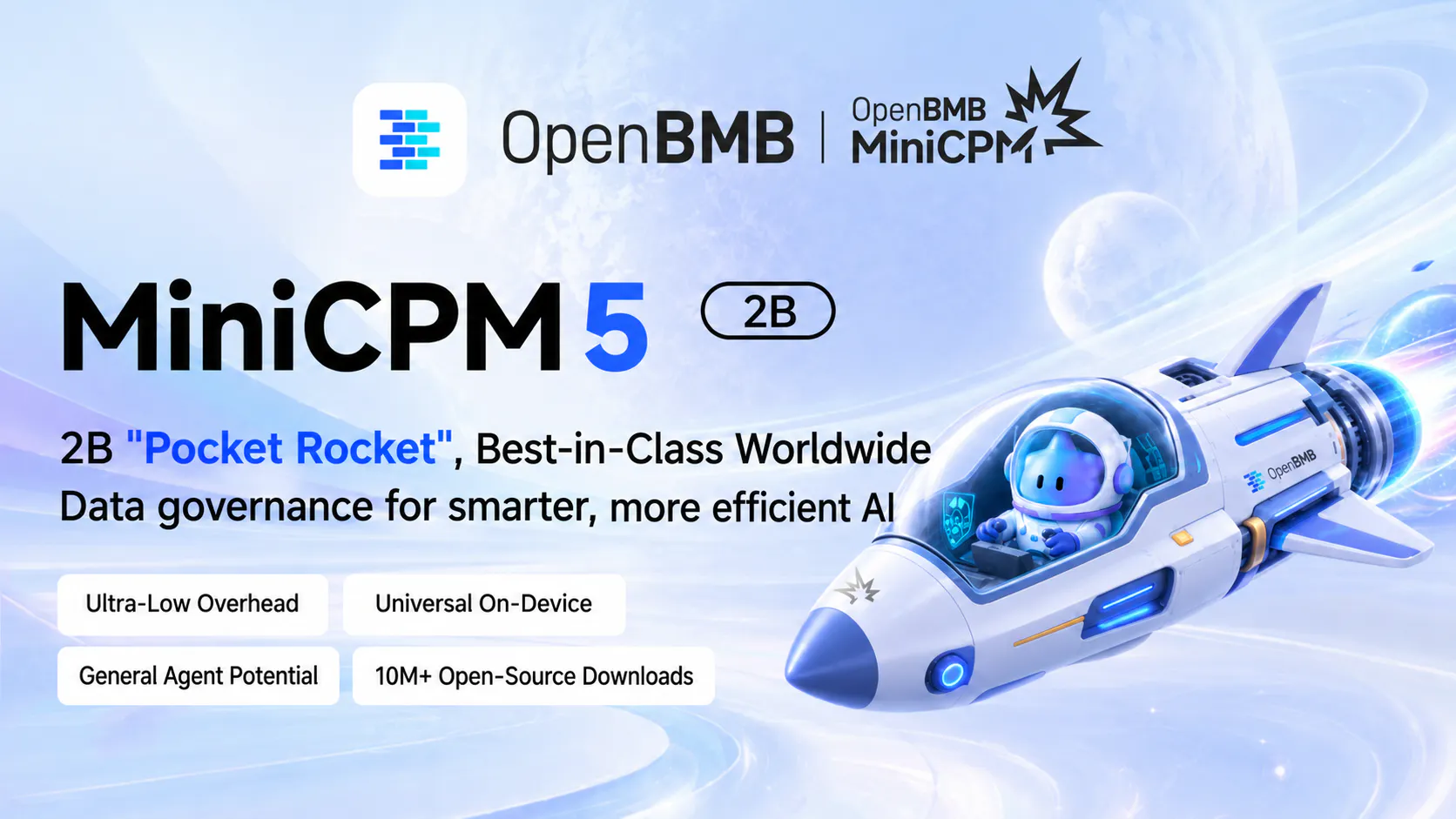
MiniCPM5-2B is OpenBMB's dense 2B follow-up to MiniCPM5-1B. It is built for on-device and local use, leads the 2B open-source class, and stays competitive with larger 4B models on coding, math, long context, and agent tasks. Apache 2.0 weights, GGUF, and MLX are up.
AI Analysis
MiniCPM5-2B is OpenBMB's 2B parameter dense LLM, optimized for on-device and local use. It leads open-source 2B models and rivals larger 4B models in coding, math, long context, and agent tasks. Available under Apache 2.0 with GGUF and MLX formats for easy deployment across platforms. It solves key pain points including cloud dependency, latency, privacy risks, and high inference costs by enabling efficient local AI on consumer devices. Value proposition: delivers high-performance AI in a compact, accessible package for privacy-focused and offline scenarios.
The current market timing is favorable. In 2025-2026, industry trends favor on-device AI driven by advanced mobile NPUs, rising privacy regulations (e.g. GDPR expansions), demand for low-latency offline AI agents, and cost pressures on cloud inference. Technology maturity for small efficient models has improved significantly. Excellent Timing.
High. The model is already developed and released by OpenBMB with open weights, resulting in low deployment costs and technical barriers for users. Multiple optimized formats (GGUF, MLX) ensure broad hardware compatibility with minimal operation overhead. Low compliance risks under Apache 2.0; strong scalability across devices. Main challenge of balancing size and performance has been addressed. Rating: High.
Main target segments: AI/ML developers, edge computing engineers, mobile/IoT app creators, open-source enthusiasts, and privacy-conscious enterprises. Demographics: tech professionals aged 22-45. Industries: software development, AI research, consumer electronics. Geographic: global with strong adoption in China, US, Europe. Estimated TAM for on-device AI ~$20B+ by 2026; SAM for small open LLMs ~$2B; SOM for leading 2B models ~$150M. Core pain points: cloud costs, data privacy, offline capability. Willingness to pay: moderate for support/tools, high for enterprise integrations (base model is free).
Medium. Direct competitors: 1. Microsoft Phi-3 Mini (https://huggingface.co/microsoft/Phi-3-mini), 2. Google Gemma-2B (https://ai.google.dev/gemma), 3. Meta Llama 3.2 1B (https://llama.meta.com), 4. Alibaba Qwen2.5-1.5B (https://qwenlm.github.io/blog/qwen2.5/). Advantages: leads 2B benchmarks, strong on agent/long-context tasks, multiple easy formats (GGUF/MLX), fully open Apache 2.0. Disadvantages: smaller brand recognition and ecosystem compared to Meta/Google/Microsoft models; limited marketing reach.
Upgrade Pro to unlock full AI analysis
Similar Products

Cohere Parse 5
Turn complex docs, tables & images into AI-ready data
▲ 158 votes

Opaline
PostHog for team Claude Code and Codex sessions.
▲ 141 votes

Adapt
The company brain that gets work done
▲ 124 votes

Tapfree for Chrome
Voice dictation that adapts to what’s on your screen
▲ 122 votes

CodeBurn
See where your AI coding spend actually goes
▲ 101 votes

WikiFix for Confluence
Find and fix issues in your knowledge base
▲ 86 votes