
MiniMax Hub
Desktop AI workstation with agent-driven visual canvas
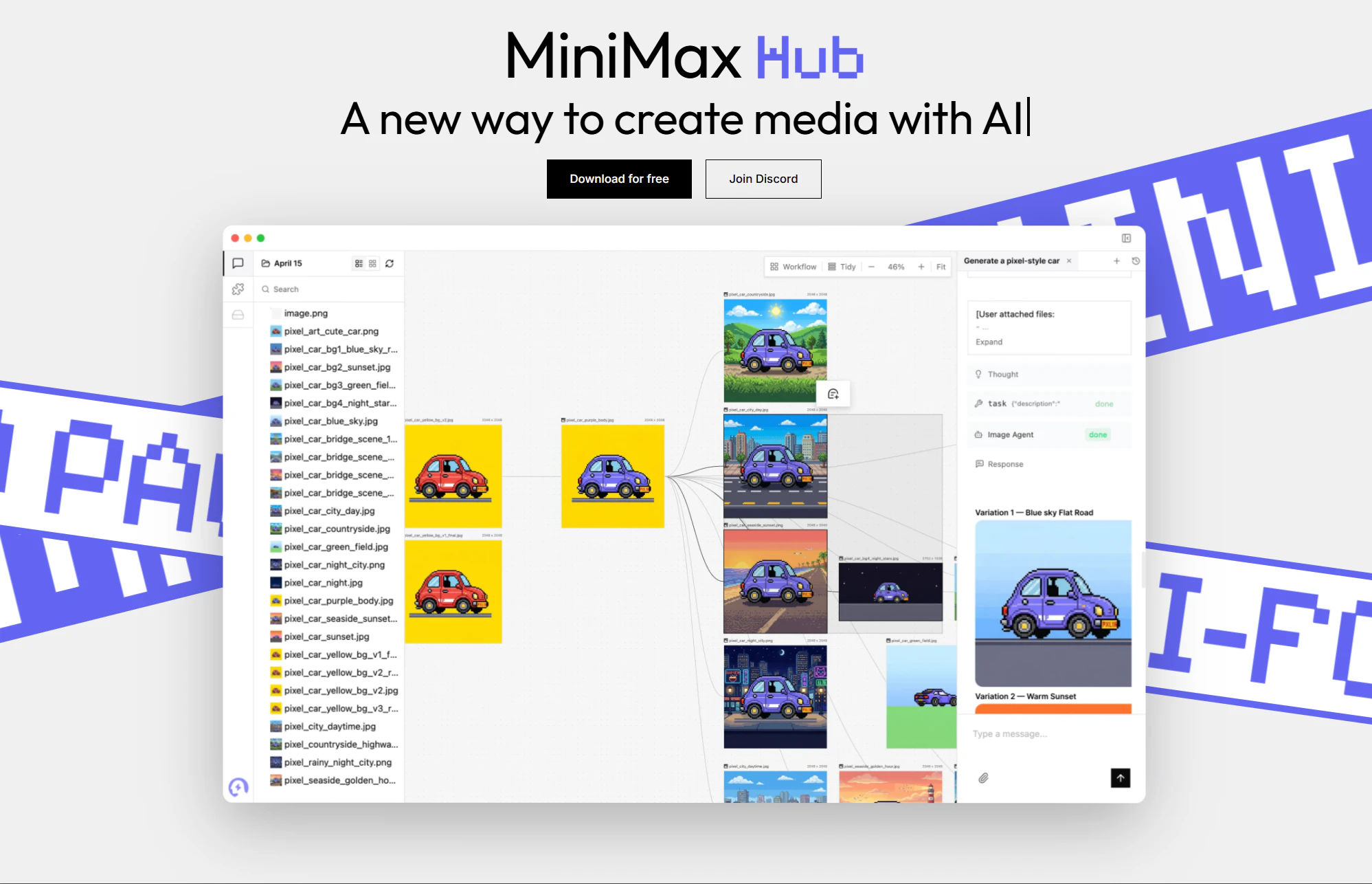
MiniMax Hub is a desktop AI creative workstation that combines an AI agent, multimodal generation, visual canvas, workflow view, and reusable Skills. It can create and edit images, videos, audio, and text, work with local files, and automate creative workflows from natural language.
AI Analysis
MiniMax Hub is a desktop AI creative workstation integrating an AI agent, multimodal generation for images, videos, audio, and text, visual canvas, workflow view, and reusable Skills. It works with local files and automates complex creative workflows from natural language prompts. USPs include its agent-driven intuitive interface and modular reusable components for efficiency. It solves key pain points like fragmented tools across media types, time-consuming manual edits, and lack of automation in creative processes. The value proposition is a unified, powerful desktop environment that boosts productivity and creativity for content production.
The current market timing for 2025-2026 is favorable. Multimodal AI and agent technologies are maturing rapidly, aligning with rising user demand for integrated creative automation amid exploding digital content needs. Economic focus on AI productivity tools and supportive innovation policies create ideal conditions. Excellent Timing.
Technical difficulty is medium as it builds on advancing AI models but requires complex desktop integration of agents, canvas, and multimodal systems. Development/operation costs are significant for AI compute but manageable for a SaaS-hardware hybrid. Low supply chain risks; data privacy compliance is key. Strong scalability potential via skills ecosystem. Overall rating: High, supported by current tech maturity and clear product-market fit.
Main target segments: Professional content creators, graphic designers, video editors, digital artists, and marketing teams (ages 25-45, tech-savvy). Industries: Design, media/entertainment, advertising. Geographic: Global with focus on North America, Europe, East Asia. Estimated market size: TAM for AI creative tools ~$10B+ by 2026, SAM for integrated desktop AI ~$2B, SOM ~$300M. Core pain points: Tool fragmentation and lack of intelligent workflow automation. Potential willingness to pay: High for time-saving pro features (likely subscription $20-100/mo).
Competition level: Medium. Direct competitors: 1. Runway (runwayml.com), 2. ComfyUI (comfyui.org), 3. Adobe Firefly (firefly.adobe.com), 4. Kling AI (kling.ai), 5. Luma Dream Machine (lumalabs.ai/dream-machine). Advantages: Unique agent-driven natural language automation, integrated visual canvas with reusable Skills, strong local file/desktop focus. Disadvantages: Newer player with less brand ecosystem than Adobe; may require more local compute than cloud-only rivals; video quality still catching up to specialized competitors.
Upgrade Pro to unlock full AI analysis
Similar Products

Auriko
Trading desk for LLM calls
▲ 332 votes

Cohere Parse 5
Turn complex docs, tables & images into AI-ready data
▲ 158 votes

Opaline
PostHog for team Claude Code and Codex sessions.
▲ 141 votes

Adapt
The company brain that gets work done
▲ 124 votes

Tapfree for Chrome
Voice dictation that adapts to what’s on your screen
▲ 122 votes

CodeBurn
See where your AI coding spend actually goes
▲ 101 votes