
MockPilot
Turn live websites into editable mockups
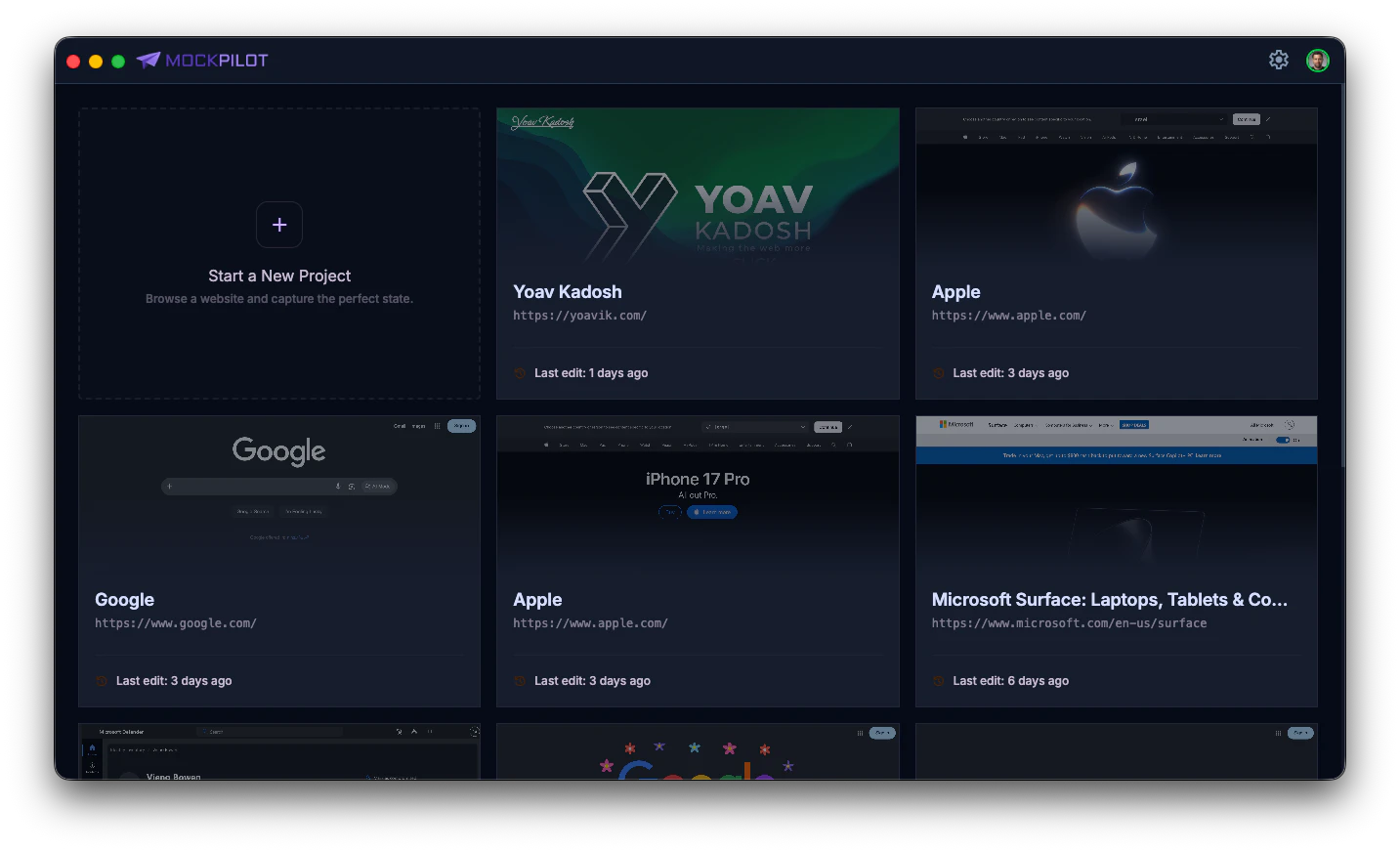
MockPilot turns any live webpage into an editable mockup on your desktop. Use natural language - no design or coding skills needed. 📸 Capture full pages or single components from any URL 🎨 Auto-extracts typography, colors, components & icons into a reusable asset library 💬 Edit in plain English — just tell the AI what to change, and it uses your assets to keep everything on-brand 📦 Export as clean, standalone HTML Free & open source. macOS + Windows.
AI Analysis
MockPilot is a desktop app that transforms any live webpage into an editable mockup using AI and natural language. Core features: capture full pages or components from URLs, auto-extract typography/colors/components/icons into a reusable asset library, edit via plain English prompts (AI maintains brand consistency using your assets), and export clean standalone HTML. No design or coding skills required. It solves key pain points of time-consuming manual recreation of web UIs, skill barriers for non-designers, and maintaining visual consistency. USP is its seamless AI-driven workflow from live sites to branded editable mockups. Value proposition: democratizes fast web prototyping and iteration for developers, designers, PMs and non-technical users. Free and open-source on macOS + Windows.
In 2025-2026, market timing is highly favorable. AI technologies for UI understanding and generation have reached strong maturity with advanced multimodal LLMs. Industry trends heavily favor no-code, AI-assisted design and productivity tools, with rising demand from users seeking intuitive interfaces without specialized skills. Economic environment supports AI innovation in SaaS and dev tools. This product aligns perfectly with the shift toward natural language interfaces in creative software. Rating: Excellent Timing.
Overall feasibility is high. Technical difficulty is moderate as it combines established web parsing, computer vision, and LLM APIs (feasible with current tech). Development/operation costs are low-moderate, especially as free/open-source with potential community support. Minimal supply chain or compliance risks for desktop software. Strong scalability via cloud AI backends. Best fit for teams experienced in AI/desktop dev. Main risk is AI accuracy/consistency in complex edits. Rating: High.
Main target segments: Web developers, UI/UX designers, product managers (ages 25-45) in tech startups, SaaS companies, and digital agencies; also indie hackers and non-technical entrepreneurs. Geographic focus: Global with heavy adoption in North America and Europe. Estimated market size: TAM for AI design/prototyping tools exceeds $10B, SAM for web mockup/conversion tools ~$800M, SOM ~$80M. Core pain points: slow manual mocking of live sites and brand inconsistency. High willingness to pay for productivity gains, though currently positioned as free/open-source to drive adoption.
Competition level: Medium. Direct competitors: 1. Uizard (uizard.io), 2. v0 by Vercel (v0.dev), 3. Galileo AI (usegalileo.ai), 4. Visily (visily.ai), 5. Locofy.ai. Advantages vs competitors: handles live URLs directly (not just screenshots), automatic on-brand asset library extraction, pure natural language desktop editing, completely free/open-source. Disadvantages: desktop-only (vs web-based collaboration in Figma/Uizard), potential inconsistencies in AI outputs, less brand recognition and ecosystem than established players like Vercel or Figma. Good differentiation in seamless live-site to editable mockup workflow.
Upgrade Pro to unlock full AI analysis
Similar Products
Cohere Parse 5
Turn complex docs, tables & images into AI-ready data
▲ 158 votes

Adapt
The company brain that gets work done
▲ 124 votes

Tapfree for Chrome
Voice dictation that adapts to what’s on your screen
▲ 122 votes

Replay QA Security Scan
Automated Penetration Testing for AI-Built Apps
▲ 102 votes

Kosshi
Simple, fast outliner for Mac and iPhone.
▲ 90 votes

Thoughts for Mac
Capture notes from your menubar using text, images or voice
▲ 90 votes