monolog
Chat to yourself and find anything by what you remember
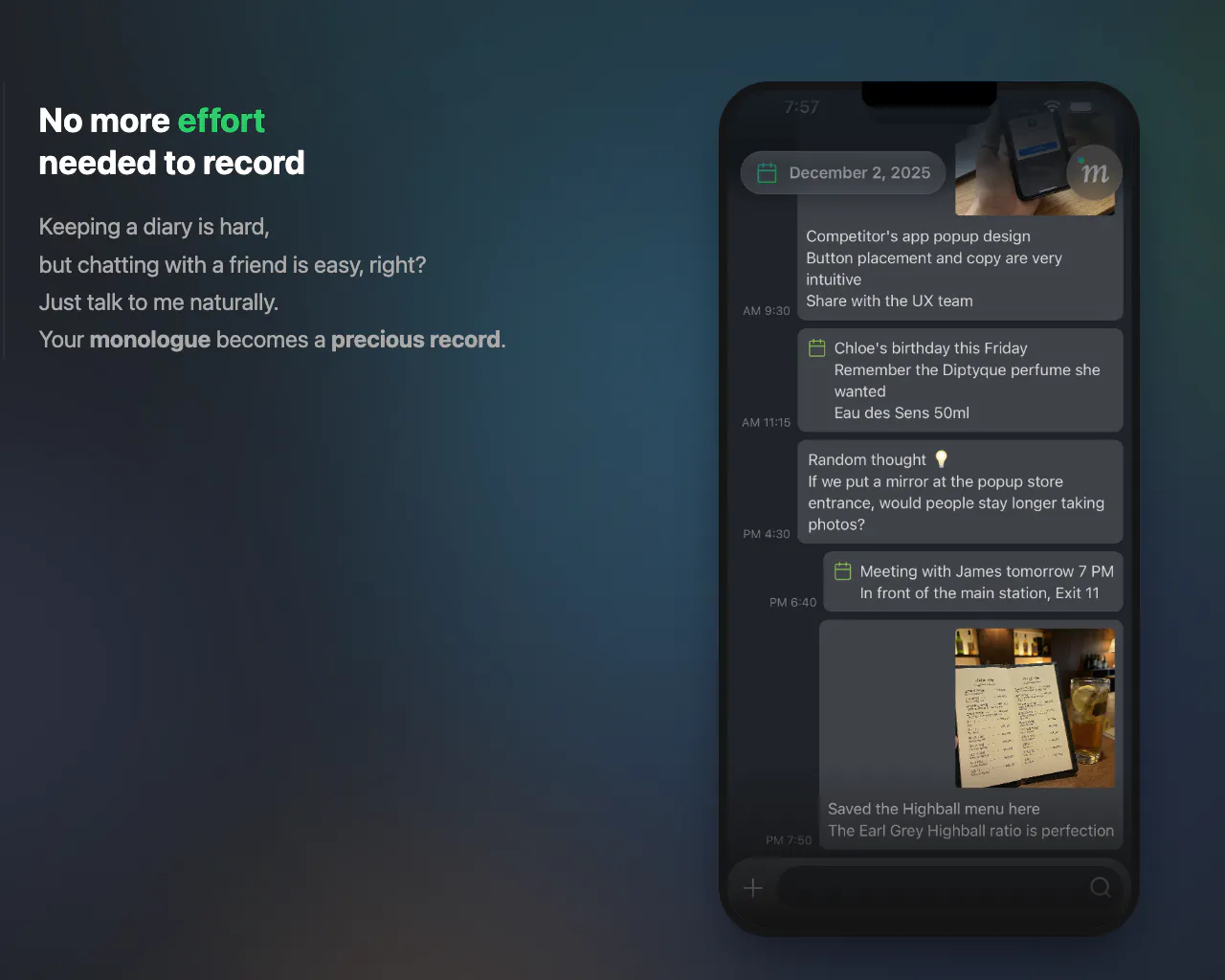
Chat to yourself. monolog takes care of the rest. No titles, folders, or tags to manage. AI quietly understands what you write, recognizes schedules and tasks, and reminds you when it matters. Semantic search finds records by what they were about—even if you forgot the exact words you used. Everything stays synced across iOS, Android, Web, Desktop, and Chrome. Just write naturally. monolog handles the organizing, remembering, and finding later.
AI Analysis
Monolog is a cross-platform AI-powered journaling app that lets users chat or write naturally without managing titles, folders, or tags. AI automatically understands entries, identifies tasks and schedules, sets intelligent reminders, and powers semantic search to retrieve information based on context and meaning—even from vague memories. Synced across iOS, Android, Web, Desktop, and Chrome. It solves key pain points like note disorganization, difficulty recalling or finding old entries, and manual structuring overhead. The value proposition is effortless, intelligent personal knowledge capture and retrieval for seamless daily productivity and memory augmentation.
In 2025-2026, timing is favorable due to maturing LLMs enabling advanced semantic understanding and reminders, rising demand for intuitive AI productivity tools amid information overload, and user shift toward natural interfaces over rigid structures. Economic emphasis on efficiency and AI adoption supports growth, though note-taking market saturation poses challenges. Overall: Excellent Timing.
Technically feasible leveraging existing LLM APIs for understanding, task extraction, and semantic search. Multi-platform sync (iOS/Android/Web/Desktop/Chrome) raises development and maintenance costs. AI inference operational costs and data privacy compliance (personal notes) are notable risks. Good scalability potential via cloud. Overall rating: Medium, supported by API maturity but challenged by cross-platform complexity and ongoing AI expenses.
Primary users: tech-savvy knowledge workers, professionals, students, and journalers aged 25-45 seeking better memory and organization. Industries: technology, creative fields, management. Geographic: global with strong adoption in US/Europe. Core pain points: disorganized notes, forgetting tasks/reminders, ineffective search. TAM for AI productivity tools is multi-billion; specific AI note-taking segment shows strong demand. High willingness to pay for seamless AI features via likely subscription.
Medium. Direct competitors: 1. Mem (mem.ai), 2. Reflect (reflect.app), 3. Notion AI (notion.so), 4. Rewind (rewind.ai), 5. Day One (dayoneapp.com). Advantages: unique 'chat to yourself' natural interface, strong focus on semantic memory-based search without any manual organization, broad platform sync. Disadvantages: potentially higher AI usage costs, less established ecosystem or collaboration features compared to Notion, newer player with smaller user base.
Upgrade Pro to unlock full AI analysis
Similar Products

Cohere Parse 5
Turn complex docs, tables & images into AI-ready data
▲ 158 votes

Opaline
PostHog for team Claude Code and Codex sessions.
▲ 141 votes

Adapt
The company brain that gets work done
▲ 124 votes

Kosshi
Simple, fast outliner for Mac and iPhone.
▲ 90 votes

Thoughts for Mac
Capture notes from your menubar using text, images or voice
▲ 90 votes
Refoid
Automate App Store refund responses and track every outcome
▲ 68 votes