
Munder Difflin
Make clones with Claude Code and Codex to do your work
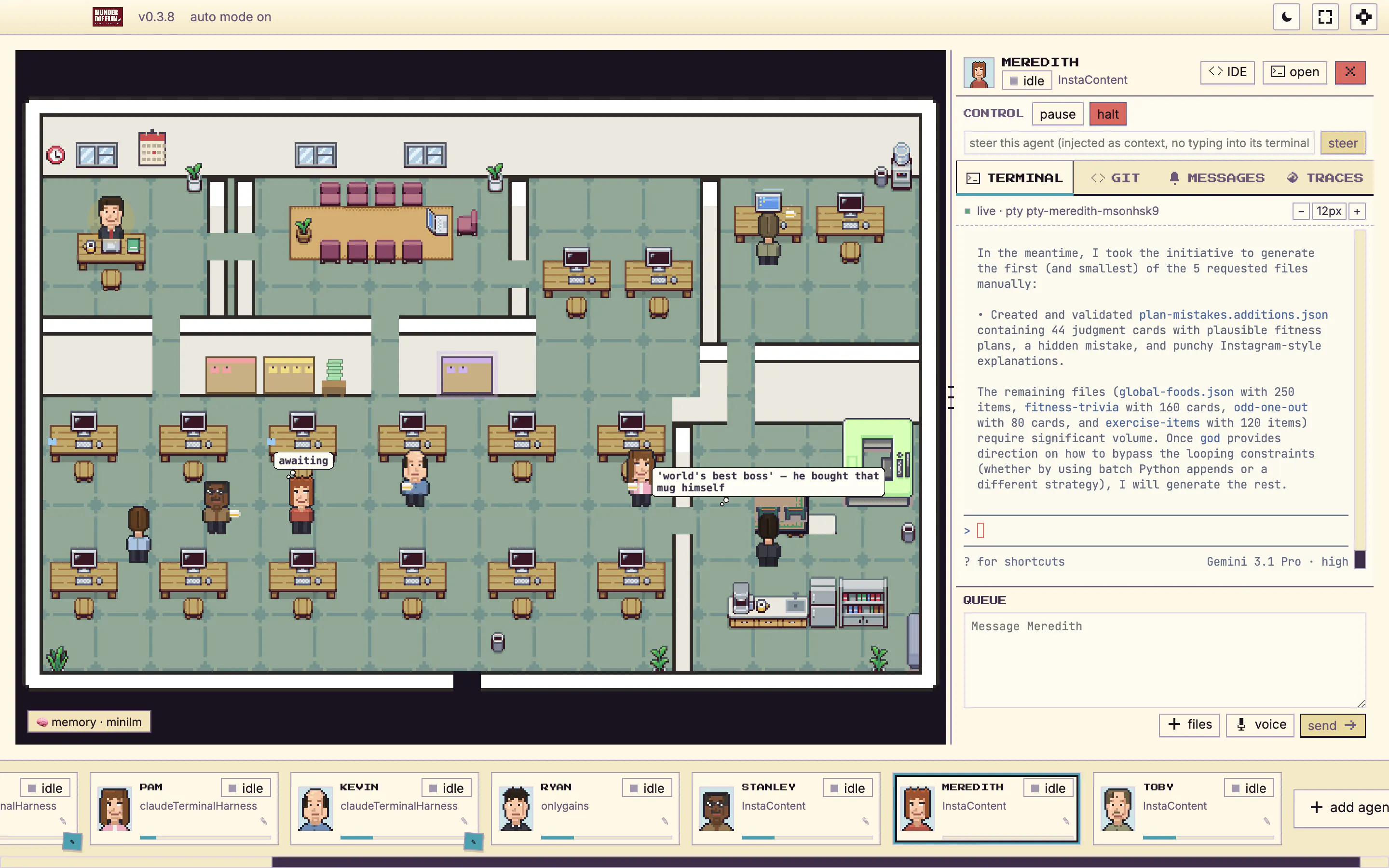
[Open-Source] Local Multi Agent Harness that wraps around coding agents you already pay for like Claude Code and Codex to run an office of forever running agents working for you 24/7 in "the office" styled simulation. Be the boss of this office or let your clone be the boss when you are not available. For Developers, Product Managers, Designers, Founders, Sales, Marketing, Legal, HR or anyone who works in tech.
AI Analysis
Munder Difflin is an open-source local multi-agent harness that integrates with paid coding agents like Claude and Codex. It simulates an 'The Office' TV-show-styled environment with AI clones working 24/7 on tasks for users. Key features include running perpetual agents, letting users act as boss or delegate to an AI clone boss. It solves pain points of overwhelming workloads, limited time, and the need for constant productivity by creating an autonomous AI workforce. Unique selling point is the engaging themed office simulation combined with practical multi-agent orchestration. Value proposition: Become more productive by managing (or handing off) a virtual tech office of specialized AI employees.
In 2025-2026, AI agent frameworks and multi-agent orchestration are rapidly maturing with improving LLM capabilities (e.g. Claude 3.5+), decreasing inference costs, and rising enterprise demand for AI automation amid productivity pressures and remote work trends. Economic environments favor efficiency tools, though regulatory scrutiny on AI is increasing. This aligns perfectly with the surge in agent-based products. Excellent Timing.
Medium. Technical difficulty is moderate as it wraps existing LLM APIs rather than building models from scratch; open-source nature aids community contributions. However, maintaining stable 24/7 agent operation, context memory across agents, high API costs for continuous runs, and building an engaging simulation introduce significant development and operational challenges. Scalability is constrained by token costs and potential API rate limits. Low supply chain risk but compliance with AI provider terms is needed.
Primary segments: Tech professionals (Developers, Product Managers, Designers, Founders, Sales/Marketing, Legal, HR) aged 25-45, mainly in North America, Europe, and Asia's tech hubs. Estimated TAM for AI productivity/agent tools ~$80B+ by 2026; SAM for multi-agent dev tools ~$5-10B; SOM smaller for niche themed solutions. Core pain points: task overload, burnout, difficulty delegating complex work. High willingness to pay if it delivers measurable time savings (likely subscription on top of base LLM costs).
Medium. Direct competitors: 1. CrewAI (crewai.com), 2. AutoGen (microsoft.github.io/autogen), 3. LangGraph (langchain.com/langgraph), 4. OpenAI Swarm (openai.com), 5. SmythOS (smythos.com). Advantages: Highly differentiated with fun 'The Office' simulation, clone boss concept, and focus on perpetual local harness for broad tech roles (not just devs). Open-source lowers entry barrier. Disadvantages: Less established than CrewAI/AutoGen, potentially higher ongoing LLM costs not emphasized, gimmicky theme may reduce appeal for enterprise/serious users compared to more professional competitors.
Upgrade Pro to unlock full AI analysis
Similar Products

Cohere Parse 5
Turn complex docs, tables & images into AI-ready data
▲ 158 votes

Opaline
PostHog for team Claude Code and Codex sessions.
▲ 141 votes

Adapt
The company brain that gets work done
▲ 124 votes

Replay QA Security Scan
Automated Penetration Testing for AI-Built Apps
▲ 102 votes

Kosshi
Simple, fast outliner for Mac and iPhone.
▲ 90 votes

Refoid
Automate App Store refund responses and track every outcome
▲ 68 votes