
Muse Code
Meta’s terminal agent for long-horizon coding
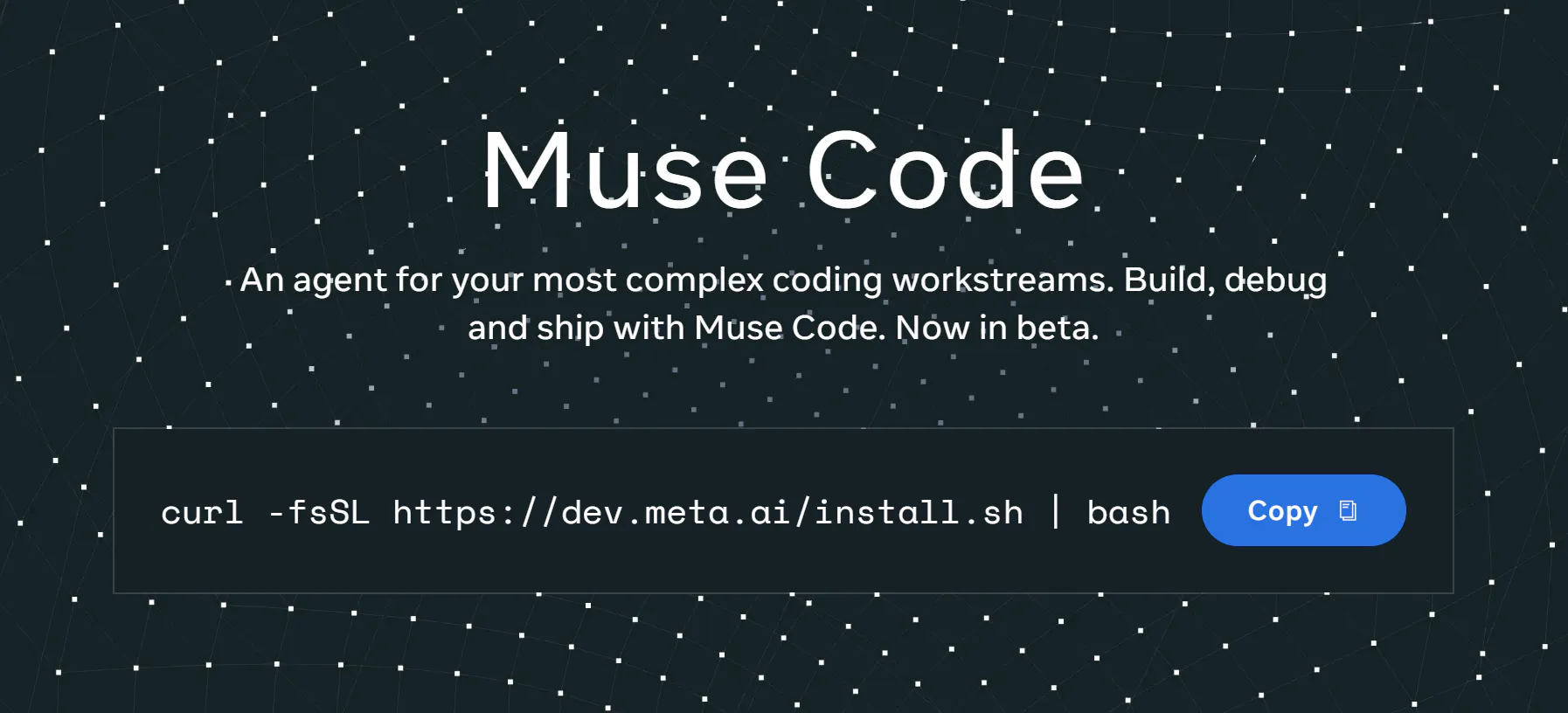
Introducing Muse Code, a terminal coding agent powered by Muse Spark 1.2, with persistent background agents, repository-scale execution, and built-in verification.
AI Analysis
Muse Code is Meta’s terminal coding agent powered by Muse Spark 1.2. Core features include persistent background agents for long-horizon tasks, repository-scale code execution, and built-in verification for accuracy. It solves developer pain points like context loss during extended coding sessions, inefficiency with large codebases, and manual error checking. The USP is deep terminal integration enabling autonomous, persistent AI assistance at scale. Overall value proposition: dramatically improved productivity for complex software engineering workflows by combining AI reasoning with native developer environments.
Current timing is favorable for 2025-2026. AI agent technology has matured with advanced LLMs capable of multi-step reasoning; industry trends show explosive growth in autonomous coding tools as developers demand higher productivity amid talent shortages. User needs are shifting toward persistent, workflow-native agents rather than simple autocomplete. Economic environment supports AI investment. Excellent Timing.
Technical difficulty is high due to requirements for persistent stateful agents, reliable repository-scale execution, and robust verification loops, but Meta’s existing AI infrastructure and models lower the barrier. Development and operation costs are significant (compute, training), yet scalability potential is strong via cloud. Minimal supply chain risk; compliance mainly around data privacy. Overall rating: High, thanks to Meta’s resources and AI expertise.
Primary users: professional software developers, engineering teams at tech companies and startups; demographics 25-45 years old, strong presence in North America, Europe, and East Asia. Industries: software development, IT services. TAM for AI developer tools exceeds $15B, SAM for coding agents ~$3B, SOM for terminal-focused agents ~$500M. Core pain points are prolonged task management and verification overhead. High willingness to pay via subscriptions or enterprise licenses for proven productivity gains.
Competition level: High. Direct competitors: 1. Cursor (cursor.com), 2. Aider (aider.chat), 3. Devin (cognition-labs.com), 4. GitHub Copilot (github.com/features/copilot), 5. Continue.dev (continue.dev). Advantages: Meta backing, native terminal persistence, repository-scale focus and built-in verification provide strong differentiation for long-horizon tasks. Disadvantages: less mature ecosystem than Copilot, potentially higher learning curve than IDE-centric tools like Cursor; pricing unknown but must compete with established freemium models.
Upgrade Pro to unlock full AI analysis
Similar Products

Cohere Parse 5
Turn complex docs, tables & images into AI-ready data
▲ 158 votes

Adapt
The company brain that gets work done
▲ 124 votes

Tapfree for Chrome
Voice dictation that adapts to what’s on your screen
▲ 122 votes

Replay QA Security Scan
Automated Penetration Testing for AI-Built Apps
▲ 102 votes

Kosshi
Simple, fast outliner for Mac and iPhone.
▲ 90 votes

Thoughts for Mac
Capture notes from your menubar using text, images or voice
▲ 90 votes