
Muse Code by Meta
Meta's autonomous coding agent for developers
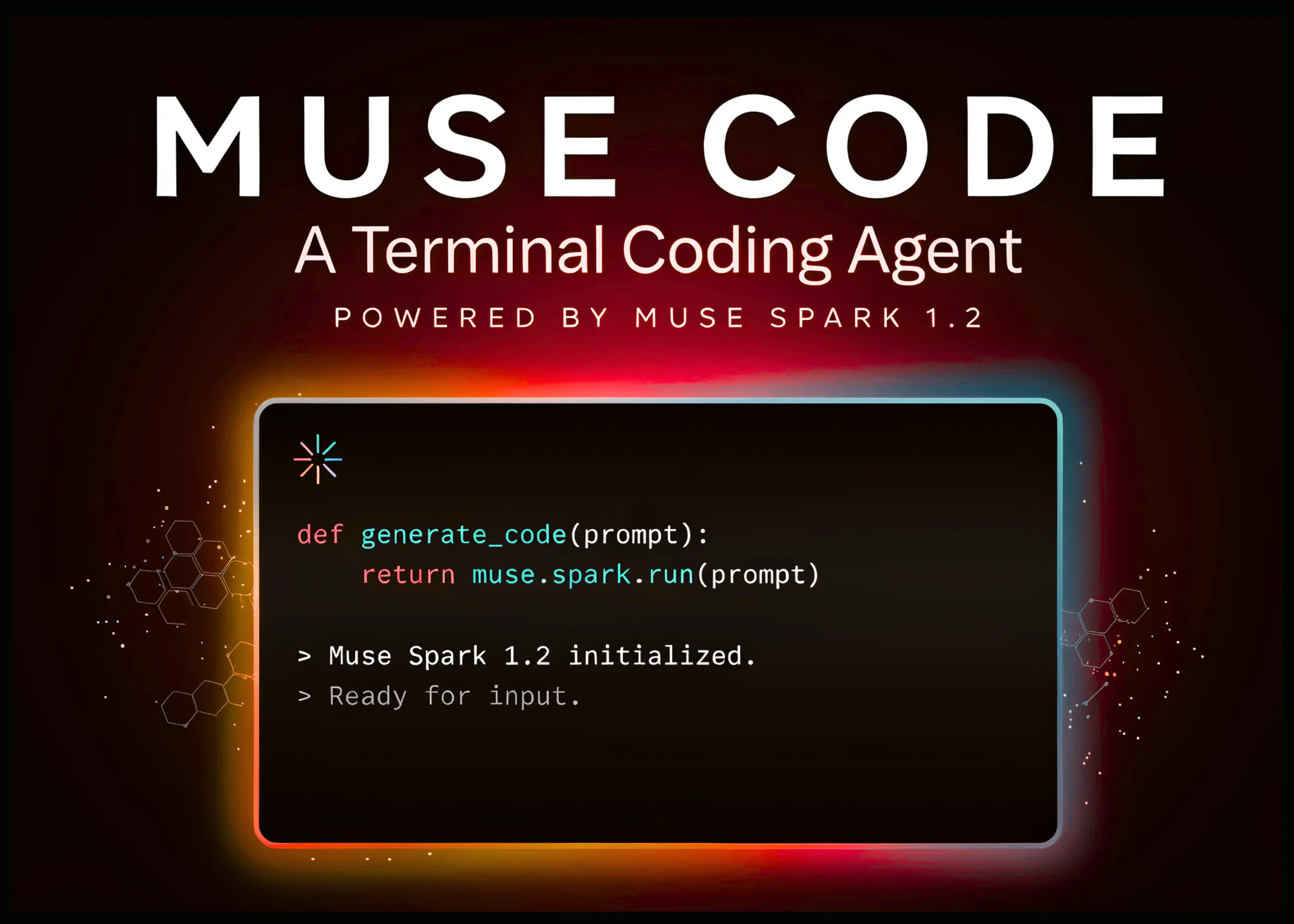
Muse Code is Meta’s AI coding agent designed to help developers build software through autonomous workflows. Powered by Muse Spark 1.2, it can understand codebases, plan changes, write code, debug issues, and handle complex engineering tasks directly from the terminal. With persistent agents, multi-step reasoning, and long-running workflows, Muse Code brings the idea of an AI software engineer closer to reality.
AI Analysis
Muse Code is Meta’s autonomous AI coding agent that enables developers to build software via natural language and terminal interactions. Core features include codebase comprehension, task planning, code generation, debugging, and execution of complex engineering workflows. Powered by Muse Spark 1.2, it offers persistent agents, multi-step reasoning, and support for long-running tasks. It solves major pain points such as time-intensive manual coding, error debugging in large codebases, and cognitive overload in software engineering. The value proposition is transforming developers' productivity by approximating an AI software engineer that handles end-to-end development autonomously.
The current market timing is favorable for 2025-2026. Industry trends show rapid maturation of agentic AI and LLMs capable of complex reasoning, aligning with surging developer demand for tools that address talent shortages and accelerate release cycles. Economic pressures favor productivity-enhancing technologies, and supportive AI policies in major markets create a conducive environment. Overall, it is Excellent Timing.
Overall feasibility is High. Technical difficulty is moderated by Meta's AI expertise and the existing Muse Spark 1.2 foundation, though achieving reliable autonomous multi-step coding remains challenging. Development and operation costs are manageable for a company of Meta's scale. Supply chain and compliance risks are low for software, with strong scalability potential through cloud-based deployment. Team fit is excellent given Meta's resources.
Main target segments are professional software developers, engineering teams, and CTOs in tech startups and enterprises (ages 25-45). Industries: software development, SaaS, fintech. Geographic distribution: primarily North America, Europe, with growing adoption in Asia. The AI developer tools TAM is estimated in the multi-billion dollar range by 2026; SAM for autonomous agents is several hundred million. Core pain points include slow iteration and maintenance of complex code. Users show high willingness to pay for proven productivity gains via subscriptions.
Competition level is High. Direct competitors: 1. Devin (cognition.ai), 2. Cursor (cursor.com), 3. GitHub Copilot Workspace (github.com/features/copilot), 4. Replit Agent (replit.com), 5. Aider (aider.chat). Advantages: Meta backing, terminal-native autonomous workflows, persistent agents for long tasks, and potentially stronger multi-step reasoning via Muse Spark. Disadvantages: Newer entrant with possibly less mature ecosystem/integration than GitHub Copilot, unclear pricing, and faces pressure from well-established tools with large user bases.
Upgrade Pro to unlock full AI analysis
Similar Products

Cohere Parse 5
Turn complex docs, tables & images into AI-ready data
▲ 158 votes

Adapt
The company brain that gets work done
▲ 124 votes

Tapfree for Chrome
Voice dictation that adapts to what’s on your screen
▲ 122 votes

Replay QA Security Scan
Automated Penetration Testing for AI-Built Apps
▲ 102 votes

Kosshi
Simple, fast outliner for Mac and iPhone.
▲ 90 votes

Thoughts for Mac
Capture notes from your menubar using text, images or voice
▲ 90 votes