
Nano Banana 2.1
Google's image model with sharper design and mask editing
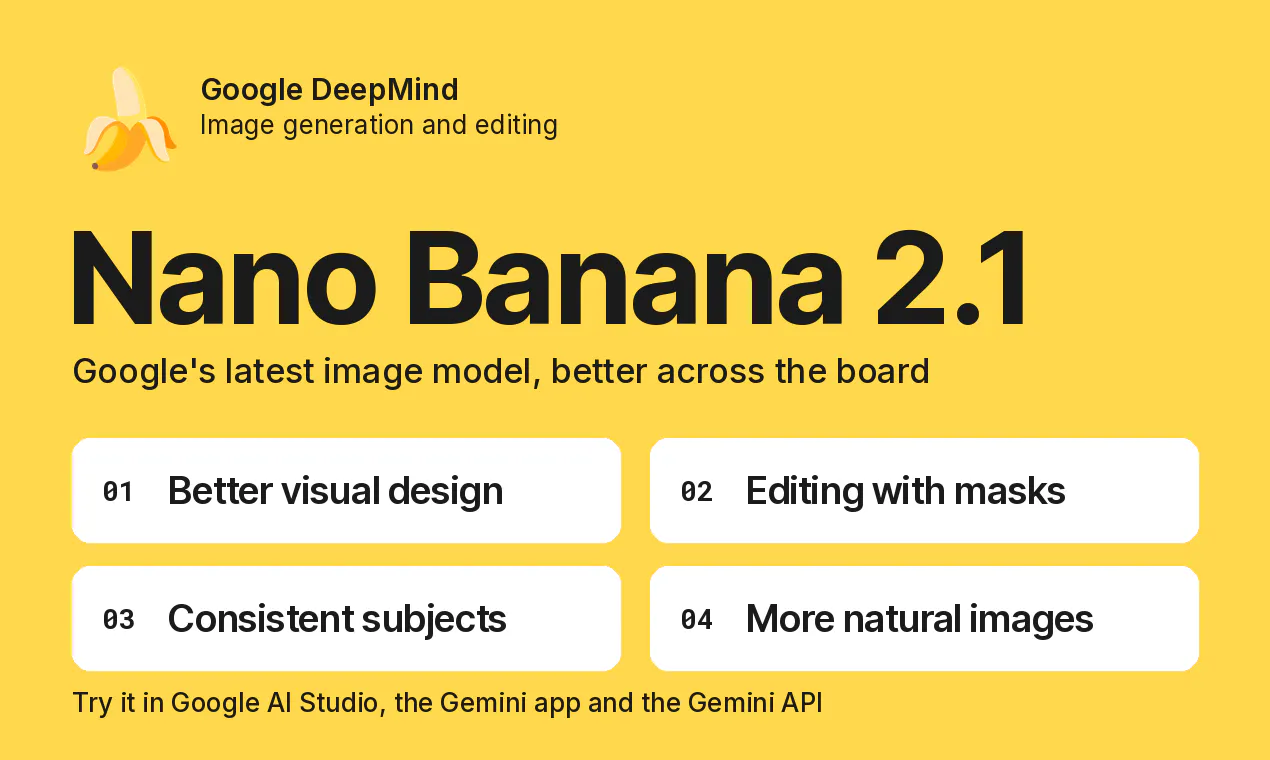
Nano Banana 2.1 is Google's latest image generation and editing model. Google says it outperforms earlier Nano Banana models across the board, with better visual design, mask based editing, stronger subject consistency and more natural looking images. It also improves text rendering and consistency across turns, with Search grounding at 1K, 2K and 4K. Try it in Google AI Studio or the Gemini app, or build with it in the Gemini API and Google Cloud.
AI Analysis
Nano Banana 2.1 is Google's latest image generation and editing model. Core features include superior visual design, mask-based editing, strong subject consistency, natural-looking images, improved text rendering, and search grounding at 1K, 2K, and 4K resolutions. It solves key user pain points such as inconsistent outputs, unnatural visuals, poor text integration, and limited editing precision in AI-generated content. The value proposition lies in delivering high-performance, accessible tools for creators and developers via Google AI Studio, the Gemini app, Gemini API, and Google Cloud, enabling efficient production of professional-quality images.
In 2025-2026, generative AI trends emphasize multimodal integration, higher consistency, and practical editing tools amid maturing diffusion models and rising demand for natural AI visuals. User needs are shifting toward seamless search-grounded creation, supported by favorable AI investment environments and policies. This aligns perfectly with industry growth. Excellent Timing.
High. Leverages Google's established AI infrastructure and expertise, minimizing technical difficulty. Development and operation costs are supported by their resources; excellent scalability via Gemini API and Google Cloud. Low supply chain risks as a software model; compliance handled by Google with strong team fit.
Main segments: graphic designers, digital artists, content creators, marketers, and developers integrating AI (ages 25-45, tech-savvy). Industries: design, advertising, media. Geographic: global with focus on US, Europe, Asia. Core pain points are inconsistent and low-quality AI images. Strong willingness to pay for API and premium access in a large, growing AI tools market.
High. Direct competitors: DALL-E 3 (openai.com), Midjourney (midjourney.com), Stable Diffusion 3 (stability.ai), Adobe Firefly (adobe.com/firefly). Advantages: superior mask editing, subject consistency, text quality, search grounding, and Google ecosystem integration. Disadvantages: potentially restricted access compared to open competitors and reliance on Google accounts/services.
Upgrade Pro to unlock full AI analysis
Similar Products
Cohere Parse 5
Turn complex docs, tables & images into AI-ready data
▲ 158 votes

Opaline
PostHog for team Claude Code and Codex sessions.
▲ 141 votes

Adapt
The company brain that gets work done
▲ 124 votes

Tapfree for Chrome
Voice dictation that adapts to what’s on your screen
▲ 122 votes

CodeBurn
See where your AI coding spend actually goes
▲ 101 votes

WikiFix for Confluence
Find and fix issues in your knowledge base
▲ 86 votes