
NINA
Guide users step by step inside your product.
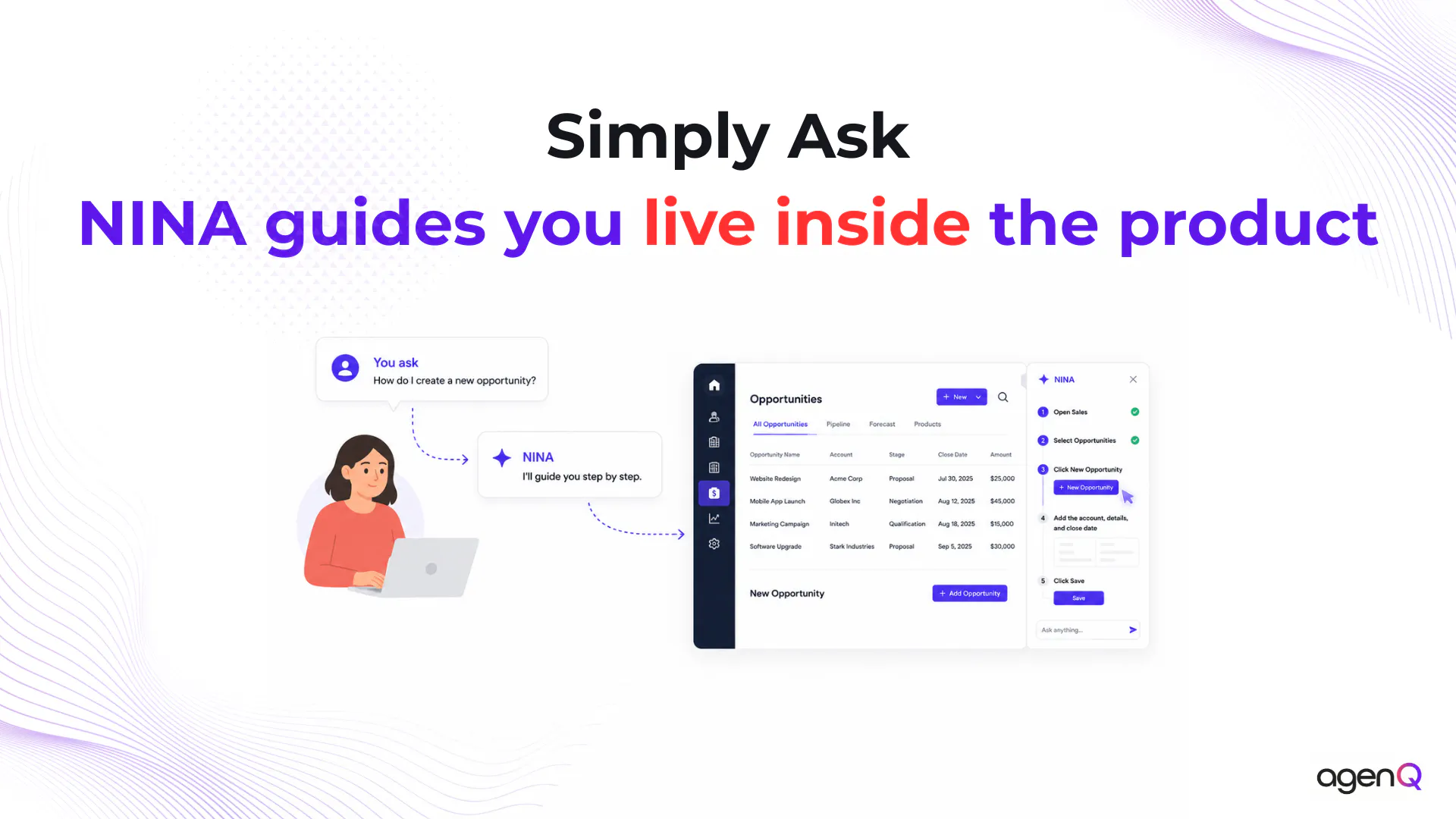
NINA lives inside your product and helps users exactly where they get stuck. They ask “How do I…?” by voice or text, and NINA guides them step by step on the live interface before they open a ticket, search documentation, or message support. It is not a scripted tour, chatbot, or FAQ. NINA is built for B2B SaaS teams still relying on onboarding calls, product videos, Slack channels, and repeated support answers.
AI Analysis
NINA is an AI assistant that embeds directly into B2B SaaS products to provide real-time, step-by-step guidance on the live interface. Users ask 'How do I...?' via voice or text, and NINA interactively directs them without scripts, tours, chatbots, or FAQs. It solves key pain points like user confusion leading to support tickets, inefficient onboarding via calls/videos/Slack, and repeated queries. USP: contextual, on-screen assistance that reduces friction before users escalate. Value proposition: boosts adoption, cuts support costs, and enhances customer success for SaaS teams.
In 2025-2026, AI agent technology and multimodal models are maturing rapidly, enabling UI understanding and real-time guidance. SaaS companies face rising pressure to reduce support costs and improve self-serve UX amid competitive markets and economic efficiency demands. User expectations for instant, voice-enabled help are growing with AI adoption. This aligns perfectly with trends in product-led growth and AI copilots. Excellent Timing.
Technical difficulty is medium-high, requiring deep SDK integration, context-aware AI for UI navigation, and handling diverse product environments. Development and LLM inference costs may be substantial, with ongoing maintenance for accuracy. Privacy/compliance risks exist for voice/data handling. Scalability is strong for cloud delivery, but initial team expertise in AI/UI agents is needed. Overall rating: Medium.
Main segments: Product, CX, and customer success teams at B2B SaaS companies (mid-market to enterprise), focused on complex tools with high learning curves. Primarily North America and Europe-based tech firms. TAM for digital adoption platforms ~$10B+, SAM for AI in-app assistants ~$2B, SOM ~$200M for early adopters. Core pains: user drop-off, high support volume, slow time-to-value. Willingness to pay: high (subscription per MAU or seat), as ROI is clear via reduced tickets and churn.
Medium. Direct competitors: 1. CommandBar (commandbar.com), 2. Appcues (appcues.com), 3. Whatfix (whatfix.com), 4. Pendo (pendo.io), 5. Userpilot (userpilot.com). Advantages: truly live interface step-by-step guidance (not just tooltips/tours), voice support, pre-ticket intervention, non-scripted AI. Disadvantages: likely higher integration effort than no-code alternatives, newer player so less established analytics/enterprise features, potential higher AI usage costs vs. traditional guides.
Upgrade Pro to unlock full AI analysis
Similar Products

Auriko
Trading desk for LLM calls
▲ 332 votes

Cohere Parse 5
Turn complex docs, tables & images into AI-ready data
▲ 158 votes

Adapt
The company brain that gets work done
▲ 124 votes

Tapfree for Chrome
Voice dictation that adapts to what’s on your screen
▲ 122 votes

React UI Kit V7
All the chat components you need. None of the complexity
▲ 115 votes
CodeBurn
See where your AI coding spend actually goes
▲ 101 votes