
NobodyWho
Run AI models on any device
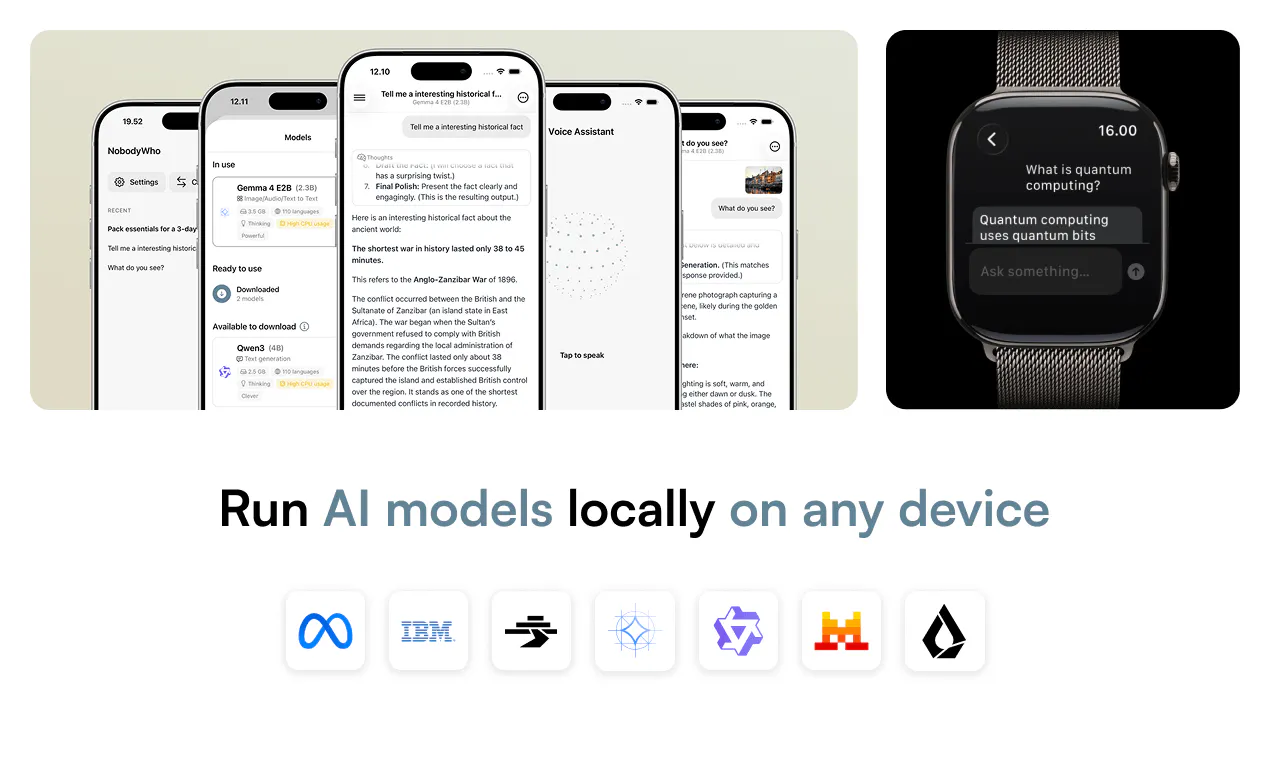
NobodyWho is an inference engine for running LLMs fully on-device, built on llama.cpp. Open-source, free, no API keys, no cloud calls. We support Swift, Kotlin, Flutter, React Native, Python, and Godot. Includes type-safe tool calling with automatic grammar generation, multimodal input, Text-to-Speech & Speech-to-Text, GPU acceleration via Vulkan & Metal, and Hugging Face model downloads.
AI Analysis
NobodyWho is an open-source on-device inference engine built on llama.cpp for running LLMs locally without cloud dependency, API keys, or internet. It supports Swift, Kotlin, Flutter, React Native, Python, and Godot with features like type-safe tool calling via automatic grammar generation, multimodal input, TTS/STT, GPU acceleration (Vulkan/Metal), and Hugging Face model downloads. It addresses key developer pain points including privacy risks, API costs, latency, and connectivity issues. The value proposition is enabling easy integration of efficient, private, offline AI capabilities into apps across platforms at zero cost.
In 2025-2026, with maturing on-device AI hardware (e.g. NPUs in phones), rising privacy regulations like GDPR expansions, demand for offline/low-latency AI, and shift from cloud-centric models due to costs and data sovereignty concerns, timing is highly favorable. Industry trends favor edge AI for consumer and enterprise apps. Excellent Timing.
High technical feasibility leveraging the mature llama.cpp base with proven GPU acceleration and multi-platform bindings. Low development/operation costs as it's fully open-source with no cloud infrastructure needed. Minimal supply chain risks; compliance focuses on app store policies for mobile. Strong scalability across devices. High.
Primary segments: Cross-platform mobile developers, AI application builders, game developers (Godot users), and indie/open-source contributors. Industries include software tools, consumer mobile apps, and privacy-sensitive sectors like health tech. Geographically global with strong adoption in US, Europe, and Asia tech hubs. Growing demand for on-device AI; core pain points are cloud dependency, privacy, and integration complexity. High willingness to pay for enterprise support or advanced features despite free core product.
Medium. Direct competitors: 1. MLC LLM (mlc.ai), 2. llama.cpp official (github.com/ggerganov/llama.cpp), 3. Ollama (ollama.com), 4. ExecuTorch (pytorch.org/executorch), 5. LM Studio (lmstudio.ai). Advantages: Broad SDK support for mobile/cross-platform frameworks, built-in type-safe tool calling and multimodal features. Disadvantages: Newer project may lag in ecosystem maturity/community size vs core llama.cpp; open-source model limits direct revenue vs some commercial alternatives. Strong differentiation in ease of on-device integration without cloud.
Upgrade Pro to unlock full AI analysis
Similar Products

Cohere Parse 5
Turn complex docs, tables & images into AI-ready data
▲ 158 votes

Adapt
The company brain that gets work done
▲ 124 votes

Orus
Claude for investing in perpetuals
▲ 121 votes

WikiFix for Confluence
Find and fix issues in your knowledge base
▲ 83 votes

Audryo
Customer email your agent can operate.
▲ 68 votes
Refoid
Automate App Store refund responses and track every outcome
▲ 68 votes