Nodeterm
A node-based free open source terminal manager
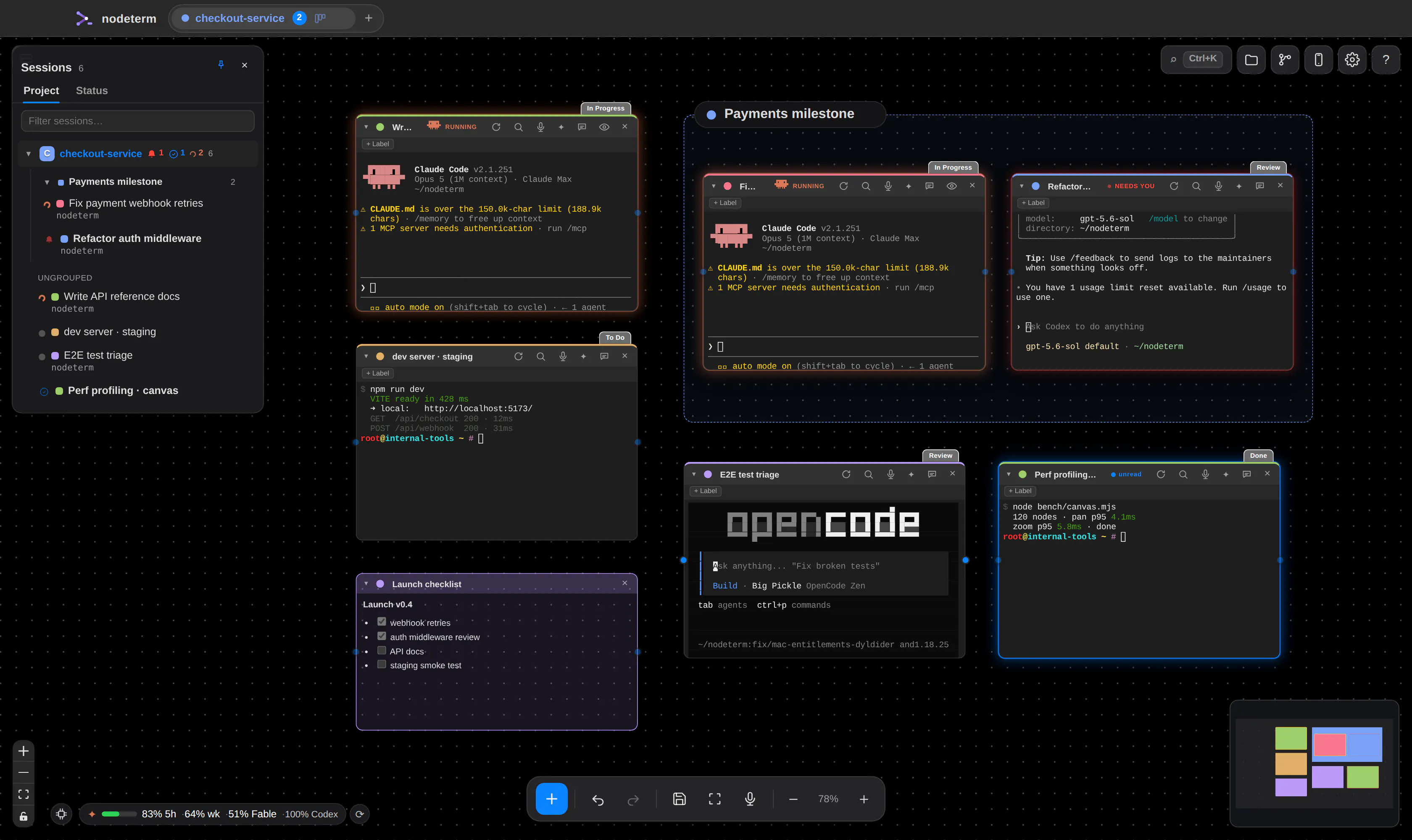
A node-based free open source terminal manager for macOS, Linux and Windows. Real terminals and coding agents as live nodes on an infinite canvas — watch Claude, Codex and Gemini work, wire them together, and never lose a session to a reboot.
AI Analysis
Nodeterm is a free open-source node-based terminal manager for macOS, Linux, and Windows. It represents real terminals and AI coding agents (Claude, Codex, Gemini) as live, interactive nodes on an infinite canvas. Users can visually wire nodes together to build workflows, observe AI agents in action, and benefit from persistent sessions that survive reboots. It solves key pain points like losing terminal sessions after crashes/reboots, fragmented management of multiple terminals and AI tools, and the lack of visual orchestration for complex dev tasks. The value proposition is an intuitive, visual workspace that merges traditional terminals with AI agents to boost developer productivity and creativity.
In 2025-2026, AI agentic workflows and visual programming tools are maturing rapidly amid surging demand for AI-augmented developer environments. Technologies like LLM APIs and canvas UIs are stable, while user needs shift toward persistent, integrated, and observable AI-terminal hybrids. Economic focus on productivity tools and open-source adoption further support it. This is Excellent Timing as it aligns perfectly with the AI developer tooling boom.
Technical difficulty is moderate: combining terminal emulation, infinite canvas, real-time AI integration, and cross-platform support is achievable with existing frameworks (e.g., Electron, WebSockets). Development and operation costs are low as it is free and open source, enabling community contributions. Minimal supply chain or compliance risks for a desktop dev tool. High scalability potential via OSS ecosystem. Overall rating: High. Supported by mature underlying technologies and the product's focus on integration rather than novel invention.
Primary users: individual software developers, full-stack engineers, DevOps professionals, and AI tool enthusiasts (ages 25-45), mainly in software/tech industries. Geographic distribution: global with strong presence in North America, Europe, and Asia. Estimated market size: TAM for developer productivity tools ~$15B, SAM for terminal/AI integration tools ~$800M, SOM for node-based visual terminals ~$80M. Core pain points include session fragility, disjointed AI-terminal usage, and non-visual workflow management. Potential willingness to pay is medium-high; while core is free OSS, users may support via sponsorships, donations, or premium cloud/enterprise features.
Competition level: Medium. Direct competitors: 1. Warp (warp.dev), 2. Fig (fig.io - now Amazon Q), 3. Node-RED (nodered.org), 4. Langflow (langflow.org), 5. Tabby (tabby.sh). Advantages vs competitors: unique infinite canvas combining live terminals and multiple AI agents (Claude/Gemini), session persistence across reboots, fully free and open source, strong visual wiring for agents. Disadvantages: potentially higher learning curve than linear terminals, less focus on pure AI autocomplete compared to Warp/Fig, newer entrant so ecosystem may be smaller.
Upgrade Pro to unlock full AI analysis
Similar Products

Opaline
PostHog for team Claude Code and Codex sessions.
▲ 141 votes

React UI Kit V7
All the chat components you need. None of the complexity
▲ 115 votes

Replay QA Security Scan
Automated Penetration Testing for AI-Built Apps
▲ 102 votes

CodeBurn
See where your AI coding spend actually goes
▲ 101 votes

Audryo
Customer email your agent can operate.
▲ 68 votes
Refoid
Automate App Store refund responses and track every outcome
▲ 68 votes