
Noodle Seed
Your product in AI and AI in your product
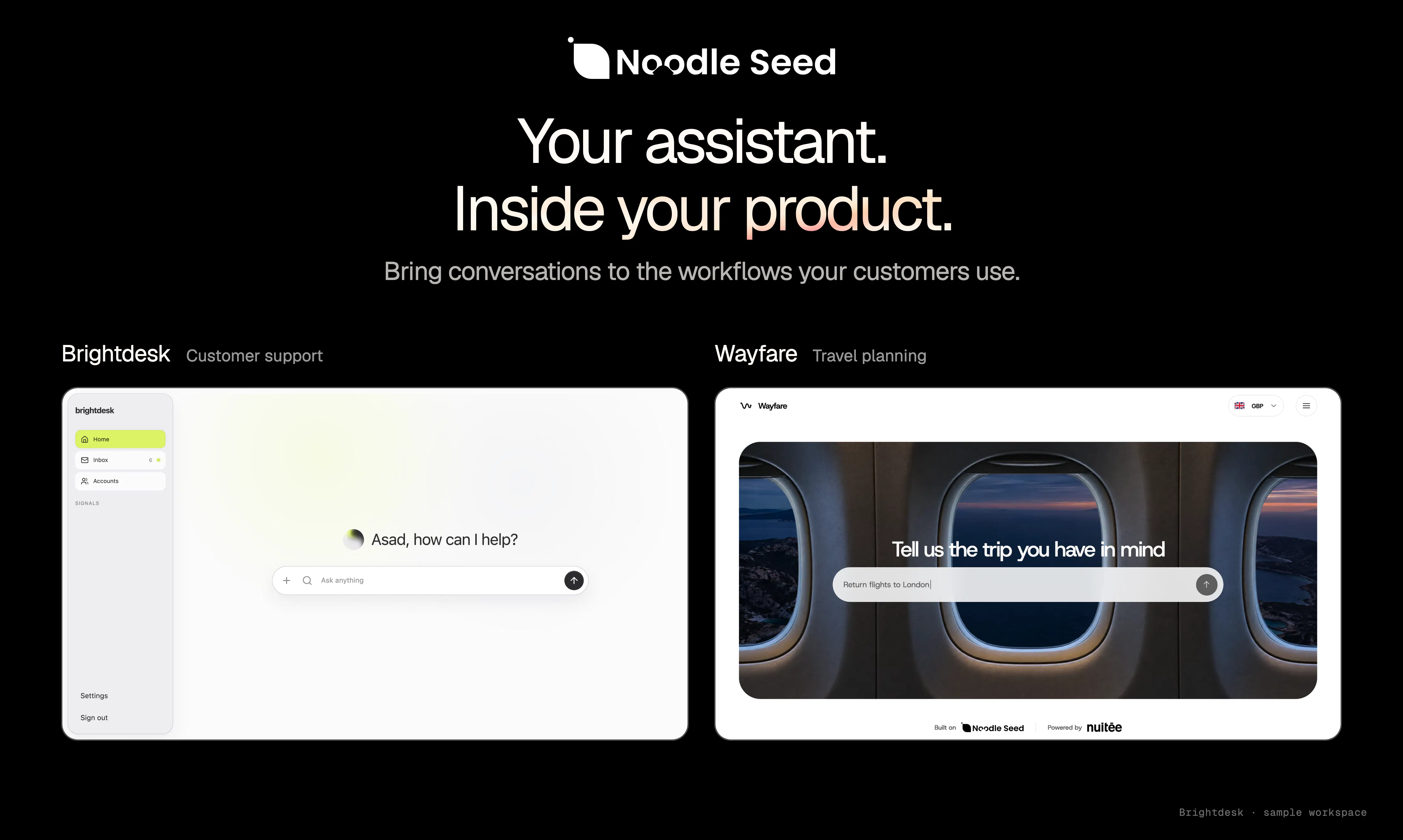
Noodle Seed helps software teams make their products ready for AI agents. Build workflows in TypeScript, expose them through a secure branded assistant inside your product, and make the same capabilities available to external agents. Instead of stitching together MCP SDKs and hosting infrastructure, Noodle Seed provides the governed runtime for identity, permissions, secrets, audit, and operations.
AI Analysis
Noodle Seed helps software teams prepare products for AI agents by allowing workflows to be built in TypeScript. It enables a secure, branded assistant inside the product and exposes the same capabilities to external agents. It provides a governed runtime managing identity, permissions, secrets, audit logs, and operations. This eliminates the complexity of combining multiple MCP SDKs and hosting infrastructure. It addresses key pain points like security risks, governance challenges, and integration overhead in AI agent adoption. The value proposition is a streamlined, secure way to make any product AI-ready with full control and minimal operational burden.
In 2025-2026, AI agent technology is maturing rapidly with rising adoption across software products. User demand for seamless AI integration is surging while governance and security concerns grow. Economic push for AI efficiency and favorable policies supporting AI innovation make this an ideal launch period. Excellent Timing.
Technical implementation leverages mature TypeScript and existing AI SDKs, though building robust governance for identity/permissions adds complexity. Development and operation costs are moderate for a SaaS platform. Compliance risks exist around data security but are manageable. Strong scalability potential via cloud runtime. Overall High feasibility for an experienced dev tools team. Rating: High.
Primary users: Software engineering teams, CTOs, and product developers at mid-to-large SaaS and tech companies. Industries: Software development, AI tooling, enterprise tech. Geographic focus: Global with concentration in US, Europe. TAM for AI integration tools exceeds $15B, SAM for agent enablement platforms around $2B, SOM ~$150M. Core pains: Fragmented AI agent integration and lack of secure governance. High willingness to pay for time-saving, secure solutions (subscription model implied).
Medium. Direct competitors: 1. LangChain (langchain.com), 2. LlamaIndex (llamaindex.ai), 3. E2B (e2b.dev), 4. CrewAI (crewai.com), 5. SmythOS (smythos.com). Advantages: Focused governed runtime for permissions/secrets/audit, branded in-product assistant, unified TS workflow for internal/external agents. Disadvantages: Newer entrant with potentially smaller ecosystem compared to established frameworks; pricing not specified but may face pressure from open-source alternatives. Strong differentiation in security and operational governance reduces direct pressure.
Upgrade Pro to unlock full AI analysis
Similar Products

Cohere Parse 5
Turn complex docs, tables & images into AI-ready data
▲ 158 votes

Adapt
The company brain that gets work done
▲ 124 votes

WikiFix for Confluence
Find and fix issues in your knowledge base
▲ 86 votes

Saldor
Speed up procurement and AP.
▲ 78 votes

Audryo
Customer email your agent can operate.
▲ 68 votes
Refoid
Automate App Store refund responses and track every outcome
▲ 68 votes