
Notion Developer Platform
Build on Notion, not just inside it
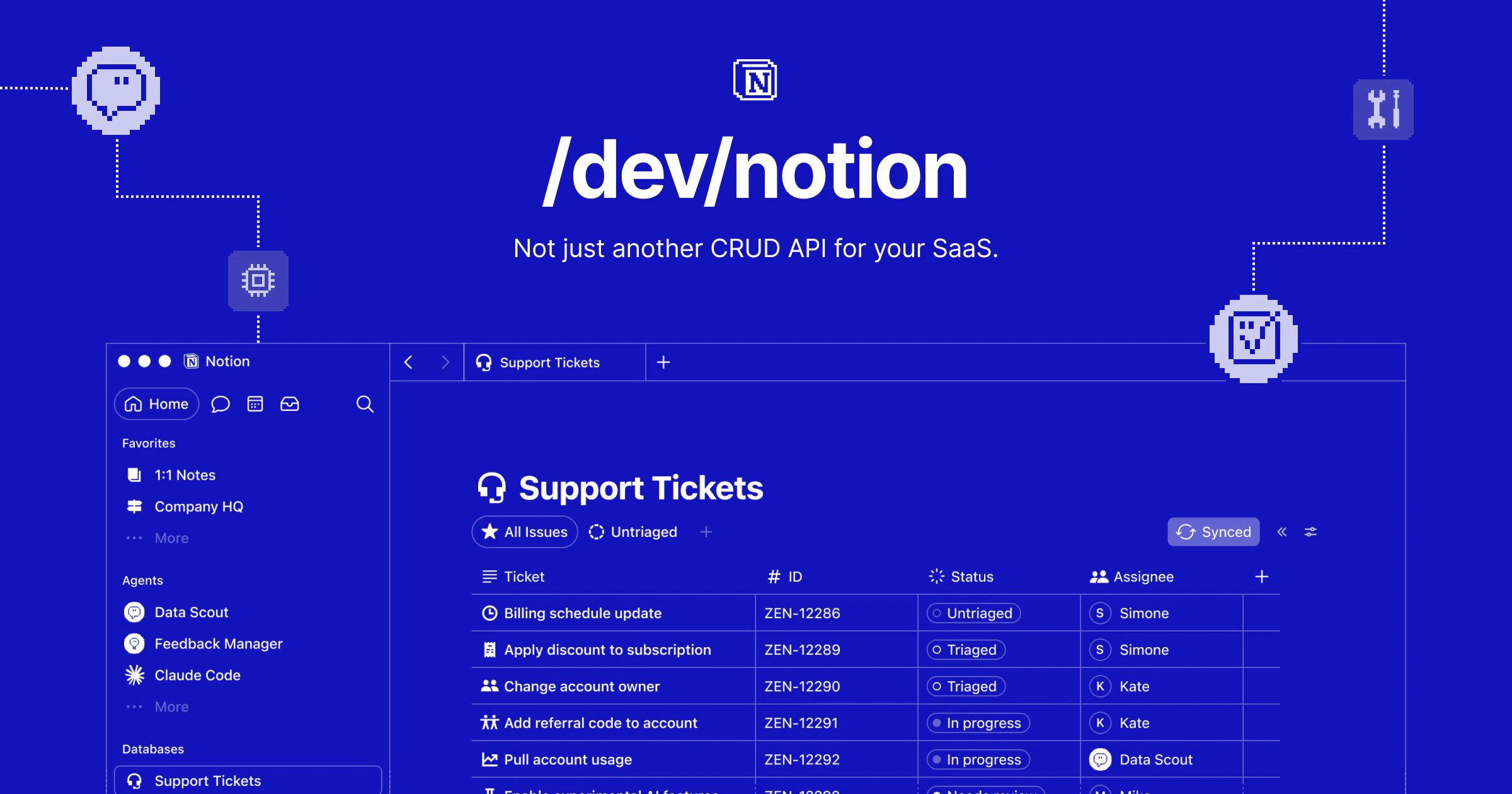
Notion Developer Platform lets teams build on Notion with CLI, Workers, database syncs, agent tools, webhook triggers, MCP, and External Agents APIs, so data, workflows, and agents can operate inside the same shared workspace.
AI Analysis
Notion Developer Platform enables building directly on Notion using CLI, Workers, database syncs, agent tools, webhook triggers, MCP, and External Agents APIs. This allows data, workflows, and AI agents to operate seamlessly inside the shared Notion workspace. Core USPs include deeper platform integration beyond basic embeds or simple APIs. It solves key pain points like fragmented tools, manual data syncing, and disconnected automations for Notion-heavy teams. The value proposition is a unified ecosystem that boosts productivity by embedding custom development, workflows, and intelligent agents natively within Notion.
In 2025-2026, AI agent adoption and no-code automation trends are peaking, with rising demand for unified workspaces. Notion's established user base aligns with needs for deeper integrations as teams seek to embed AI and workflows without tool switching. API and agent technologies are mature, and economic focus on productivity tools supports growth. This is an ideal launch window. Excellent Timing.
Technical difficulty is medium-high due to requirements for secure APIs, scalable workers, and safe external agent execution. Development and operation costs are significant for infrastructure but manageable for an established platform like Notion. Low supply chain risk, moderate compliance needs around data privacy. Strong scalability potential in cloud environment and good team fit. Overall rating: High.
Main segments: Software developers, AI engineers, and technical teams (25-45 years old) in tech/SaaS companies and enterprises using Notion. Industries: Productivity software, startups, consulting. Geographic: Global with concentration in North America, Europe. TAM for workspace automation platforms approx $15B, SAM for Notion ecosystem integrations ~$800M. Core pain points: siloed data and limited custom AI/workflow capabilities. High willingness to pay for API and premium developer features.
Medium. Direct competitors: 1. Zapier (zapier.com), 2. Make (make.com), 3. n8n (n8n.io), 4. Pipedream (pipedream.com), 5. Coda (coda.io). Advantages: Native deep Notion integration with specialized agent tools, MCP, and workspace-native execution; tighter data sync. Disadvantages: More limited to Notion users vs. cross-app breadth of Zapier/Make; potentially steeper learning curve for its unique APIs compared to general no-code tools.
Upgrade Pro to unlock full AI analysis
Similar Products

Auriko
Trading desk for LLM calls
▲ 332 votes

Cohere Parse 5
Turn complex docs, tables & images into AI-ready data
▲ 158 votes

Opaline
PostHog for team Claude Code and Codex sessions.
▲ 141 votes

Adapt
The company brain that gets work done
▲ 124 votes

Tapfree for Chrome
Voice dictation that adapts to what’s on your screen
▲ 122 votes

CodeBurn
See where your AI coding spend actually goes
▲ 101 votes