
Oasis
Where humans and agents come to work.
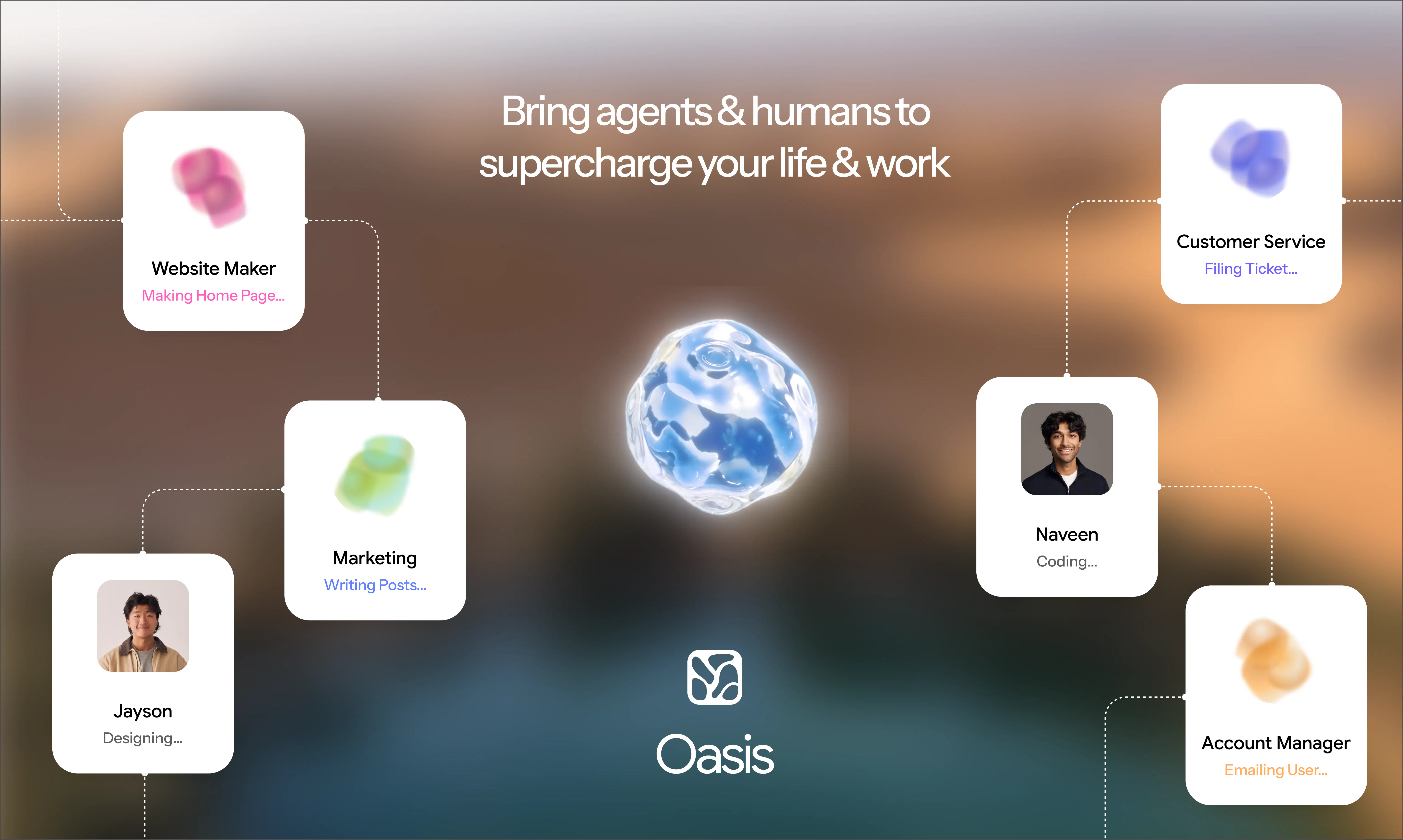
An intelligent workspace for you, all your agents, and your team. Bring the best agents from across the ecosystem into one place, where people and agents work together as equal teammates. Every conversation, decision, and artifact becomes shared knowledge that compounds over time. As the workspace learns how you work, it adapts to your needs and builds specialized tools that help everyone do its best work.
AI Analysis
Oasis is an intelligent workspace where humans and AI agents collaborate as equal teammates. It integrates the best agents from across the ecosystem into one place, turning every conversation, decision, and artifact into shared knowledge that compounds over time. The platform learns individual workflows and automatically builds specialized tools. It solves key pain points including fragmented AI tool usage, loss of institutional knowledge from disjointed interactions, and inefficient human-AI collaboration. The value proposition is a unified, adaptive environment that boosts team productivity by making collective intelligence persistent and actionable.
The market timing is favorable for 2025-2026 as AI agent technologies and LLM capabilities are maturing rapidly, enabling practical multi-agent systems. Industry trends show surging adoption of AI for productivity, with businesses demanding seamless human-AI collaboration tools amid economic pressures for efficiency. User demands are shifting towards integrated workspaces rather than siloed agents. No major negative policy impacts; instead, supportive AI innovation environments exist. This is Excellent Timing.
Overall feasibility is Medium. Technical difficulty is high for robust multi-agent integration, real-time collaboration, and adaptive tool generation, though mitigated by existing LLM APIs. Development and operation costs are significant for AI infrastructure and maintenance. Compliance risks around data privacy and IP in shared knowledge are notable. Scalability potential is high via cloud, but requires specialized AI engineering team fit. No major supply chain issues.
Main target segments: Tech professionals, developers, product teams, and knowledge workers (ages 25-45) in software, consulting, and innovation-driven industries, concentrated in US, Europe, and global remote tech hubs. TAM for AI productivity platforms exceeds $100B, SAM for agent collaboration tools ~$8B, SOM ~$500M initially. Core pain points: Scattered AI usage and knowledge fragmentation. High willingness to pay for SaaS model ($20-150/user/month) due to productivity gains.
Competition level: Medium. Direct competitors: 1. CrewAI (crewai.com), 2. Dify.ai (dify.ai), 3. SmythOS (smythos.com), 4. Lindy (lindy.ai), 5. MultiOn (multion.ai). Advantages: Strong emphasis on shared compounding knowledge, agents as true teammates, and automatic specialized tool building for better differentiation. Disadvantages: As a newer entrant, it may face challenges in ecosystem integrations and proven reliability compared to more established agent orchestration platforms; pricing not specified but assumed competitive subscription model.
Upgrade Pro to unlock full AI analysis
Similar Products

Cohere Parse 5
Turn complex docs, tables & images into AI-ready data
▲ 158 votes

Opaline
PostHog for team Claude Code and Codex sessions.
▲ 141 votes

Adapt
The company brain that gets work done
▲ 124 votes

Kosshi
Simple, fast outliner for Mac and iPhone.
▲ 90 votes

Thoughts for Mac
Capture notes from your menubar using text, images or voice
▲ 90 votes

Refoid
Automate App Store refund responses and track every outcome
▲ 68 votes