
Occasio®
Pinboard meets citation manager for shared insights.
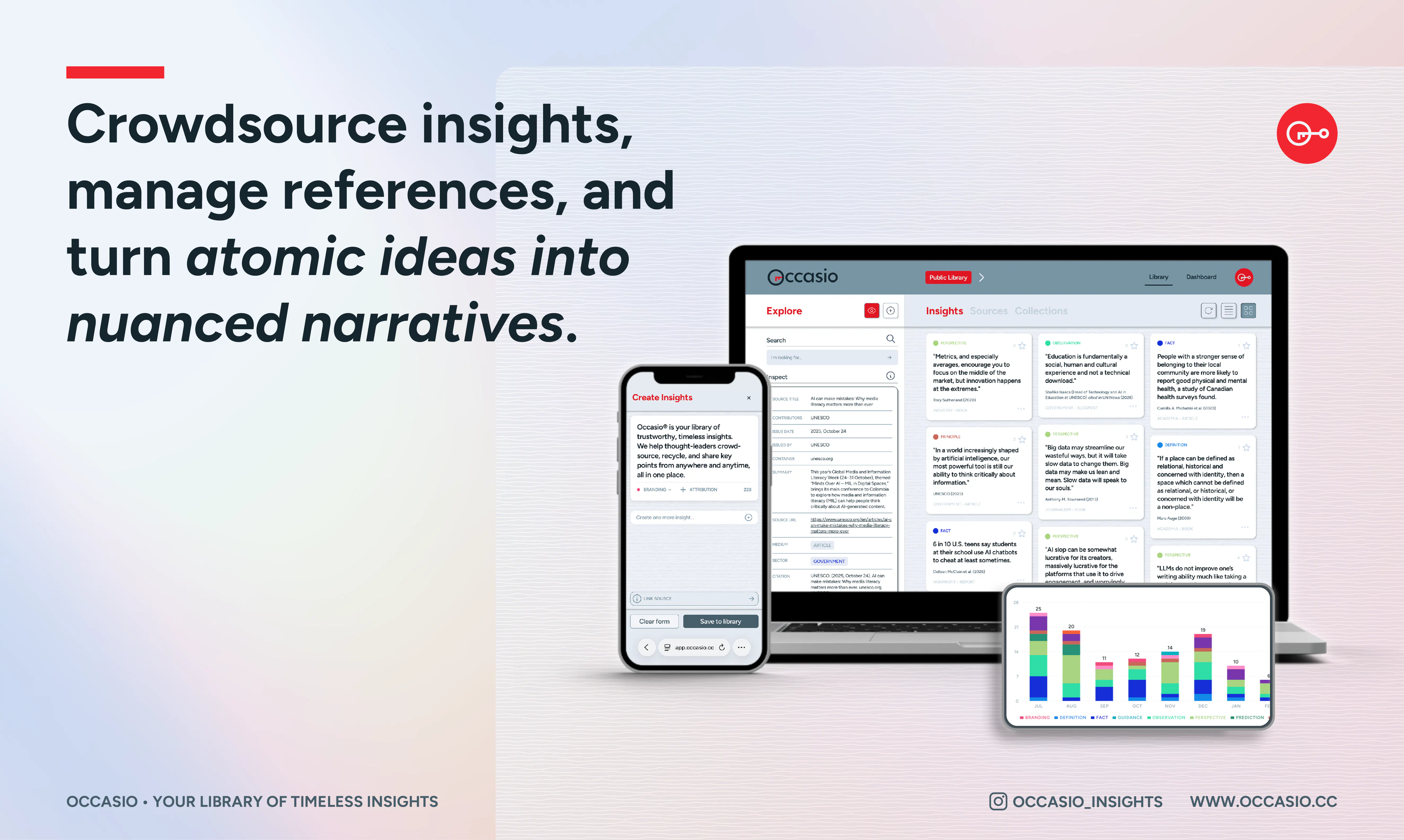
Occasio is your collaborative library of trusted, timeless insights. Distill complex knowledge onto bite-sized index cards and link sources with academic-grade citation rigour. As your library grows, analyse trends and curate endless combinations with zero duplication. Built for research teams and thought leaders who stand for original thinking and have zero tolerance for AI fluff or hallucinated sources.
AI Analysis
Occasio is a collaborative SaaS platform combining pinboard-style visuals with a rigorous citation manager for building a shared library of trusted insights. Core features include distilling complex information into bite-sized index cards, linking sources with academic-grade citations, trend analysis as the library grows, and curation of unique combinations without duplication. It solves key pain points such as knowledge fragmentation, unreliable or hallucinated sources (explicitly anti-AI fluff), citation management burdens, and collaboration challenges for original thinking. The value proposition is delivering a scalable, verifiable knowledge base for research teams and thought leaders prioritizing authenticity and timeless insights over generative AI.
In 2025-2026, timing is favorable amid AI proliferation and backlash against hallucinations, driving demand for human-curated, rigorously cited tools that emphasize originality. Collaborative productivity and knowledge management trends are maturing with remote research teams, while economic pressures favor efficiency in R&D and consulting. User demands are shifting towards verifiable insights over AI-generated content. This aligns perfectly with growing skepticism of 'AI fluff' and need for trusted shared libraries. Rating: Excellent Timing.
Overall feasibility is high. Technical challenges for a card-based database, citation tools, real-time collaboration, and basic trend analysis are manageable with established web frameworks and databases, though avoiding heavy AI keeps complexity lower. Development and operation costs are typical for SaaS startups. Low supply chain risks; compliance focuses on data privacy (e.g., GDPR) for academic users. Strong scalability via cloud infrastructure and good fit for productivity tool developers. Key risks are user adoption and building citation accuracy features. Rating: High.
Main target segments: Research teams, academics, thought leaders, and consultants (ages 25-50, often with advanced degrees). Industries include higher education, R&D, consulting firms, think tanks, and publishing. Geographic focus: Global with emphasis on English-speaking regions (US, Europe, Canada). Estimated market size: TAM in broader knowledge management SaaS (~$20B+), SAM for citation/note-taking tools (~$2B), SOM for specialized collaborative research platforms (~$100-200M). Core pain points: organizing verifiable insights without duplication, managing citations rigorously, and avoiding AI-unreliable content in teams. Potential willingness to pay: High for team subscriptions due to time savings and quality assurance in professional research.
Competition level: Medium. Direct competitors: 1. Zotero (zotero.org) - free citation manager; 2. Mendeley (mendeley.com) - Elsevier-owned reference manager with collaboration; 3. Notion (notion.so) - flexible all-in-one notes/databases; 4. Roam Research (roamresearch.com) - networked thought tool with backlinks; 5. Milanote (milanote.com) - visual board for ideas. Advantages vs competitors: Unique pinboard+citation hybrid with zero-duplication curation, explicit anti-AI focus for originality, trend analysis for growing libraries. Disadvantages: Newer entrant with likely smaller ecosystem/integrations than Zotero/Mendeley, less general-purpose than Notion, and may require more structured input than Roam/Obsidian.
Upgrade Pro to unlock full AI analysis
Similar Products

Adapt
The company brain that gets work done
▲ 124 votes

Tapfree for Chrome
Voice dictation that adapts to what’s on your screen
▲ 122 votes

Kosshi
Simple, fast outliner for Mac and iPhone.
▲ 90 votes

Thoughts for Mac
Capture notes from your menubar using text, images or voice
▲ 90 votes

Saldor
Speed up procurement and AP.
▲ 78 votes

Refoid
Automate App Store refund responses and track every outcome
▲ 68 votes