
Odyssey 3
A world model that simulates physics in real time
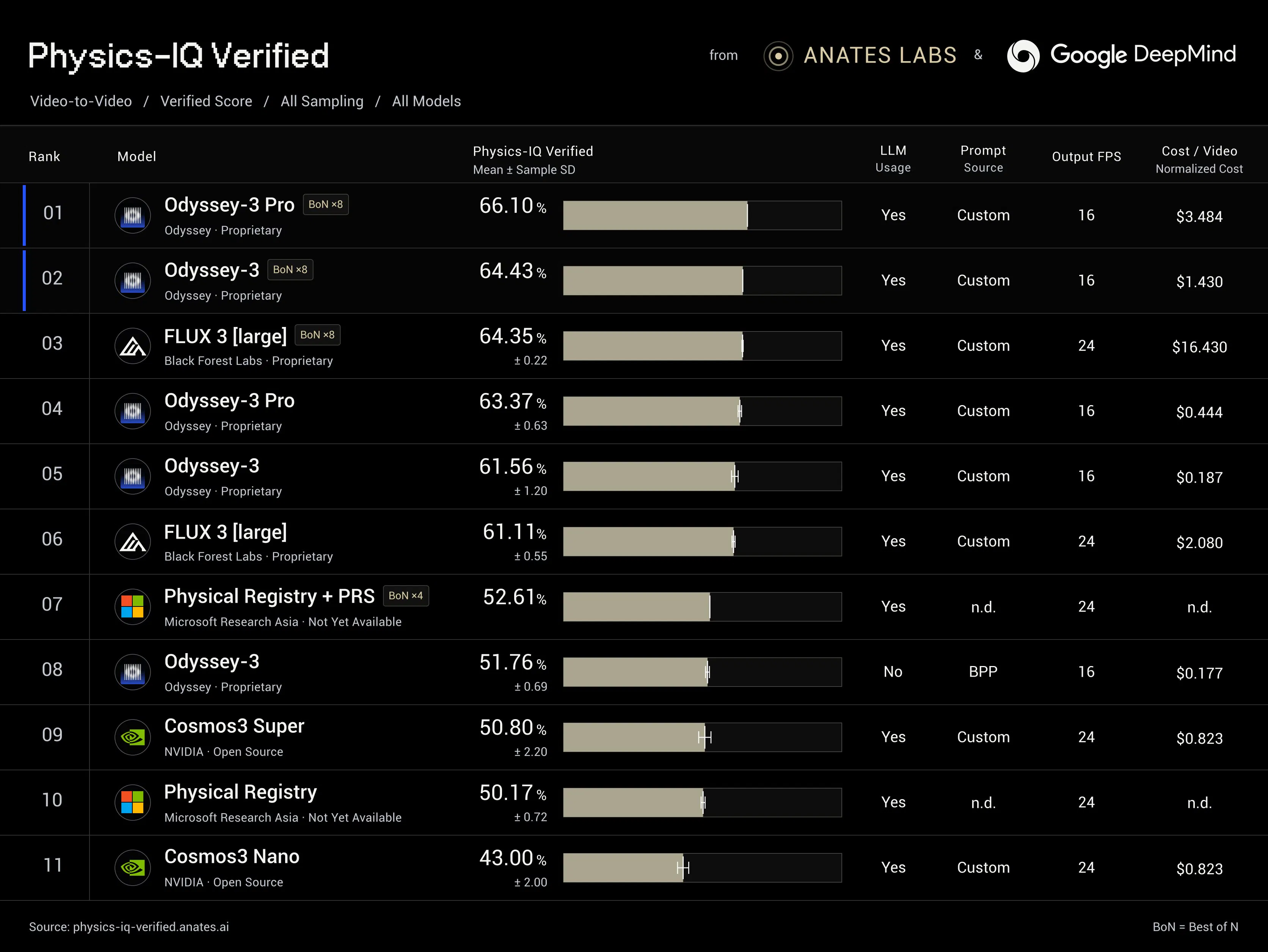
Odyssey-3 is a foundation world model that generates interactive environments from a prompt and predicts in real time how they change as you or an agent act in them. Its Pro version posts the highest reported Physics-IQ Verified video-to-video score (66.1, best-of-8). The same model has been adapted to control robot arms and humanoids, drive a car, and train agents. Try the research preview, or get in touch for API access.x`
AI Analysis
Odyssey 3 is a foundation world model that generates interactive environments from prompts and predicts real-time physics-accurate changes based on user or agent actions. It achieves the highest reported Physics-IQ Verified video-to-video score (66.1). The model adapts to control robot arms, humanoids, drive cars, and train agents. It addresses pain points in creating realistic simulations for AI/robotics development without costly physical trials or complex coding. Value proposition: accessible real-time world simulation via research preview and API for accelerated innovation in embodied AI.
Favorable for 2025-2026 due to rapid maturity of generative AI and video models following LLM advances, surging demand for embodied AI and robotics training tools that reduce real-world risks, and heavy industry investment in simulation tech. Economic push for AI efficiency and policy support for innovation align perfectly. Excellent Timing.
Medium. Technical difficulty is high for real-time inference at scale; development and GPU operational costs are substantial. Supply chain risks minimal but regulatory compliance for robotics applications adds hurdles. Strong scalability via API and proven adaptations indicate good potential, assuming the team has sufficient compute resources. Overall feasible with caveats on cost.
Primary segments: AI/ML researchers, robotics engineers, autonomous vehicle developers, and simulation specialists; mainly in North America, Europe, and East Asia tech hubs. TAM for AI world models/simulation tools projected ~$15B+ by 2028; SAM for physics-based interactive AI ~$3B. Pain points: inaccurate/expensive simulations for training. High willingness to pay for API among enterprises and labs.
Medium. Direct competitors: 1. Google DeepMind Genie (deepmind.google/technologies/genie), 2. OpenAI Sora (openai.com), 3. NVIDIA Cosmos (nvidia.com/cosmos), 4. Meta V-JEPA (ai.meta.com). Advantages: superior Physics-IQ benchmark, real-time interactivity and proven cross-domain adaptation to physical control. Disadvantages: research preview stage may limit accessibility; pricing undisclosed vs. more commercialized competitors with broader tooling ecosystems.
Upgrade Pro to unlock full AI analysis
Similar Products

Cohere Parse 5
Turn complex docs, tables & images into AI-ready data
▲ 158 votes

Opaline
PostHog for team Claude Code and Codex sessions.
▲ 141 votes

Adapt
The company brain that gets work done
▲ 124 votes

Tapfree for Chrome
Voice dictation that adapts to what’s on your screen
▲ 122 votes

CodeBurn
See where your AI coding spend actually goes
▲ 101 votes

WikiFix for Confluence
Find and fix issues in your knowledge base
▲ 86 votes