
Omi
Ask your computer anything you saw or heard
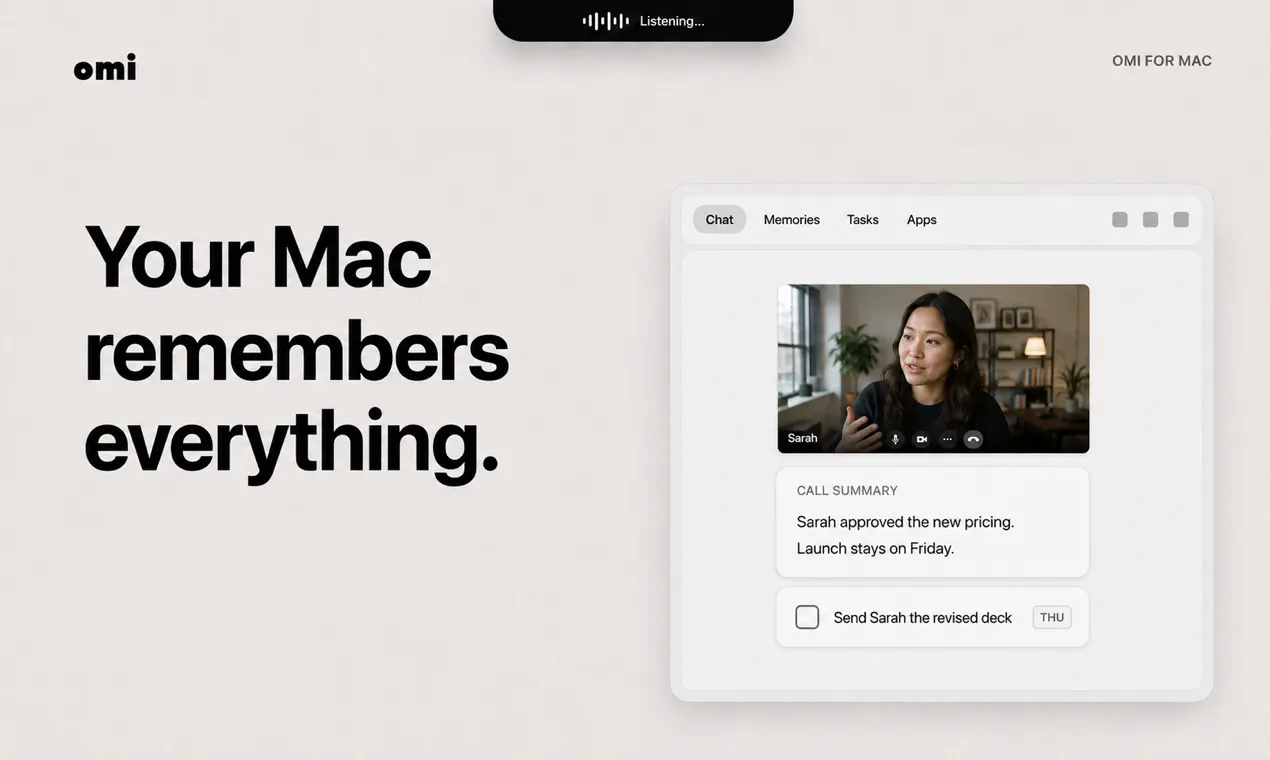
Omi captures your screen and conversations, creates tasks, reminders and advice, helping you find anything you saw or discussed Turn calls into summaries and action items, and ask questions with the context attached. Omi is open source, local and works with your own AI keys, giving you full control over what gets recorded, paused, or deleted.
AI Analysis
Omi is an open-source, privacy-first AI productivity tool that locally captures screen activity and conversations. Core features include auto-generating tasks, reminders, advice, call summaries, action items, and contextual Q&A over captured data. Users retain full control to pause, delete, or manage recordings and use personal AI keys. It solves key pain points like forgetting details from meetings/calls/browsing, poor information recall, and lack of actionable insights from daily interactions. USP is its fully local, open-source nature ensuring data privacy and control. Overall value: acts as a personal AI second brain to boost productivity without cloud dependency.
Favorable for 2025-2026 due to maturing local LLMs (e.g. Ollama/Llama), rising privacy regulations and user concerns over cloud AI data practices, booming AI-powered productivity demand in remote/hybrid work, and economic push for efficient tools. Omi aligns perfectly with the shift toward on-device AI and open-source alternatives amid tech backlash on surveillance. Excellent Timing.
High technical feasibility leveraging mature screen/audio capture, open-source transcription (Whisper), and local LLM integrations. Development/operation costs are low due to its open-source model and on-device processing reducing server needs. Main risks are legal/compliance around recording consent (e.g. wiretap laws by region). Strong scalability on user hardware and good fit for AI-focused teams. High.
Primary segments: tech-savvy knowledge workers, managers, consultants, and professionals in software, business, and creative fields (ages 25-45). Geographic focus: North America, Europe (privacy-sensitive markets). TAM for AI productivity tools ~$100B+ by 2026; SAM for AI memory assistants ~$10B; SOM for local/open-source niche ~$1-2B. Core pains: meeting overload and recall failure. Moderate-to-high willingness to pay for pro features, support, or companion hardware despite base open-source model.
Medium. Direct competitors: Rewind (rewind.ai), Otter.ai (otter.ai), Fireflies.ai (fireflies.ai), Mem (getmem.ai), Limitless (limitless.ai). Advantages: superior privacy via fully local/open-source design, no data sharing, user-controlled AI keys, and screen+audio integration. Disadvantages: potentially higher setup friction for non-technical users, relies on user's AI quota, may lag in polished UI/polish compared to VC-backed cloud competitors. Strong differentiation on privacy but faces execution challenges.
Upgrade Pro to unlock full AI analysis
Similar Products

Cohere Parse 5
Turn complex docs, tables & images into AI-ready data
▲ 158 votes

Opaline
PostHog for team Claude Code and Codex sessions.
▲ 141 votes

Adapt
The company brain that gets work done
▲ 124 votes

Kosshi
Simple, fast outliner for Mac and iPhone.
▲ 90 votes

WikiFix for Confluence
Find and fix issues in your knowledge base
▲ 86 votes

Refoid
Automate App Store refund responses and track every outcome
▲ 68 votes