Open Minis
An on-device AI Agent that runs on your phone, open & secure
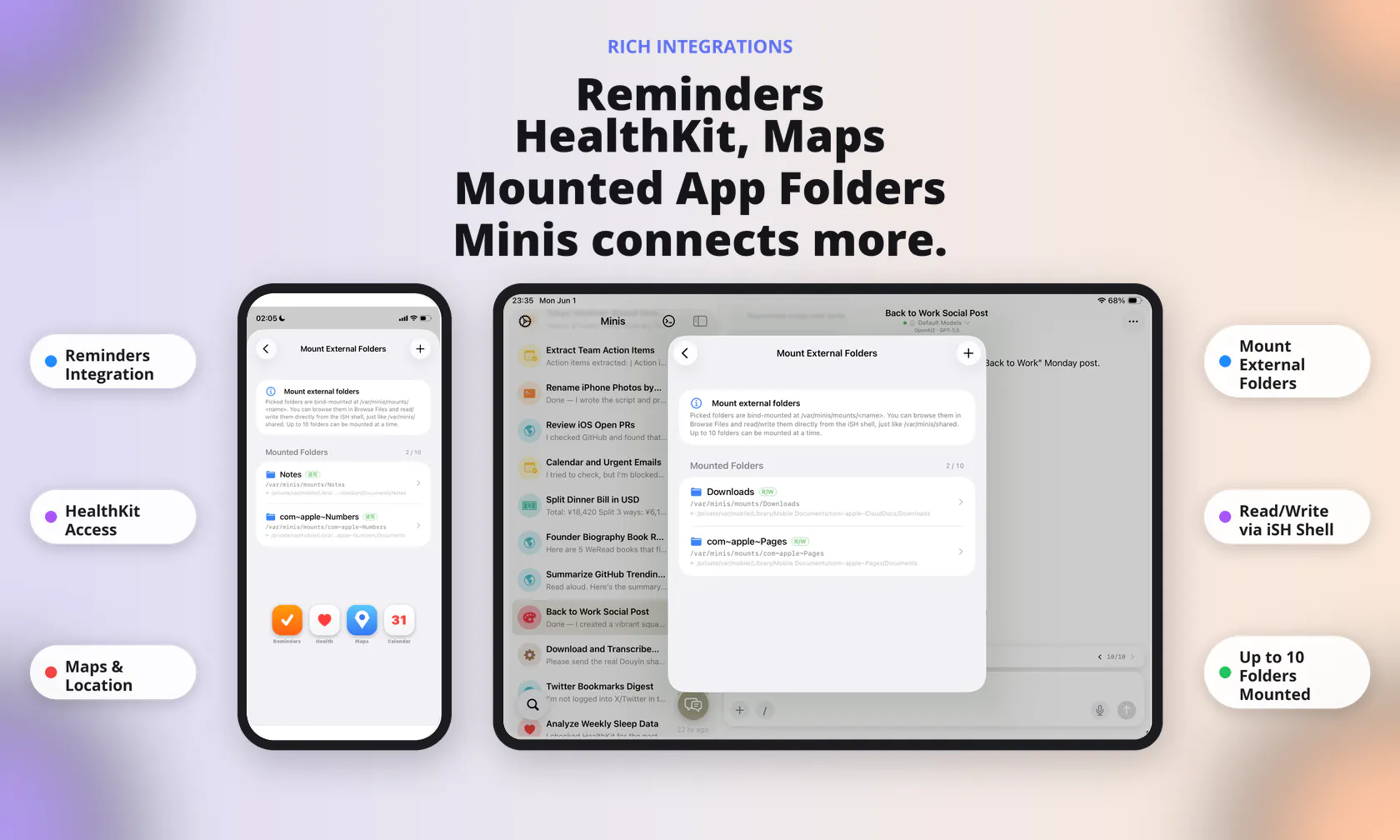
Open Minis is a free, open-source AI agent for iOS and Android that does more than chat — it gives the model a real computer to work with. A sandboxed Alpine Linux shell runs on your device: it installs packages, runs Python, edits real files and drives a browser. Around it, 30+ native bridges reach HealthKit, HomeKit, Calendar, Photos. etc. Bring your own model — Claude, GPT, Gemini, Kimi, Grok, or any OpenAI-compatible endpoint. Keys and data never leave your phone. Free and Open Source.
AI Analysis
Open Minis is a free, open-source on-device AI agent for iOS and Android. Core features include a sandboxed Alpine Linux shell enabling package installation, Python execution, file editing, and browser control, plus 30+ native bridges to device services like HealthKit, HomeKit, Calendar, and Photos. It supports any LLM (Claude, GPT, Gemini, Grok, or OpenAI-compatible endpoints) with all keys and data staying on-device. Unique selling points are its privacy-first design, open-source nature, and transforming passive chat into actionable computing on the phone. It solves key pain points of cloud AI data leaks, limited agent capabilities, and lack of deep device integration. The value proposition is a secure, extensible AI productivity tool that empowers users with real computational agency without compromising privacy.
In 2025-2026, on-device AI is accelerating with maturing small language models, improved mobile hardware for local inference, and rising user demand for privacy amid stricter data regulations (e.g., GDPR expansions). AI agent capabilities are a major trend beyond simple chatbots, aligning with post-ChatGPT expectations for actionable tools. Economic factors favor open-source solutions reducing vendor lock-in. This is a strong match for current demands. Excellent Timing.
High. While technical difficulty is notable (sandboxed Linux on mobile, cross-platform bridges for 30+ native APIs, model integration), the product is already implemented as open-source, keeping development and operation costs moderate via community contributions. No significant supply chain risks as pure software; compliance is favorable due to strong privacy focus. Team fit is ideal for mobile/AI devs, with high scalability through app stores and GitHub. Key risks are performance optimization on varied devices.
Main target segments: tech-savvy developers, AI enthusiasts, and privacy-conscious productivity users (demographics: 20-45 years old, tech professionals/hobbyists). Industries: software development, personal productivity. Geographic: global with concentration in US, Europe, China (GitHub-active regions). Estimated market size: TAM for AI productivity software ~$15B+, SAM for mobile on-device agents ~$1-2B, SOM for open-source privacy tools ~$200M+. Core pain points: AI data privacy risks and inability to perform real device actions. Potential willingness to pay: high for related API usage or premium extensions, though core product is free.
Medium. Direct competitors: 1. Open Interpreter (openinterpreter.com) - code execution agent, mostly desktop/cloud focused. 2. Auto-GPT (github.com/Significant-Gravitas/AutoGPT) - autonomous agents but not mobile/on-device native. 3. AgentGPT (reworkd.ai) - browser-based AI agents. 4. Apple Intelligence (apple.com) - on-device AI with integrations but closed-source. 5. Gemini for Android (google.com/gemini) - mobile AI but limited agent actions and not open. Advantages: superior privacy (true on-device sandbox), open-source customizability, extensive native bridges, free. Disadvantages: potentially steeper learning curve, hardware-dependent performance vs polished commercial alternatives.
Upgrade Pro to unlock full AI analysis
Similar Products

Adapt
The company brain that gets work done
▲ 124 votes

Tapfree for Chrome
Voice dictation that adapts to what’s on your screen
▲ 122 votes

CodeBurn
See where your AI coding spend actually goes
▲ 101 votes

Buddy AI Note
Your daily memo that turns notes into a plan
▲ 94 votes

Kosshi
Simple, fast outliner for Mac and iPhone.
▲ 90 votes

Thoughts for Mac
Capture notes from your menubar using text, images or voice
▲ 90 votes