
Openbase
Manage your team of AI agents by voice, from anywhere
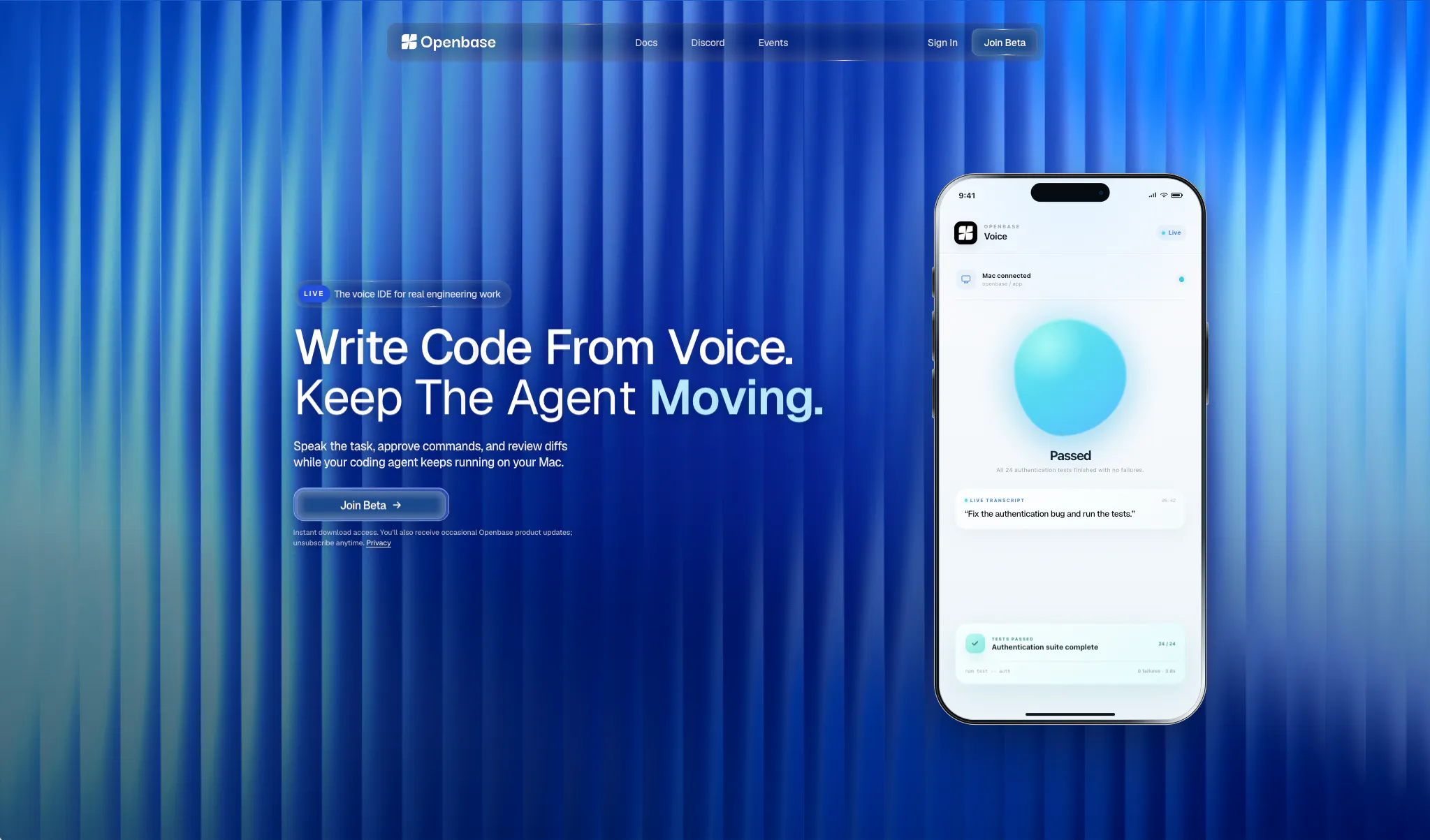
Openbase lets you manage a team of AI coding agents by voice, from anywhere; no screen, no desk. AI agents can work async, but supervising them still pulls you back to a laptop. OpenBase fixes that. Dispatch tasks, steer agents mid-work, and approve changes just by talking. The agents write code, control your computer, open PRs, commit and push; you stay in control from your phone. Works across providers and syncs to your machine, so you pick up at your desk right where you left off.
AI Analysis
Openbase allows users to manage a team of AI coding agents entirely by voice from anywhere, without needing a screen or desk. Core features include dispatching tasks, real-time steering of agents, approving changes, and enabling agents to write code, control computers, open PRs, commit, and push. It addresses the key pain point that while AI agents can work asynchronously, supervising them traditionally requires returning to a laptop. The unique selling point is hands-free voice control via phone that works across AI providers and seamlessly syncs to the user's machine for continuity. Overall value proposition: Empowers developers to stay productive and in control while mobile or away from their workstation.
The timing is favorable as 2025-2026 will see maturing AI coding agents (post-Devon-like tools), advanced voice AI (improved LLMs for context understanding), and rising demand for flexible, remote-first developer workflows. Tech industry trends favor AI productivity tools amid economic pressures for efficiency. No major policy barriers in key markets. Excellent Timing.
Medium feasibility. Technical difficulty is high for accurate voice command interpretation in complex coding contexts, multi-provider integration, secure computer control, and reliable syncing. Development and operation costs are elevated due to AI inference and voice tech. Low supply chain risk but compliance (data privacy) is a concern. Strong scalability potential if core integrations succeed. Key reasons: Leverages existing AI APIs but requires sophisticated orchestration.
Main target users: Software developers, AI engineers, engineering managers, and indie hackers (ages 25-45, tech-savvy). Industries: Software development and tech startups. Geographic: Primarily US, Europe, and global remote workers. Estimated market size: Developer tools TAM ~$15B (2025), SAM for AI coding assistants ~$2B, SOM for voice/agent management ~$300M. Core pain points: Laptop dependency for AI supervision, need for mobility. High willingness to pay for productivity gains via subscription.
Medium. Direct competitors: 1. Cognition Devin (cognition.ai), 2. OpenDevin (github.com/OpenDevin), 3. Aider (aider.chat), 4. GitHub Copilot Workspace (github.com), 5. Replit Agent (replit.com). Advantages: Unique voice-based mobile control without screen, seamless cross-provider sync. Disadvantages: May face challenges in voice accuracy vs. text interfaces; less established brand than GitHub or Cognition; potentially higher complexity in implementation.
Upgrade Pro to unlock full AI analysis
Similar Products

Cohere Parse 5
Turn complex docs, tables & images into AI-ready data
▲ 158 votes

Adapt
The company brain that gets work done
▲ 124 votes

Coarena by Coasty
The arena where agents battle on real-world work
▲ 104 votes

WikiFix for Confluence
Find and fix issues in your knowledge base
▲ 86 votes

Audryo
Customer email your agent can operate.
▲ 68 votes

Refoid
Automate App Store refund responses and track every outcome
▲ 68 votes