
OpenCode Superapp
The power of Codex with local, self-hosted models and voice
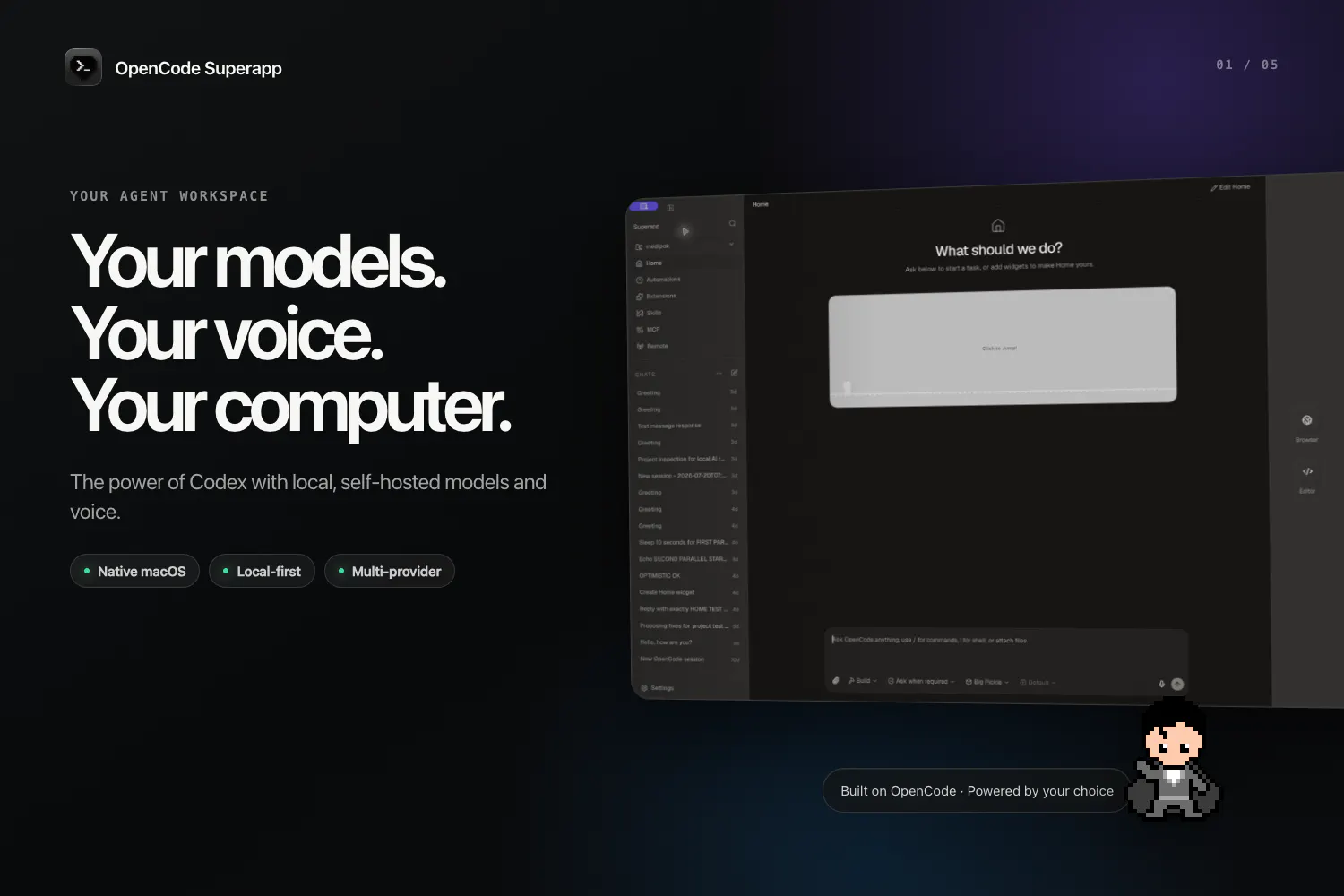
OpenCode Superapp brings the agentic power of Codex to the models and infrastructure you choose. Run cloud, local, or self-hosted models in a native workspace where agents understand your projects, work with files, Git, and terminals, speak with you through voice, and operate Mac apps through supervised Computer Use. Private by design and extensible through skills and MCPs, it gives you capable agents without giving up model choice or control. Built from the ground up with Codex and GPT-5.6.
AI Analysis
OpenCode Superapp delivers agentic AI coding capabilities similar to Codex, but with full user control over cloud, local, or self-hosted models. It features a native workspace for project understanding, file/Git/terminal operations, voice conversations, and supervised Computer Use to control Mac apps. Private by design and extensible via skills and MCPs, it solves key pain points like loss of model choice, privacy risks in cloud-only tools, and poor integration with local dev environments. The value proposition is flexible, powerful AI agents that enhance productivity while maintaining data control and customization, built with advanced models like Codex and GPT-5.6.
In 2025-2026, market timing is favorable as local and open-source LLMs continue to mature (e.g. via Ollama/Llama 3), privacy regulations tighten, and demand grows for agentic dev tools beyond cloud dependencies. User needs for voice-enabled, privacy-first coding agents align with rising AI adoption in software engineering. Economic focus on AI productivity tools supports this. Excellent Timing.
Medium feasibility. Technical challenges are high for seamless multi-model integration, real-time voice, project context awareness, and safe Mac OS computer use. Development and maintenance costs for a native cross-model app are significant. Supply chain risks are low but compliance for data privacy is complex with self-hosting. Strong scalability for local use; requires experienced AI/dev team. Overall achievable but resource-intensive.
Primary users: Software developers, full-stack engineers, AI/ML practitioners, and indie hackers (ages 25-45, tech-savvy). Industries: Software development, tech startups, enterprises with privacy needs. Geographic: Global, concentrated in US, Europe, China tech hubs. TAM for AI coding tools ~$15B by 2026; SAM for agentic/local AI dev ~$3B; SOM for privacy-focused superapps ~$500M. Core pains: Inefficient workflows, cloud data risks, lack of voice/native integration. High willingness to pay ($20-60/mo subscriptions).
Medium. Direct competitors: 1. Cursor (cursor.com), 2. GitHub Copilot (github.com/features/copilot), 3. Continue (continue.dev), 4. Aider (aider.chat), 5. Devin (cognition.ai). Advantages: Superior model flexibility (local/self-hosted), voice interaction, Mac app control, strong privacy focus and extensibility. Disadvantages: Newer entrant with unproven scale, potentially higher setup complexity for local models vs cloud-first rivals, relies on emerging tech like GPT-5.6. Strong differentiation in control and privacy reduces pressure.
Upgrade Pro to unlock full AI analysis
Similar Products

Cohere Parse 5
Turn complex docs, tables & images into AI-ready data
▲ 158 votes

Adapt
The company brain that gets work done
▲ 124 votes

Kosshi
Simple, fast outliner for Mac and iPhone.
▲ 90 votes

WikiFix for Confluence
Find and fix issues in your knowledge base
▲ 86 votes

Audryo
Customer email your agent can operate.
▲ 68 votes

Refoid
Automate App Store refund responses and track every outcome
▲ 68 votes