
OpenHuman
An open source AI harness built with the human in mind
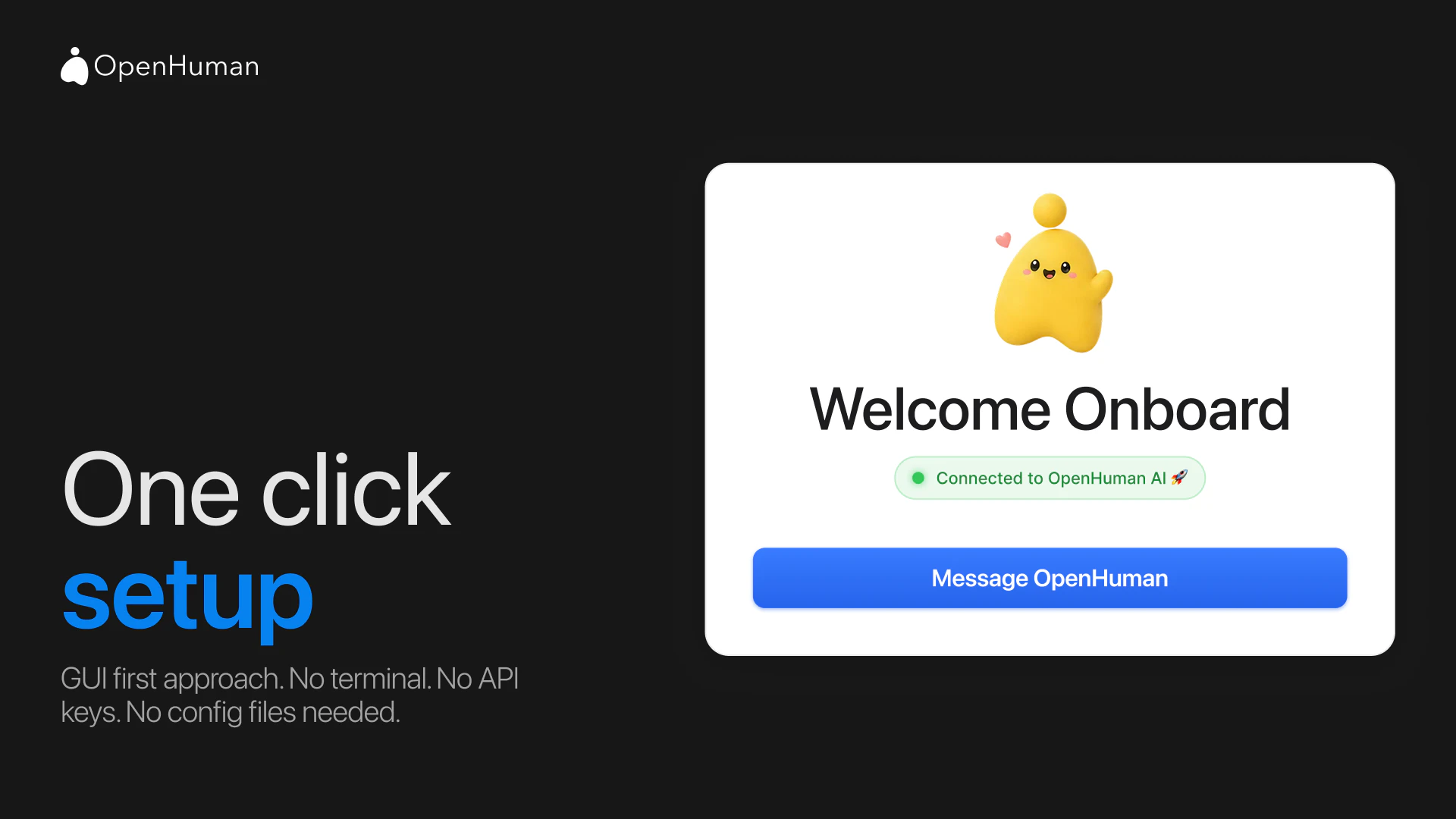
90% of people who try AI agents give up. Three reasons: memory that resets every session, your data sitting in someone else's cloud and a terminal just to get started. Real blockers. OpenHuman fixes all of it. Local-first, privacy-first. It remembers everything about you and actually gets smarter the more you use it. Every feature lives in one simple interface. Fully open source. One-click setup. P.S. The product is in beta, so expect bugs, but we're building and shipping fast.
AI Analysis
OpenHuman is an open-source, local-first AI agent that solves major barriers to AI adoption: session-resetting memory, privacy risks from cloud data storage, and complex terminal interfaces for getting started. It features persistent memory that learns and improves with use, keeps all user data on-device, and delivers everything in one simple, unified interface. With one-click setup and full transparency as open source, it offers a privacy-first, personalized AI harness. The value proposition is making AI truly intelligent about the user, accessible without steep barriers, and secure, enhancing long-term productivity in a beta stage with rapid iterations.
The timing is favorable for 2025-2026 as local AI and on-device processing mature rapidly with models like Llama and frameworks such as Ollama. Rising user demands for privacy amid data scandals, regulatory pushes (e.g., stricter data laws), and AI agent fatigue create strong pull for local-first solutions. The AI productivity boom and open-source momentum align perfectly, though hardware demands for local inference could be a minor limiter. Overall: Excellent Timing.
Feasibility is high. Technical difficulty is moderate by building on mature local LLM tools; one-click setup reduces user barriers. Development costs are lowered by open-source community contributions. No significant supply chain risks; privacy-first design aids compliance. Scalability is strong on a per-user local basis, though beta bugs and hardware variability (for running AI locally) pose challenges. Team fit appears good given rapid shipping focus. Rating: High.
Main targets: Tech-savvy individuals, developers, AI enthusiasts, and privacy-focused professionals (ages 25-45). Industries: software development, productivity, research. Geographic: Global with concentration in US/Europe where open-source and privacy awareness is high. Estimated market: AI agent/productivity tools TAM in tens of billions; SAM for local/open-source AI in several billion; SOM niche portion in hundreds of millions. Core pains: ephemeral AI memory, data privacy fears, setup complexity. Willingness to pay: moderate-to-high for enhanced features, though core is open-source (likely freemium/donation model).
Competition level: Medium. Direct competitors: 1. Open Interpreter (openinterpreter.com), 2. Ollama (ollama.com), 3. AnythingLLM (useanything.com), 4. PrivateGPT (privategpt.io). Advantages: superior persistent memory that 'gets smarter', non-terminal simple UI, strong emphasis on privacy and one-click setup vs. often technical setups. Disadvantages: currently in beta with expected bugs, potentially higher local hardware requirements, less mature ecosystem than established players. Differentiation in human-centric design and full open-source approach is strong but faces pressure from fast-moving open-source AI projects.
Upgrade Pro to unlock full AI analysis
Similar Products

Cohere Parse 5
Turn complex docs, tables & images into AI-ready data
▲ 158 votes

Opaline
PostHog for team Claude Code and Codex sessions.
▲ 141 votes

Adapt
The company brain that gets work done
▲ 124 votes

Kosshi
Simple, fast outliner for Mac and iPhone.
▲ 90 votes

Thoughts for Mac
Capture notes from your menubar using text, images or voice
▲ 90 votes

Refoid
Automate App Store refund responses and track every outcome
▲ 68 votes