
OpenTag
AI coworker lives on Slack and Teams
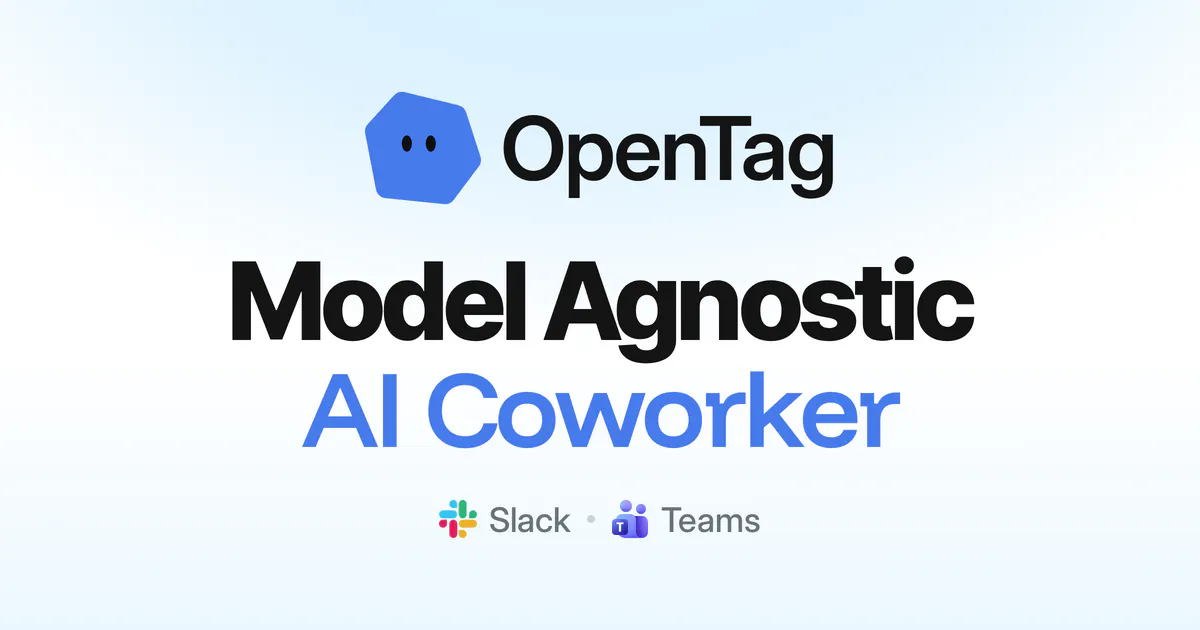
OpenTag is an AI coworker that lives where your team collaborates. It has full context on your company, so it takes actions and real work off your team's plate.
AI Analysis
OpenTag is an AI coworker that integrates directly into Slack and Microsoft Teams, where teams already collaborate. It maintains full context on the company, enabling it to understand nuances, answer queries accurately, and take real actions like automating tasks. It solves key pain points such as repetitive manual work, information fragmentation, slow decision-making, and overburdened employees. The unique selling point is its ability to perform actual work rather than just chat, acting as a proactive team member. Overall value proposition is boosting productivity by offloading routine and contextual work to AI, allowing humans to focus on high-value activities.
The market timing is favorable for 2025-2026 as AI agent technologies are maturing rapidly with better context handling and tool-use capabilities. User demand is shifting towards AI that seamlessly integrates into existing tools like Slack and Teams amid hybrid work trends. Economic pressures push for productivity gains without headcount increases, and supportive AI policies in major markets aid adoption. However, data privacy concerns and integration complexities exist. Overall: Excellent Timing.
Feasibility is High. Technical difficulty is manageable with mature Slack/Teams APIs, LLM integrations, and RAG for company context. Development and operation costs are moderate but ongoing LLM inference can add up. Supply chain is not applicable; compliance risks around data security and privacy (e.g. GDPR) are notable since it handles company data. Scalability is strong via cloud infrastructure. Requires AI-savvy team but aligns well with current tech stack. Key risks: maintaining accurate context without hallucinations.
Main target segments: Tech-savvy teams in startups, SMBs, and enterprises using Slack or Teams; roles include operations, engineering, product, and support staff. Demographics: Professionals aged 25-45 in collaborative industries. Geographic focus: Primarily North America and Europe. Industries: Software, marketing, consulting, and remote-first companies. Estimated market size: Workplace AI and automation TAM is large and expanding rapidly (multi-billion dollar opportunity); SAM for Slack/Teams integrations is significant; SOM depends on capture of AI coworker niche. Core pain points: Task overload and knowledge access delays. Potential willingness to pay: Medium to high for proven ROI via subscription models.
Competition level is High. Direct competitors: 1. Slack AI (slack.com/ai), 2. Microsoft Copilot for Microsoft 365 (microsoft.com/copilot), 3. Moveworks (moveworks.com), 4. Lindy (lindy.ai), 5. Sierra (sierra.ai). Advantages: Deep company-specific context and action-taking focus, lives natively in both Slack and Teams. Disadvantages: Likely higher competition pressure from established players with vast resources, data, and integrations; may lack the brand trust and advanced enterprise features of incumbents; differentiation relies heavily on execution quality of 'full context' which is challenging to maintain.
Upgrade Pro to unlock full AI analysis
Similar Products

Cohere Parse 5
Turn complex docs, tables & images into AI-ready data
▲ 158 votes

Opaline
PostHog for team Claude Code and Codex sessions.
▲ 141 votes

Adapt
The company brain that gets work done
▲ 124 votes

Kosshi
Simple, fast outliner for Mac and iPhone.
▲ 90 votes

WikiFix for Confluence
Find and fix issues in your knowledge base
▲ 86 votes
Refoid
Automate App Store refund responses and track every outcome
▲ 68 votes