
OpenWorker
Local-first desktop agent for everyday work
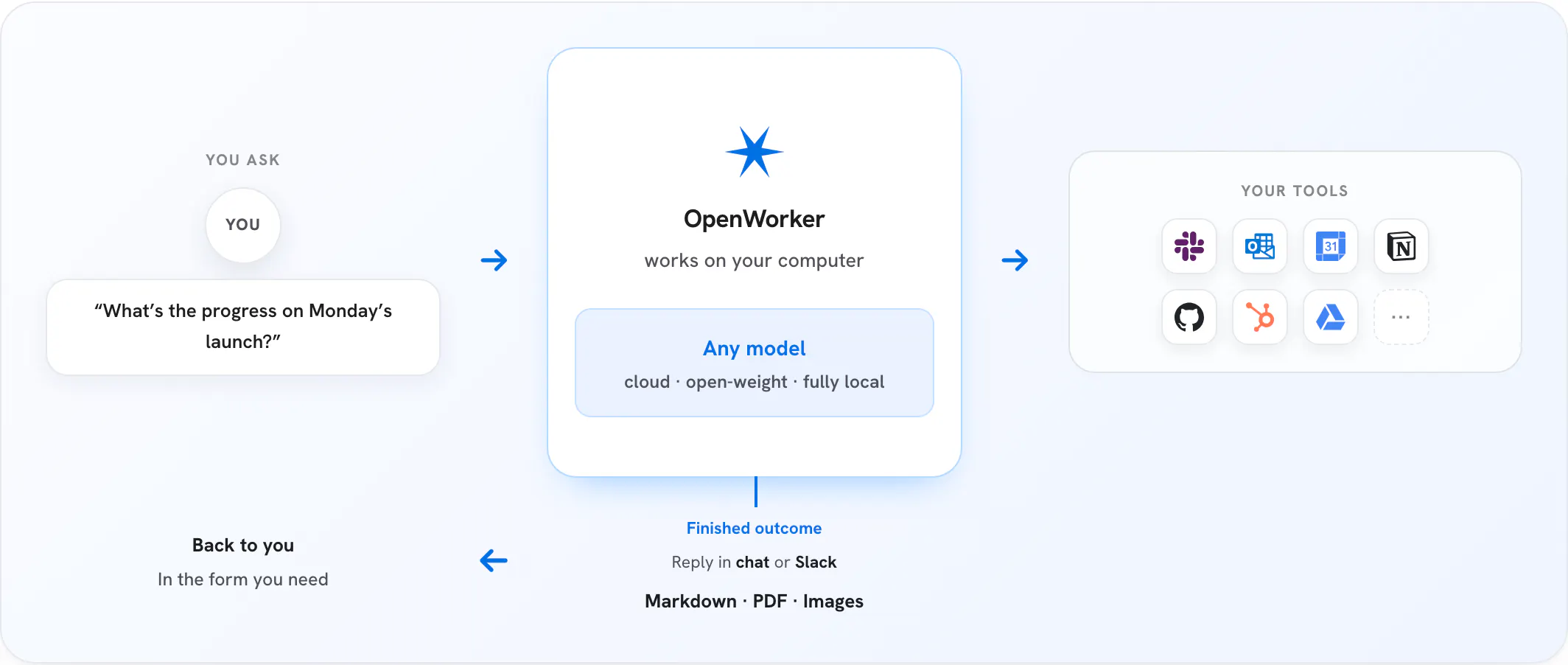
OpenWorker is an AI agent that runs on your own computer, works in your everyday tools, and turns what you ask into finished deliverables — checking in before anything important. Free, open source, bring your own model.
AI Analysis
OpenWorker is a local-first, open-source desktop AI agent that runs on the user's computer, integrates with everyday tools, and transforms natural language requests into completed deliverables while confirming before important actions. Key features include bring-your-own-model support, full privacy with no cloud dependency, and seamless workflow integration. It solves critical pain points like data privacy risks from cloud AI services, ongoing subscription costs, and lack of control over AI behaviors in daily productivity tasks. The value proposition is delivering a free, customizable, and trustworthy AI collaborator that enhances efficiency for tech-savvy users without compromising security or requiring internet access.
The timing is favorable for 2025-2026 as local AI models mature rapidly (e.g. via Ollama and similar), privacy concerns and regulations intensify globally, and demand grows for offline, cost-free productivity agents amid economic pressures on SaaS subscriptions. User shift from cloud-only AI to local-first solutions aligns perfectly with OpenWorker's design. However, broader adoption depends on improving agent reliability. Overall: Excellent Timing.
Feasibility is high. Technical challenges exist in building safe, cross-tool desktop automation and integrating variable user-provided models, but open-source foundations reduce development costs significantly. Operational costs are minimal as it runs locally with no servers required. Low supply chain risk, but compliance with OS-level permissions and scalability relies on community contributions. Team fit is strong for open-source AI developers. Key risks are model hallucination and OS compatibility. Rating: High.
Primary users: Tech professionals, software developers, freelancers, and knowledge workers aged 25-45, concentrated in North America and Europe, active on GitHub. Industries: Software engineering, content creation, general productivity. Estimated TAM for AI productivity agents is $30B+, SAM for local/open-source tools ~$4B, SOM for desktop agents ~$800M. Core pain points include repetitive manual tasks, privacy fears, and tool fragmentation. Willingness to pay is moderate; as a free OSS product, users may contribute via donations, premium models, or enterprise support.
Competition level: Medium. Direct competitors: 1. Open Interpreter (openinterpreter.com), 2. Aider (aider.chat), 3. Cline (cline.bot), 4. Roo Code (roocode.com), 5. Anthropic Claude Computer Use (anthropic.com - cloud). Advantages: Fully local/offline, completely free and open-source, explicit human-in-the-loop confirmation for safety, no vendor lock-in. Disadvantages: Relies on user-supplied models which may underperform vs proprietary ones, potentially less mature UI/integration compared to commercial offerings, smaller marketing reach.
Upgrade Pro to unlock full AI analysis
Similar Products

Cohere Parse 5
Turn complex docs, tables & images into AI-ready data
▲ 158 votes

Opaline
PostHog for team Claude Code and Codex sessions.
▲ 141 votes

Adapt
The company brain that gets work done
▲ 124 votes

Kosshi
Simple, fast outliner for Mac and iPhone.
▲ 90 votes

WikiFix for Confluence
Find and fix issues in your knowledge base
▲ 86 votes

Refoid
Automate App Store refund responses and track every outcome
▲ 68 votes