
Opposable
Computer use for phones to give your AI thumbs
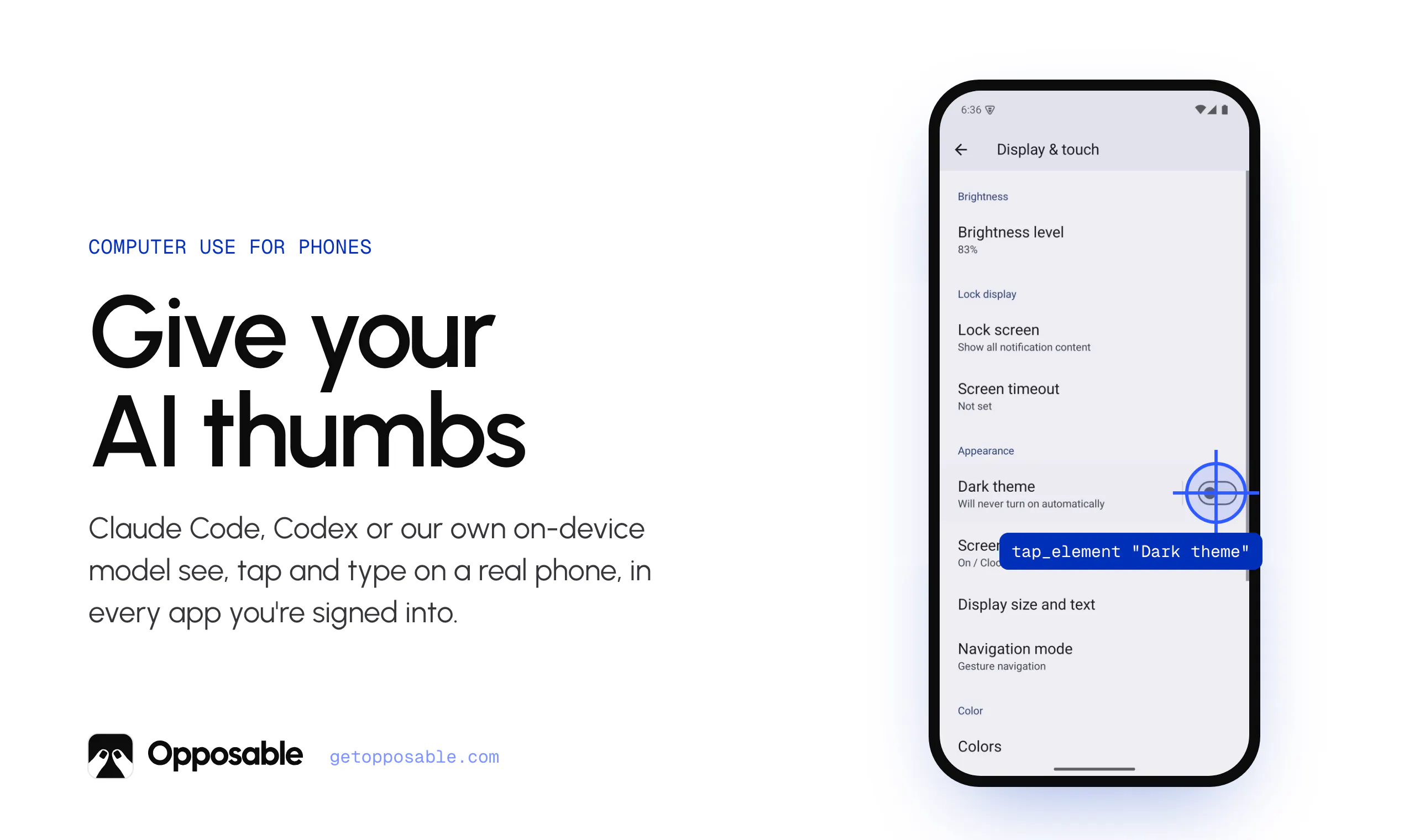
Opposable lets Claude Code, Codex or any MCP agent see, tap and type on a real iPhone or Android phone, in every app you're signed into. Common tasks run on the phone with no model at all, payments wait for your tap, and iPhones work through Bluetooth or a tiny USB stick.
AI Analysis
Opposable enables AI agents like Claude, Codex or any MCP agent to see, tap, and type on real iPhones and Android phones across signed-in apps. Core features include local execution of common tasks without models, user confirmation for payments, and iPhone connectivity via Bluetooth or tiny USB stick. It solves key pain points of AI lacking reliable access to authenticated mobile environments and device-specific interfaces. USP is secure, hardware-based mobile control that combines AI intelligence with human oversight. Value proposition: grants AI 'thumbs' for practical phone usage, enabling automation while preserving security.
In 2025-2026, timing is favorable due to surging adoption of agentic AI and multimodal models (e.g. Claude's computer use). Technology for vision-based interaction has matured while user demand shifts toward mobile automation beyond web. Policy and investment environment strongly support AI tooling innovation. Excellent Timing.
Overall feasibility is Medium. Technical difficulty is notable for real-time vision, cross-platform input simulation and custom iOS hardware (USB stick). Development and operational costs are elevated due to device compatibility and hardware supply chain. Compliance risks exist for iOS integration; scalability is promising for developers once built. No major team-fit data available from sources.
Primary segments: AI developers, automation engineers and tech companies building mobile agents (ages 25-45, tech professionals). Industries: software development and AI. Geographic focus: US, Europe, East Asia. Estimated market size (based on AI dev tools trends): TAM multi-billion, SAM several hundred million for agent interfaces, SOM tens of millions. Pain points: inability of LLMs to securely act within signed-in mobile apps. High willingness to pay for time-saving, reliable tooling.
Low. Direct competitors: 1. Appium (appium.io), 2. Airtest (airtest.netease.com), 3. Detox (detox.dev), 4. Selendroid (selendroid.io). Advantages vs competitors: native LLM integration (Claude etc.) for intelligent decisions, real-device focus with human-in-loop security, simplified iOS setup via USB/Bluetooth. Disadvantages: likely higher cost/latency than pure automation frameworks, newer product with less established ecosystem.
Upgrade Pro to unlock full AI analysis
Similar Products

Cohere Parse 5
Turn complex docs, tables & images into AI-ready data
▲ 158 votes

Adapt
The company brain that gets work done
▲ 124 votes

Orus
Claude for investing in perpetuals
▲ 121 votes

WikiFix for Confluence
Find and fix issues in your knowledge base
▲ 86 votes

Audryo
Customer email your agent can operate.
▲ 68 votes

Refoid
Automate App Store refund responses and track every outcome
▲ 68 votes