
Ota
Contract-first repo-readiness infrastructure
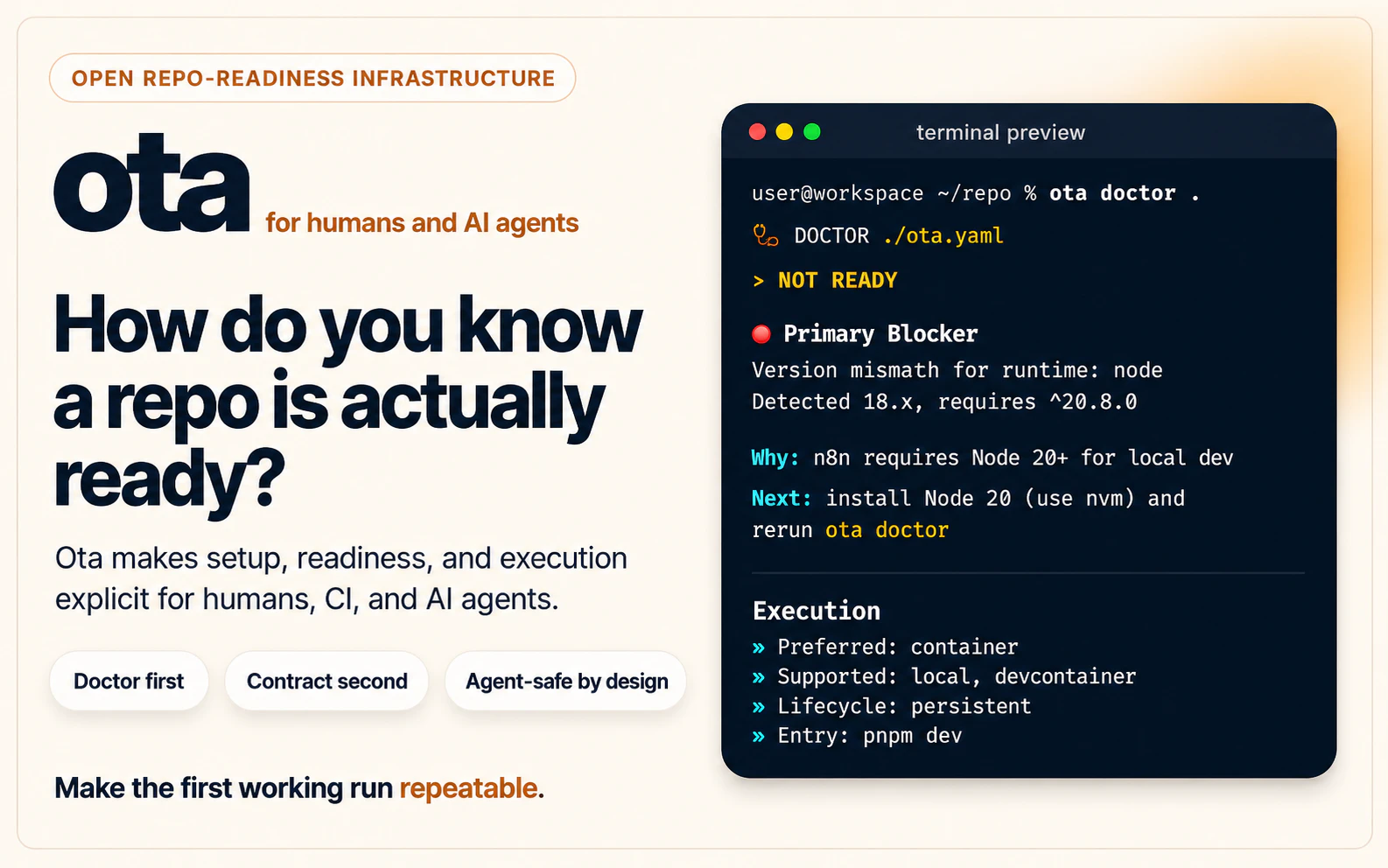
Ota is an open-source CLI for repo readiness. It helps developers understand what a repo needs, why it is not ready, and how to make it runnable reliably. Most repos look complete until you actually try to use them. The real setup and runtime truth is usually scattered across READMEs, scripts, CI config, env files, and tribal knowledge. Ota surfaces what is missing, explains blockers, and helps bring it into a trustworthy, runnable state across local development, CI, and automation.
AI Analysis
Ota is an open-source CLI for repo readiness that analyzes repositories to surface missing setup and runtime components scattered across READMEs, scripts, CI configs, and other sources. It explains specific blockers and guides users to achieve a trustworthy, runnable state for local development, CI, and automation. It directly solves the widespread pain point where repos appear complete but fail during actual use due to incomplete or tribal knowledge. Unique selling point is its contract-first approach that prioritizes verifiable readiness over assumptions. Overall value proposition: saves developers hours of debugging, ensures consistency, and makes open-source and internal repos reliably usable.
In 2025-2026, timing is favorable due to surging AI-assisted development, explosive growth in open-source repositories on GitHub, and increasing demand for reproducible environments amid complex cloud-native and AI workflows. Developer frustration with setup friction continues to rise while tools leveraging LLMs for code understanding mature. Economic push for engineering efficiency supports adoption. Excellent Timing.
Overall feasibility is High. Technical difficulty is moderate: parsing diverse files and interpreting natural language in READMEs is achievable with existing libraries or lightweight AI, with no complex hardware needs. Development and operation costs are low for an open-source CLI. Minimal supply chain or compliance risks. Strong scalability potential via integrations with GitHub Actions and IDEs. Assumes team has strong CLI/devtools experience.
Main target segments: individual software developers, open-source maintainers/contributors, DevOps and platform engineers, primarily ages 25-45, in software/tech, AI/ML, and web development industries. Geographically global with heavy concentration in North America, Europe, and Asia. TAM for developer productivity tools exceeds $15B; SAM for repository and environment setup tools ~$800M; SOM for OSS CLI segment ~$150M. Core pain points: wasted time on unreliable setups and 'it works on my machine' issues. Potential willingness to pay is medium-high for enterprise support, premium features or hosted versions.
Competition level: Medium. Direct competitors: 1. Gitpod (gitpod.io), 2. GitHub Codespaces (github.com/features/codespaces), 3. Dev Containers (containers.dev), 4. repo2docker (jupyter.org/repo2docker), 5. Earthly (earthly.dev). Ota's advantages include focused diagnostic analysis that explains 'why' a repo is unready, contract-first philosophy, and lightweight open-source CLI nature versus heavy cloud IDEs or full build systems. Disadvantages: narrower scope (analysis over full environment provisioning), newer entrant with less brand recognition, and potential overlap in dev environment tooling space.
Upgrade Pro to unlock full AI analysis
Similar Products

Auriko
Trading desk for LLM calls
▲ 332 votes

Opaline
PostHog for team Claude Code and Codex sessions.
▲ 141 votes

React UI Kit V7
All the chat components you need. None of the complexity
▲ 115 votes

Replay QA Security Scan
Automated Penetration Testing for AI-Built Apps
▲ 102 votes

CodeBurn
See where your AI coding spend actually goes
▲ 101 votes

Refoid
Automate App Store refund responses and track every outcome
▲ 68 votes