
Paint the Cameras Dead
Postcards for pushing back against surveillance.
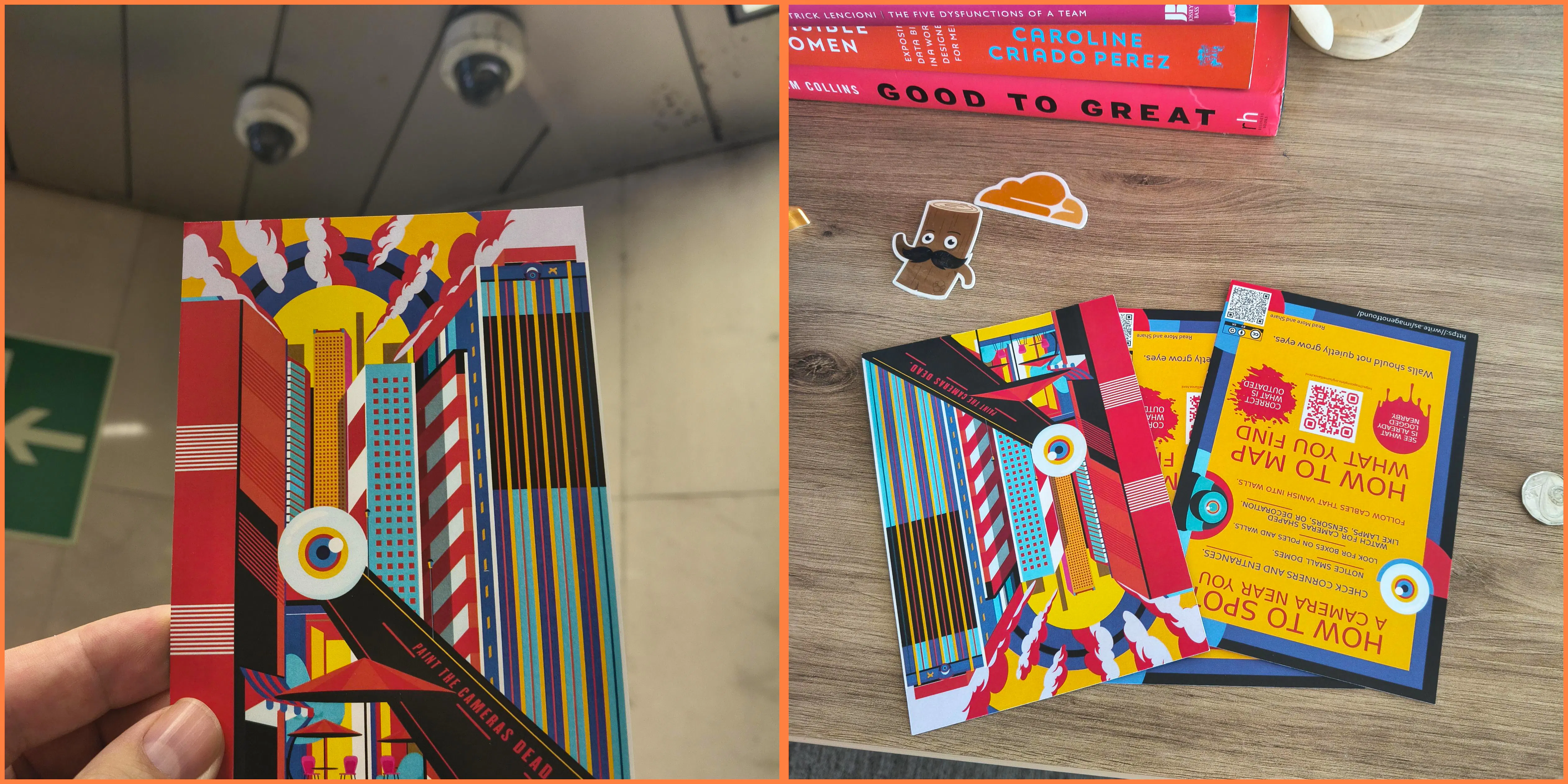
Not every project needs an app, an AI model or another screen. Paint the Cameras Dead is a physical set of postcards made for the street, not the cloud. Each card helps you notice surveillance cameras hiding in plain sight, ask who controls them and map what you find. Print them, share them, leave them in cafés, libraries or community spaces, and use them today. No download, no account, no update cycle. Just paper, attention and a small act of resistance.
AI Analysis
Paint the Cameras Dead is a physical set of postcards for resisting surveillance. Core features include printable cards that help users spot hidden cameras, question who controls them, and map their locations. It is designed for real-world distribution in cafes, libraries, and streets. Unique selling points are its purely analog, screen-free nature with no apps, accounts, or updates required. It solves user pain points of pervasive but unnoticed surveillance, feelings of helplessness, and digital fatigue by enabling simple, tangible acts of awareness and resistance. The value proposition lies in fostering attention, community engagement, and offline pushback using paper as a tool for privacy and survival.
In 2025-2026, rising AI-powered surveillance, smart city deployments, facial recognition proliferation, and heightened global privacy regulations (e.g., expanding GDPR-like rules) align well with growing public awareness and fatigue from digital tracking. While most privacy solutions are app-based, this analog approach benefits from trends in digital minimalism, tangible activism, and offline resistance. It is a favorable window before potential crackdowns on physical protest tools. Rating: Excellent Timing.
High. Technical difficulty is minimal as it involves graphic design and printing only. Development and operation costs are very low with no servers, apps, or ongoing tech maintenance. Supply chain is simple (printing services), compliance risks are low (promotes legal awareness, not vandalism), and it scales easily via digital downloads of designs. No complex team expertise needed beyond creative skills. Key risks are limited mainly to distribution reach.
Primary segments: Privacy advocates, urban activists, artists, educators, and civil liberties supporters aged 25-45; concentrated in high-surveillance cities in the US, Europe, and UK. Industries include tech workers, NGOs, and academic communities focused on surveillance studies. TAM for broader privacy tools exceeds $10B, but SAM for physical/activism products is ~$100M; SOM for this niche is likely under $5M annually. Core pain points: constant unseen monitoring and lack of agency. Willingness to pay is moderate (for printed kits, downloads, or donations) as many may self-print.
Low. Direct competitors: 1. EFF Surveillance Self-Defense (ssd.eff.org), 2. Privacy International toolkits (privacyinternational.org), 3. Adam Harvey's CV Dazzle/Stealth Wear projects (ahprojects.com), 4. Various CCTV mapping zines or apps like iSeeYou. Advantages: Fully physical and artistic format encourages immediate real-world action without tech barriers; highly differentiated as 'no app needed'. Disadvantages: Lower scalability and reach than digital platforms; depends on users' willingness to print and engage offline. Strong in niche differentiation with minimal direct overlap.
Upgrade Pro to unlock full AI analysis
Similar Products

Oasis Browser for Mac
A privacy-first AI browser you can train anonymously
▲ 211 votes

FileFlan
Instant private universal file sharing
▲ 100 votes
Whiteout
Auto-redact sensitive info from Mac screenshots
▲ 83 votes

Netfox
A native local macOS network monitor
▲ 82 votes

FaveNest
Bookmarks that organize themselves with Apple Intelligence
▲ 70 votes

Lastbox
Put your AI to work on physical junk mail
▲ 55 votes