PixelForge
Turn photos into game assets
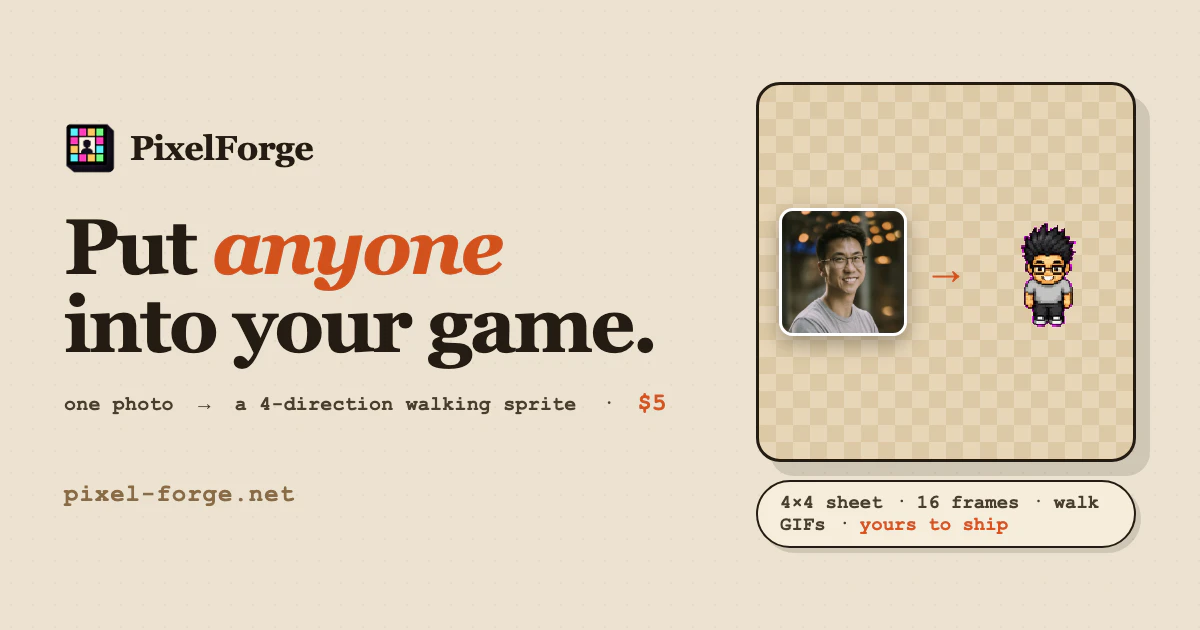
Turn one photo into a recognizable RPG character that actually walks - a 4-direction sprite pack (4x4 sheet, 16 transparent PNG frames, walk GIFs) ready for Godot, Unity, or the web. One-time $5. No account, no subscription. Generated by AI, finished by code.
AI Analysis
PixelForge is an AI-powered tool that converts one user photo into a recognizable RPG character sprite pack, delivering a 4x4 sprite sheet (16 transparent PNG frames), walking animations, and GIFs ready for Godot, Unity, or web use. Core USPs include one-time $5 pricing, no account or subscription, and AI generation refined by code for quality output. It solves key pain points for users lacking artistic skills, time, or budget to create custom animated game assets manually. The value proposition is fast, affordable, and accessible high-quality assets that accelerate indie game development.
In 2025-2026, timing is favorable due to mature generative AI for image-to-asset conversion, surging indie game dev with accessible engines like Godot/Unity, and rising demand for low-cost, rapid asset tools amid economic efficiency focus. No major regulatory hurdles for such AI tools yet. Excellent Timing.
Technical difficulty is medium-high, relying on fine-tuned AI models plus custom code for consistent 4-dir animations and sprite formatting. Development costs are manageable for a web-based tool; inference/operation costs could rise with volume at $5 one-time price. Low supply chain or compliance risks. Strong scalability via cloud. Overall High with proven execution.
Main segments: indie/solo game developers, hobbyists and designers (ages 18-40, tech-savvy, male-skewed), globally distributed with strong presence in North America, Europe, and Asia (e.g., Unity/Godot communities, itch.io). TAM for game asset tools exceeds $1B, SAM for AI-powered ~$200M, SOM for this niche ~$10-20M. Core pains: time/skill barriers to asset creation. High willingness to pay $5 for instant utility.
Medium. Direct competitors: 1. Leonardo.ai (leonardo.ai), 2. Scenario (scenario.com), 3. Unity Muse (unity.com/products/muse), 4. Krea.ai (krea.ai), 5. Luma AI (lumalabs.ai). Advantages: specialized photo-to-walking-sprite output, ultra-low one-time $5 price, zero account friction, code-refined consistency. Disadvantages: likely fewer customization/editing features and less brand recognition than established platforms; quality may vary based on input photo.
Upgrade Pro to unlock full AI analysis
Similar Products
Cohere Parse 5
Turn complex docs, tables & images into AI-ready data
▲ 158 votes

Opaline
PostHog for team Claude Code and Codex sessions.
▲ 141 votes

Adapt
The company brain that gets work done
▲ 124 votes

Tapfree for Chrome
Voice dictation that adapts to what’s on your screen
▲ 122 votes

CodeBurn
See where your AI coding spend actually goes
▲ 101 votes

WikiFix for Confluence
Find and fix issues in your knowledge base
▲ 86 votes