Product Analytics for Agents and Users
Optimize Agent Actions with User Behavior.
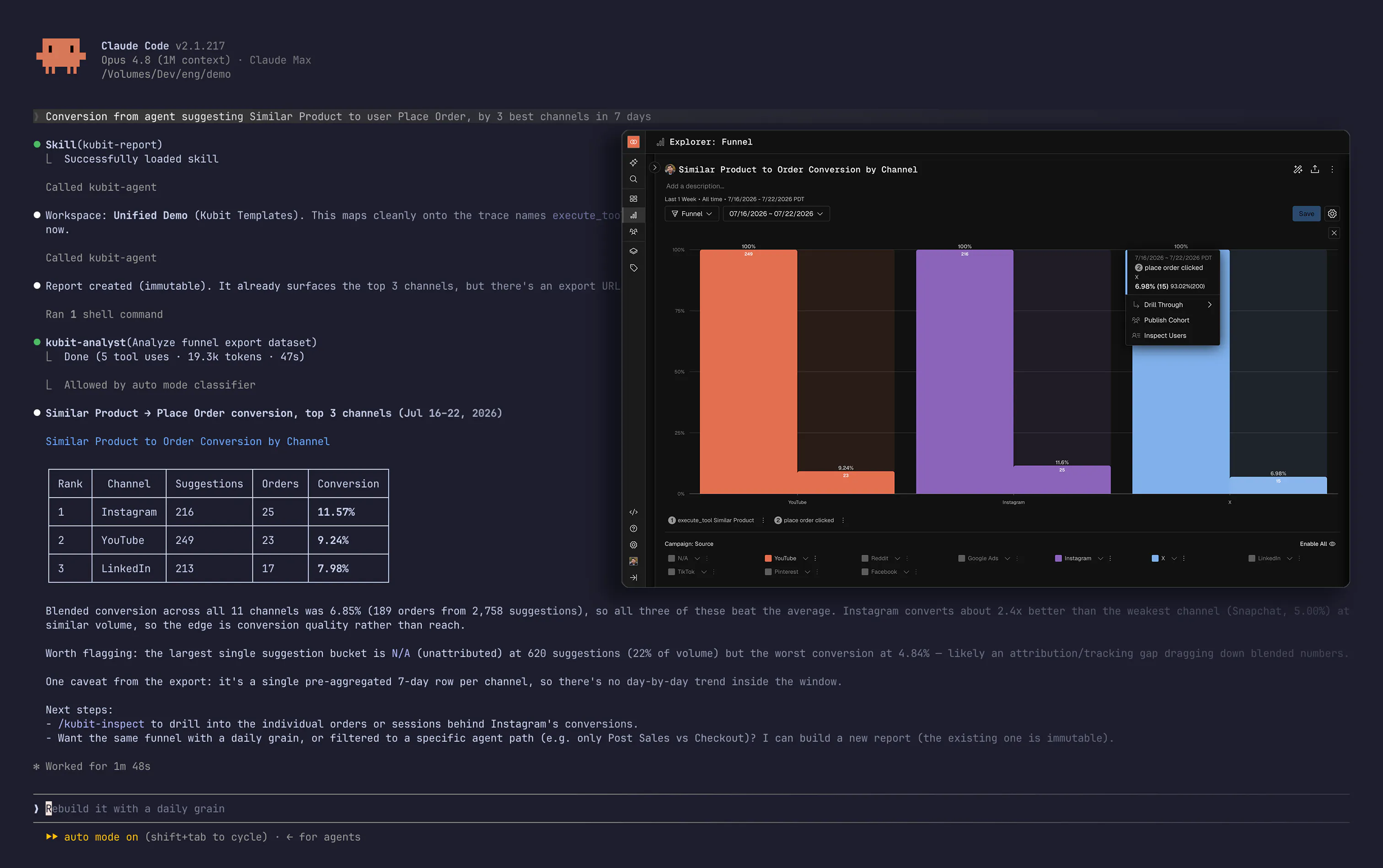
Kubit helps product engineers optimize AI agents with user behavior. Connect agent traces directly to user activities to see exactly why users re-prompt, drop off, or convert. Then, feed those insights straight into your coding agent to build AI products that actually stick. Start instantly with seamless integrations via OTel, your CDP, or Bring Your Own Warehouse (BYOW).
AI Analysis
Kubit is a product analytics platform for AI agents that connects agent traces directly to user behavior data. Core features include visualizing why users re-prompt, drop off, or convert, and feeding these insights into coding agents for automated improvements. It solves the key pain point of disconnected observability between AI actions and real user activities, enabling product engineers to build more engaging and sticky AI products. Unique integrations via OTel, CDP, or Bring Your Own Warehouse (BYOW) allow instant setup without heavy lifting. The value proposition is bridging user behavior with agent optimization to create AI experiences that retain users effectively.
The market timing is favorable for 2025-2026 as AI agents are transitioning from experimental to production use, with rising demand for optimization tools amid maturing LLM and observability tech (e.g., OTel standards). User expectations for reliable AI experiences are increasing, supported by strong investment in AI infrastructure. Economic environment favors productivity tools that improve retention. This is Excellent Timing because the industry is shifting focus from building agents to making them effective based on user data.
Overall feasibility is High. Technical difficulty is moderate as it leverages mature standards like OTel for trace collection and existing data warehouses. Development and operation costs are typical for SaaS analytics platforms. Low supply chain risk since it's software-only; compliance risks around data privacy (e.g., GDPR) exist but are manageable with standard practices. Strong scalability potential in cloud environments and good fit for teams with AI/observability expertise.
Main target users are product engineers, AI developers, and technical PMs at AI-first companies and SaaS firms building conversational agents (demographics: tech professionals aged 25-40). Industries: Artificial Intelligence, software/SaaS, consumer apps. Geographic: Primarily US and Europe-based startups and enterprises. TAM for AI observability/monitoring is estimated in the $1B+ range by 2026; SAM for agent-specific analytics ~$300M; SOM for early adopters ~$50M. Core pain points: unclear reasons for user disengagement with AI. High willingness to pay for tools improving product metrics (subscription pricing implied).
Medium. Direct competitors: 1. LangSmith (smith.langchain.com), 2. Helicone (helicone.ai), 3. Arize Phoenix (arize.com/phoenix), 4. Traceloop (traceloop.com), 5. Honeycomb.io (for observability). Kubit's advantages: unique focus on linking agent traces to end-user behavior for conversion insights and direct feedback loop to coding agents; flexible BYOW integration. Disadvantages: potentially less mature feature set than established LLM monitoring tools; newer market entrant may face challenges in brand awareness and ecosystem breadth compared to LangSmith's deep LangChain integration. Differentiation in user-behavior correlation is strong.
Upgrade Pro to unlock full AI analysis
Similar Products

Cohere Parse 5
Turn complex docs, tables & images into AI-ready data
▲ 158 votes

Opaline
PostHog for team Claude Code and Codex sessions.
▲ 141 votes

Adapt
The company brain that gets work done
▲ 124 votes

Tapfree for Chrome
Voice dictation that adapts to what’s on your screen
▲ 122 votes

Coarena by Coasty
The arena where agents battle on real-world work
▲ 104 votes

CodeBurn
See where your AI coding spend actually goes
▲ 101 votes