
Progress AI Observability
Trace, evaluate, and improve AI agents in production
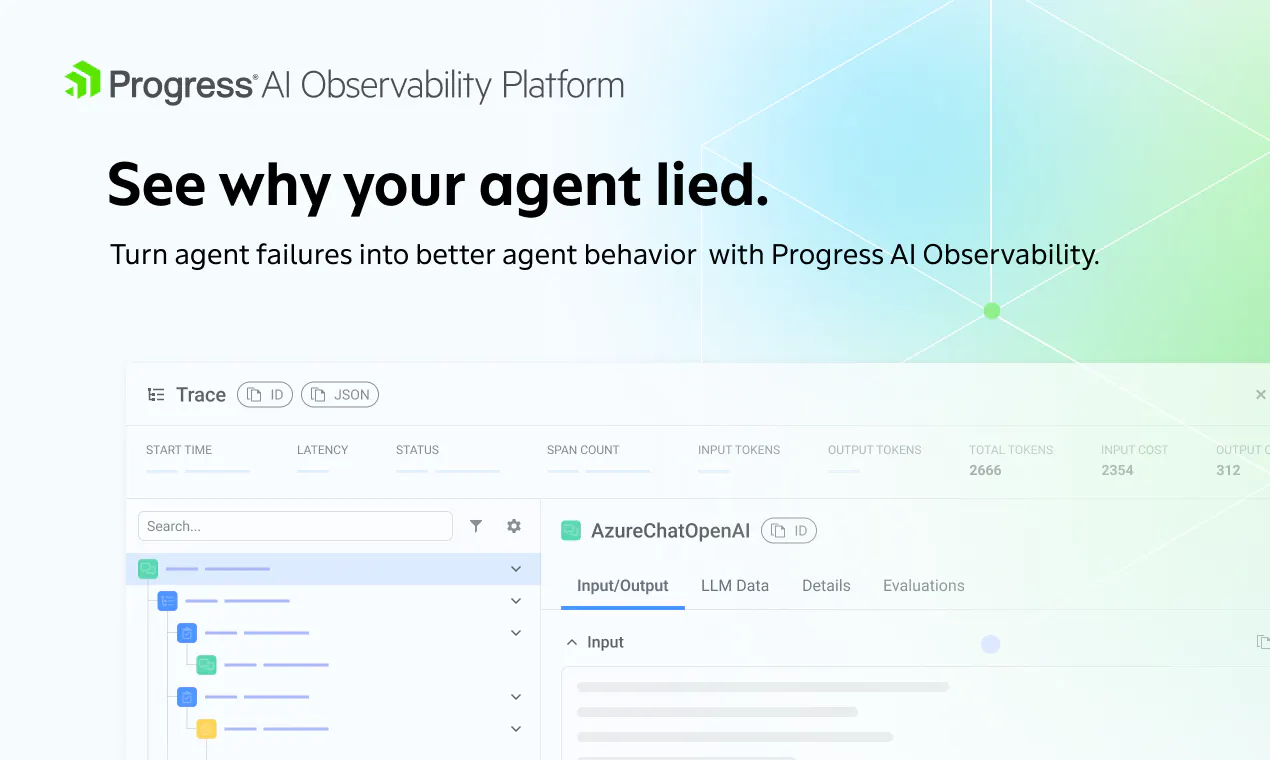
Debug and monitor AI agent failures in minutes. Trace every run, catch hallucinations and ungrounded answers that traditional monitoring misses, and see exactly what went wrong. Reduce token waste, improve agent quality, and ship faster with support forNET, Python, and JavaScript.
AI Analysis
Progress AI Observability is a SaaS platform for tracing, evaluating, and improving AI agents in production. Core features include rapid debugging of agent failures, full run tracing, detection of hallucinations and ungrounded responses missed by traditional tools, token waste reduction, and SDK support for .NET, Python, and JavaScript. It solves key pain points such as opaque AI decision-making, unreliable outputs in live environments, high operational costs, and slow iteration cycles. The value proposition is enabling developers to ship higher-quality AI agents faster with production-grade visibility and optimization.
The 2025-2026 period is highly favorable as AI agents transition from experimentation to widespread production deployment. Industry trends emphasize reliable, observable AI systems amid growing regulatory scrutiny on AI safety and accuracy. Technology for distributed tracing is mature, user demand for specialized AI monitoring is surging, and economic pressures favor tools that cut token costs. This aligns perfectly with the boom in autonomous AI applications. Excellent Timing.
Technically feasible leveraging established tracing standards and multi-language SDKs, though building robust hallucination detection requires ongoing AI expertise. Development and operational costs are moderate for a SaaS observability tool (primarily cloud infrastructure). Low supply chain and compliance risks in standard data privacy regimes. Strong scalability potential via cloud-native architecture. Overall rating: High, supported by proven patterns in the APM and LLMOps space.
Primary users are AI/ML engineers, software developers, and technical teams building production AI agents, primarily in tech, fintech, healthcare, and enterprise software industries. Geographically concentrated in North America and Europe with global reach. Estimated TAM for AI observability and LLMOps tools exceeds $4B by 2026; SAM for agent-specific monitoring around $1B; SOM for early adopters ~$150M. Core pain points include debugging non-deterministic AI behavior and controlling costs. High willingness to pay for tools that prevent failures in customer-facing applications (subscription pricing typical).
High. Direct competitors: 1. LangSmith (smith.langchain.com), 2. Helicone (helicone.ai), 3. Arize Phoenix (arize.com/phoenix), 4. TruLens (trulens.org), 5. Honeycomb.ai (for AI tracing). Advantages: specialized hallucination/ungrounded answer detection, strong multi-language support including .NET (often missing in competitors), and focus on rapid failure debugging. Disadvantages: likely smaller ecosystem of integrations and brand recognition compared to LangSmith; may require more competitive pricing to gain traction.
Upgrade Pro to unlock full AI analysis
Similar Products

Auriko
Trading desk for LLM calls
▲ 332 votes

Cohere Parse 5
Turn complex docs, tables & images into AI-ready data
▲ 158 votes

Adapt
The company brain that gets work done
▲ 124 votes

Tapfree for Chrome
Voice dictation that adapts to what’s on your screen
▲ 122 votes

CodeBurn
See where your AI coding spend actually goes
▲ 101 votes

Saldor
Speed up procurement and AP.
▲ 78 votes