
Pushary
Approve AI requests from your lock screen
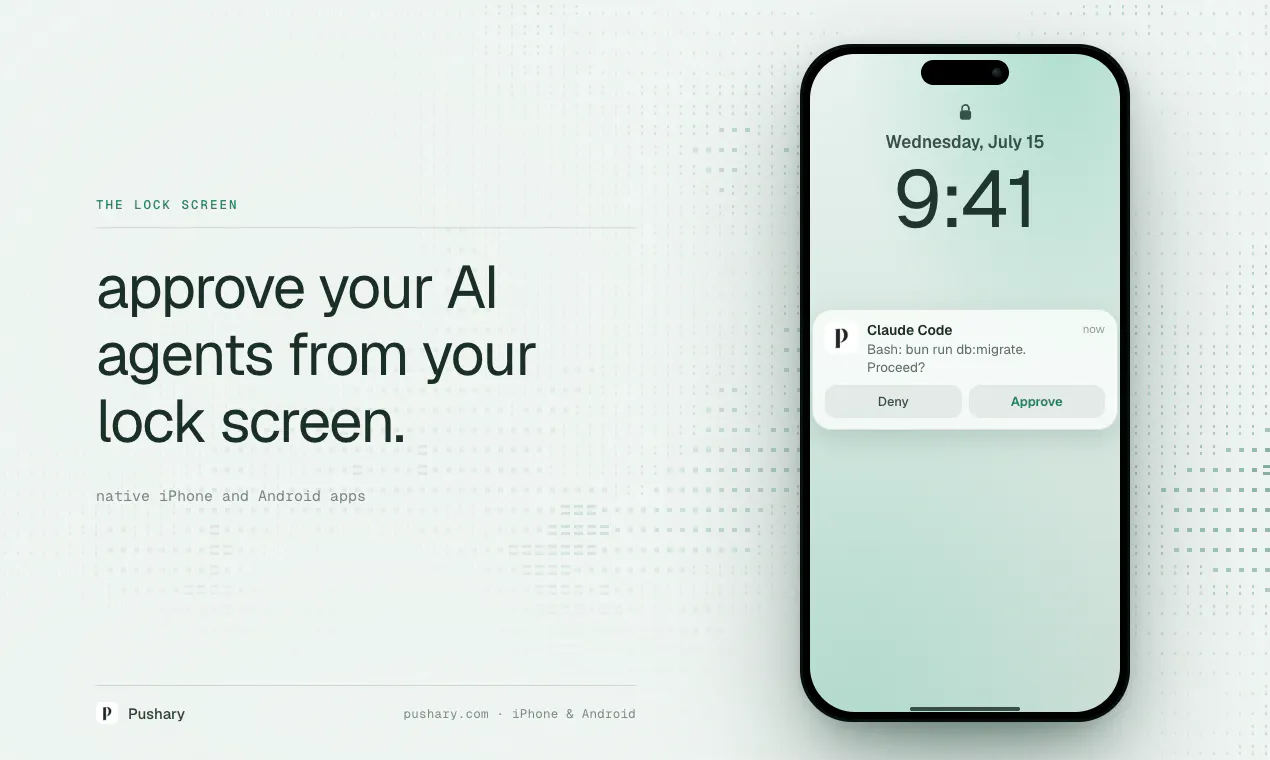
One command connects your AI agents to your lock screen. When Claude Code, Codex, Cursor, Gemini CLI, Hermes, or Claude Cowork stops to ask, you tap yes from your phone and the run keeps moving. New in this launch: native iPhone and Android apps. Pairing is a QR code you scan from the terminal, no key to paste. Per-tool policies auto-approve the safe reads. Every decision lands in an audit trail.
AI Analysis
Pushary enables approving AI agent requests directly from your phone's lock screen. One command connects tools like Claude Code, Cursor, Gemini CLI, Hermes to native iPhone/Android apps via simple QR code pairing. It offers per-tool policies to auto-approve safe reads, maintains a full audit trail of decisions, and keeps AI workflows uninterrupted. It solves key pain points of disruptive permission prompts that break developer focus and momentum during long AI tasks. The value proposition is seamless, secure human-in-the-loop oversight that boosts productivity for AI-assisted development.
In 2025-2026, AI agents and CLI tools are seeing explosive growth with rising adoption of autonomous coding assistants. User demand for frictionless human oversight is increasing as security and control concerns grow alongside AI capabilities. Notification and mobile tech are mature, supporting easy integration. Economic focus on developer productivity adds tailwinds. This aligns perfectly with the trend toward practical AI workflow enhancements. Excellent Timing.
Technical difficulty is moderate: requires secure CLI-mobile integration, app development, and compatibility with multiple AI tools, but launched native apps demonstrate viability. Dev/ops costs are reasonable for a SaaS tool with backend for audits. Low supply chain risk; privacy compliance for audit data is key but standard. Strong scalability via notifications infrastructure. Fits teams with mobile and developer tool experience. Overall: High.
Main segments: Software developers, AI engineers, and technical users of tools like Cursor/Claude (ages 25-45, tech-savvy). Industries: Software engineering, AI development firms. Geographic: Primarily North America, Europe, and East Asia tech hubs. TAM for AI dev tools exceeds $10B with high growth; SAM for workflow/approval utilities ~$500M; SOM for this solution ~$20-50M. Core pains: Workflow interruptions from AI permission requests. High willingness to pay via likely freemium/subscription for productivity gains.
Low. Direct competitors: 1. Open Interpreter (openinterpreter.com), 2. Aider (aider.chat), 3. Cline (cline.bot), 4. Continue.dev (continue.dev), 5. Replit Agent. This product differentiates with lock screen approvals, QR-based zero-config pairing, broad multi-tool policies, and dedicated audit trails. Advantages: Superior mobile convenience and low-friction UX. Disadvantages: Newer player may face integration maintenance challenges and lacks the deep embedding some competitors have within specific IDEs.
Upgrade Pro to unlock full AI analysis
Similar Products

Cohere Parse 5
Turn complex docs, tables & images into AI-ready data
▲ 158 votes

Adapt
The company brain that gets work done
▲ 124 votes

Kosshi
Simple, fast outliner for Mac and iPhone.
▲ 90 votes

WikiFix for Confluence
Find and fix issues in your knowledge base
▲ 86 votes

Audryo
Customer email your agent can operate.
▲ 68 votes

Refoid
Automate App Store refund responses and track every outcome
▲ 68 votes