
QApilot MCP for Android
Android app testing inside your coding agent
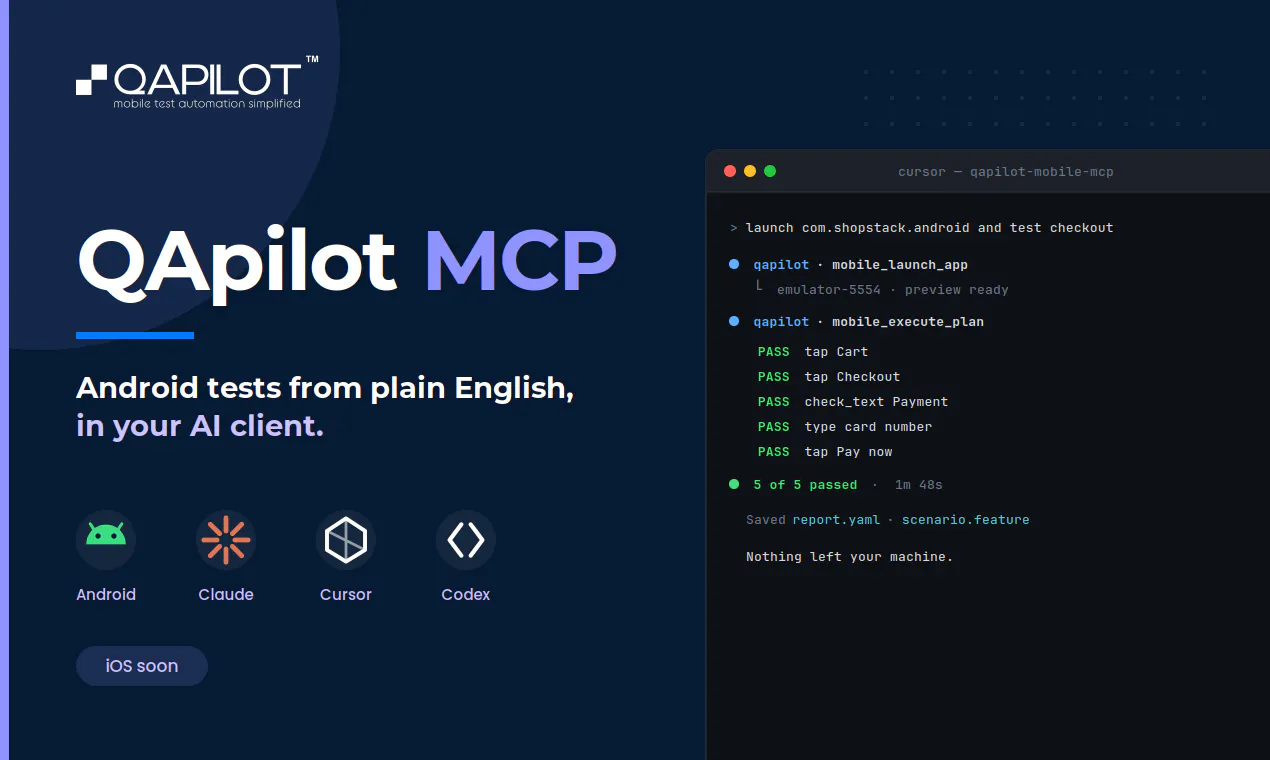
QApilot MCP automates tests on real Android devices and emulators by talking to Claude, Cursor or Codex. Describe a test flow in plain English, no Appium code required. Your agent lays out the steps. QApilot runs the steps. It finds the elements, waits for the screen to settle, retries when something moves, and caches what it learns so repeat runs are faster. Every pass saves a Gherkin feature file and becomes a replayable test case. Needs Node, Java and the Android SDK.
AI Analysis
QApilot MCP for Android is a tool that automates Android app testing through natural language instructions. It integrates with AI models like Claude, Cursor, or Codex, allowing users to describe test scenarios in plain English without writing Appium code. The system executes tests on real devices and emulators, manages element location, screen stabilization, retries, and caches learnings for faster subsequent runs. Each test generates a Gherkin feature file for reusability. It solves the pain of manual test script creation and maintenance in mobile development, offering an efficient, AI-driven value proposition for seamless testing within coding agents. Requires Node, Java, and Android SDK.
The market timing is favorable as we enter 2025-2026 with surging interest in AI agents and autonomous coding tools. Technology for LLM-based automation has matured sufficiently, user demand for reducing boilerplate in testing is high amid developer shortages, and the economic environment favors productivity-enhancing SaaS tools. Excellent Timing.
Feasibility is High. Technical difficulty is manageable by building on established Android testing frameworks and AI APIs, though achieving reliable vision-based interaction can be challenging. Development and operation costs are primarily related to AI inference and server infrastructure. Low supply chain risks, but compliance with Android policies and data security is needed. Good scalability as usage grows. Fits teams with AI and mobile dev expertise. Main reasons: Proven components exist, though integration complexity is non-trivial.
Target users are Android developers, QA testers, and indie hackers using AI coding assistants, primarily in the software engineering sector. Demographics: 25-45 years old, tech-savvy professionals. Industries: Mobile app development, fintech, gaming. Geographic distribution: Predominantly North America and Europe. TAM for AI dev tools is estimated at $10B+, SAM for mobile testing AI around $500M, SOM $20-50M. Pain points: Cumbersome test automation setup and flaky tests. Willingness to pay is high for tools that save significant time, likely via subscription.
Competition level: Medium. Direct competitors: 1. Appium (https://appium.io) 2. Kobiton (https://kobiton.com) 3. Sauce Labs (https://saucelabs.com) 4. Testim (https://www.testim.io/) 5. mabl (https://www.mabl.com/). Advantages: No-code plain English test description, tight integration with Claude/Cursor, auto Gherkin export and learning cache. Disadvantages: Dependency on local environment setup, potentially higher flakiness from AI, limited to Android currently vs cross-platform competitors. Strong differentiation in AI agent compatibility but needs to prove reliability against established players.
Upgrade Pro to unlock full AI analysis
Similar Products

Lev8
Find, research, and reach the right people
▲ 451 votes

Auriko
Trading desk for LLM calls
▲ 332 votes

Cohere Parse 5
Turn complex docs, tables & images into AI-ready data
▲ 158 votes

Adapt
The company brain that gets work done
▲ 124 votes

Tapfree for Chrome
Voice dictation that adapts to what’s on your screen
▲ 122 votes

CodeBurn
See where your AI coding spend actually goes
▲ 101 votes