
Radiq
Product intelligence for the autonomous coding era
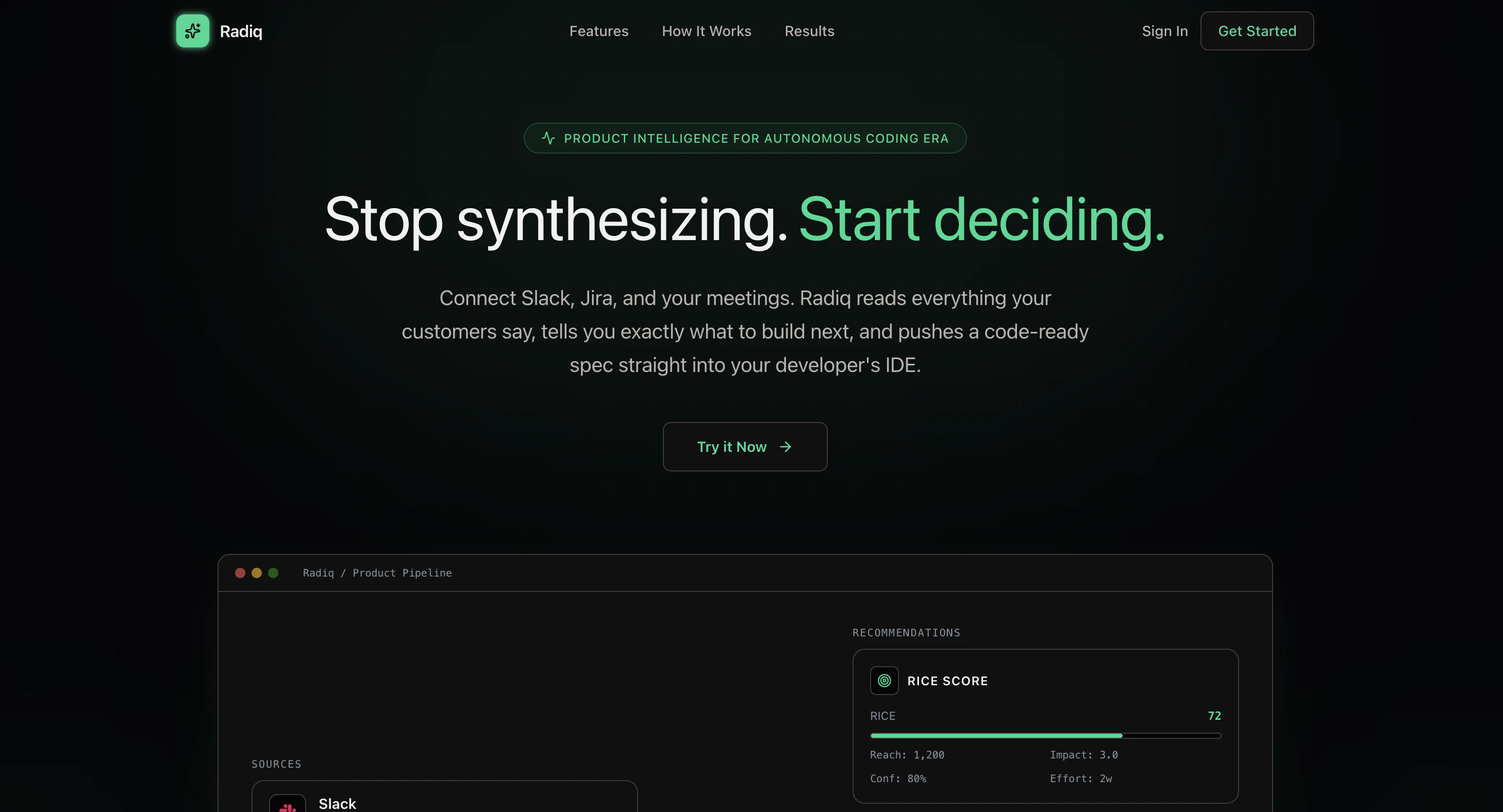
PMs lose hours every week stitching signal from Slack, Jira, Confluence, and meetings. Not deciding. Just chasing context, citing evidence, and rewriting specs engineers question anyway. Radiq runs the customer-to-code loop on autopilot: surface the decision, prioritize by evidence, generate a developer-ready spec grounded in code, and push it into the developer IDE via MCP. What took a week now takes minutes.
AI Analysis
Radiq is an AI-powered product intelligence platform for the autonomous coding era. It addresses PMs' pain of manually stitching insights from Slack, Jira, Confluence, and meetings to chase context, cite evidence, and rewrite questioned specs. Core features include autopilot customer-to-code loop: surfacing decisions, evidence-based prioritization, generating code-grounded developer-ready specs, and pushing them directly into IDEs via MCP. USP is reducing week-long processes to minutes with grounded, actionable output. Value proposition: frees PMs for high-value work, improves spec quality, and accelerates development in AI-driven coding environments.
Favorable in 2025-2026 as AI coding agents and LLMs mature rapidly (e.g., advanced models enabling IDE integration), user demand for automation in dev workflows surges amid talent shortages, and economic focus on efficiency tools grows. Policy support for AI innovation aids adoption. This aligns perfectly with the shift to autonomous coding, making it a strong time before market saturation. Rating: Excellent Timing.
Medium technical difficulty due to complex integrations across comms/tools, reliable evidence synthesis from unstructured data, code-aware spec generation, and novel MCP IDE push. Dev/ops costs tied to AI inference and maintenance are moderate. Low supply chain risks but compliance for data privacy (e.g., meeting transcripts) needed. High scalability potential in SaaS model; assumes strong AI/tech team fit. Rating: Medium. Key reasons: Leverages existing AI tech but requires high accuracy for trust in PM-dev loop.
Main segments: Product Managers, PMM, and engineering leads in SaaS/tech startups and scale-ups (demographics: 28-45yo tech professionals). Industries: Software development, primarily US/Europe with global remote users. Estimated market: TAM $5B+ (AI devtools/PM software), SAM $800M (AI PM automation), SOM $40M (early adopters). Core pains: context chasing and spec rework. High willingness to pay ($49-299/mo per seat) for proven time savings and better outcomes.
Medium. Direct competitors: 1. Productboard (productboard.com), 2. Aha! (aha.io), 3. Linear (linear.app), 4. Craft.io (craft.io), 5. Cursor (cursor.com). Advantages: Unique end-to-end automation from customer signals to code-grounded specs in IDE via MCP; stronger evidence prioritization and autonomous coding focus vs. traditional roadmapping tools. Disadvantages: Newer/less established than incumbents, potentially higher learning curve and dependency on AI accuracy; competitors have broader feature sets or lower pricing for basic use.
Upgrade Pro to unlock full AI analysis
Similar Products

Cohere Parse 5
Turn complex docs, tables & images into AI-ready data
▲ 158 votes

Opaline
PostHog for team Claude Code and Codex sessions.
▲ 141 votes

Adapt
The company brain that gets work done
▲ 124 votes

Tapfree for Chrome
Voice dictation that adapts to what’s on your screen
▲ 122 votes

Replay QA Security Scan
Automated Penetration Testing for AI-Built Apps
▲ 102 votes

Refoid
Automate App Store refund responses and track every outcome
▲ 68 votes