
ReadHere
Lightweight PDF & EPUB reader in your browser
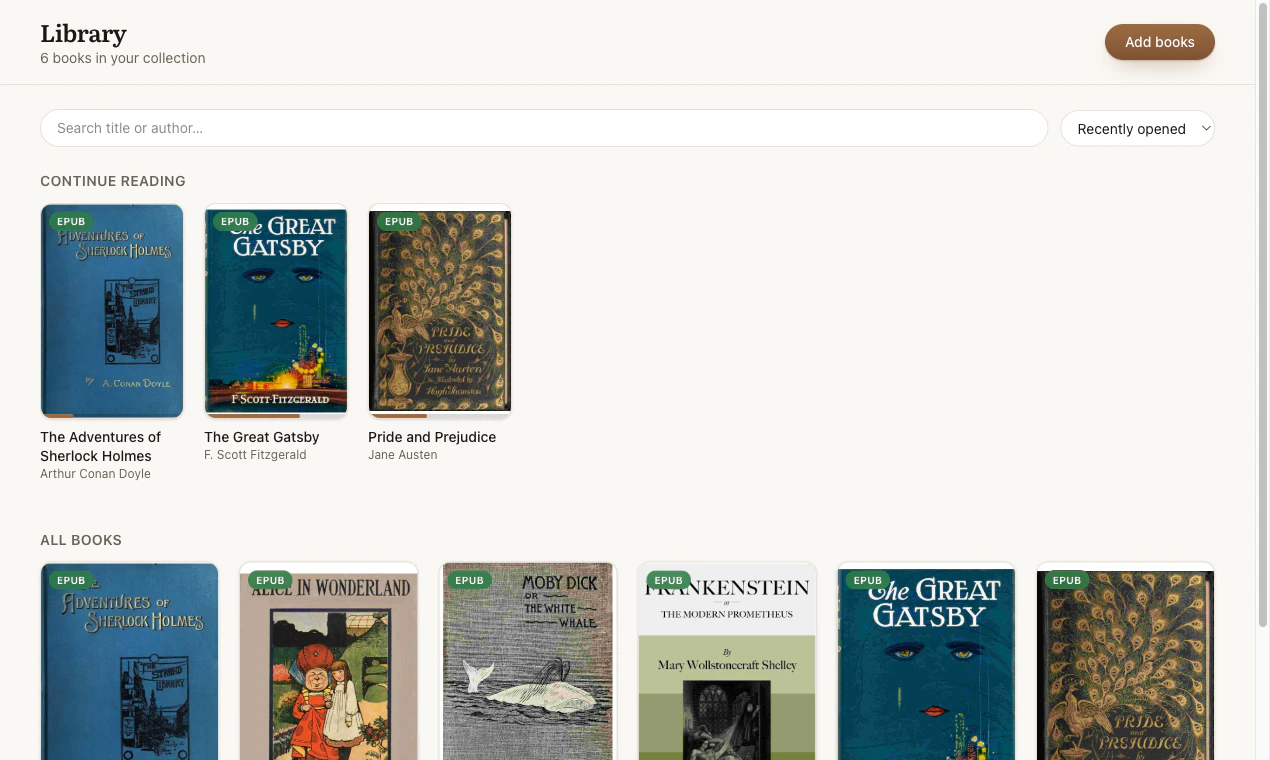
A lightweight reader for your PDFs and EPUBs, entirely in your browser; no install, no account, no ecosystem. Highlight both formats, keep a per-book journal, and read offline. Your files stay on your device. Sync to your own Google Drive coming soon.
AI Analysis
ReadHere is a lightweight browser-based PDF and EPUB reader that requires no installation, account creation, or ecosystem lock-in. Core features include support for highlighting in both formats, a per-book journal for notes, offline reading, and strict privacy as files never leave the user's device. It solves key pain points such as cumbersome app installs, cloud upload privacy risks, and fragmented reading experiences across devices or platforms. The value proposition centers on a simple, private, portable reading experience with local file control and upcoming Google Drive sync for optional convenience.
In 2025-2026, market timing is favorable due to rising privacy awareness, growth in digital reading and remote learning, mature browser technologies (PDF.js, EPUB parsers, PWAs for offline), and user fatigue with big-tech ecosystems like Kindle/Adobe. Economic factors favor lightweight, no-subscription tools. No major barriers in policy or tech maturity. Excellent Timing.
High feasibility. Technical difficulty is medium using established web libraries (pdf.js for PDFs, epub.js for EPUBs) and browser File APIs for local handling with IndexedDB for offline/journal data. Low development and operation costs as primarily client-side with no heavy backend initially. Minimal supply chain or compliance risks (no user data stored). Strong scalability for client-side app; sync feature adds moderate complexity but is optional. Good team fit for web developers.
Main segments: Students, researchers, academics, and privacy-focused professionals aged 18-45 who consume PDFs/ebooks. Industries: Education, academia, tech, legal. Geographic: Global, with strong demand in US/Europe due to GDPR/privacy concerns. TAM for digital ebook/PDF tools ~$30B+, SAM for web-based readers ~$2B, SOM for privacy-focused local readers ~$100M+. Core pain points: Privacy risks in cloud readers, need for seamless PDF+EPUB support with annotations without accounts. Potential willingness to pay: Medium-high for premium sync/advanced features via freemium model.
Medium. Direct competitors: 1. Kindle Cloud Reader (read.amazon.com) - ecosystem heavy; 2. Adobe Acrobat online (acrobat.adobe.com) - requires account/uploads; 3. Readwise Reader (readwise.io/reader) - annotation-focused but cloud-based; 4. Matter (readmatter.com) - newsletter/reader hybrid with sync; 5. Browser extensions like EPUBReader (various Chrome stores). Advantages: Superior privacy (zero uploads/accounts), seamless PDF+EPUB with per-book journals, fully offline/local. Disadvantages: Fewer integrated library features, sync still in development, potentially simpler UI than polished competitors. Strong differentiation on simplicity and data sovereignty.
Upgrade Pro to unlock full AI analysis
Similar Products

Oasis Browser for Mac
A privacy-first AI browser you can train anonymously
▲ 211 votes

FileFlan
Instant private universal file sharing
▲ 100 votes

Whiteout
Auto-redact sensitive info from Mac screenshots
▲ 83 votes

Netfox
A native local macOS network monitor
▲ 82 votes

FaveNest
Bookmarks that organize themselves with Apple Intelligence
▲ 70 votes

Lastbox
Put your AI to work on physical junk mail
▲ 55 votes