
Readr
A free reader that answers your questions and reads aloud
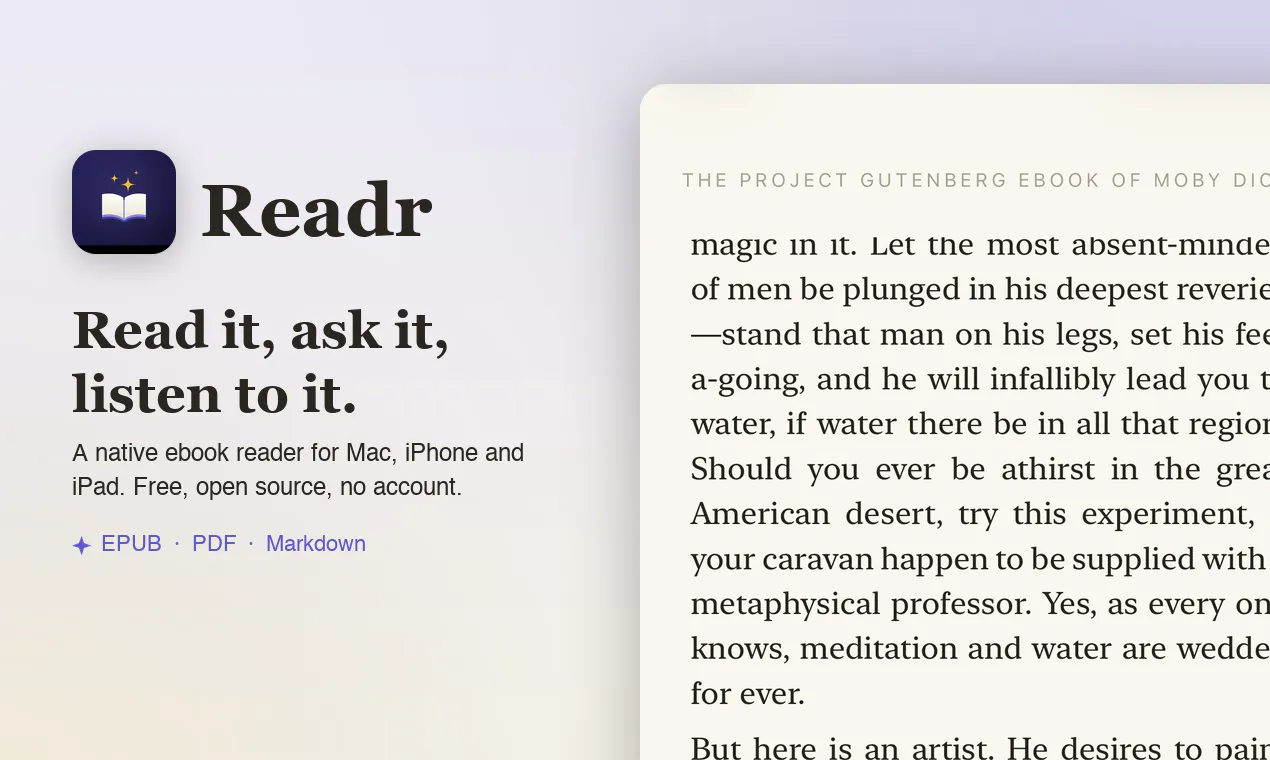
Readr is an ebook reader you can talk to. You're reading Project Hail Mary and wonder: could Astrophage exist? Select the line and ask. The answer appears in the margin, drawn from the whole book, and says when it's pulling from real science instead. Lost the thread? Ask for a recap of what you've read so far, no spoilers. Press Listen and a natural voice reads from your page, on your device, no cap. Opens the EPUBs and PDFs you own. No account, no server. Free, open source. iPhone, iPad, Mac.
AI Analysis
Readr is a free, open-source ebook reader for iPhone, iPad, and Mac that lets users interact with books via on-device AI. Core features include selecting text to ask questions with contextual answers in the margins (sourced from the entire book and noting real science), spoiler-free recaps, natural voice read-aloud, and support for EPUBs/PDFs. It requires no account or server. USPs are local AI processing for privacy, intelligent book-specific interaction, and being completely offline. It solves pain points like passive reading, poor retention of details, difficulty understanding concepts without spoilers or external searches, and inaccessible audio features. Value proposition: an intelligent, private reading companion that boosts engagement and comprehension.
In 2025-2026, timing is favorable with maturing on-device AI (e.g., efficient LLMs and Apple Intelligence), rising demand for personalized interactive reading experiences, and growing privacy concerns over cloud services. Digital book consumption continues to grow amid tech advancements. Excellent Timing.
High feasibility. Technical difficulty is manageable using existing on-device AI frameworks and RAG for book content; low dev/operation costs as it's open-source with no servers needed. Minimal supply chain or compliance risks for a local reader app. Good scalability via App Store distribution and strong potential for indie/open-source teams. Key reasons: leverages mature Apple ecosystem tech and avoids cloud infrastructure.
Main segments: Avid fiction/non-fiction readers, students, researchers, and knowledge workers aged 18-50 who are tech-savvy Apple users, concentrated in North America, Europe. TAM for global e-books ~$25B+, SAM for enhanced/AI readers ~$2B, SOM for local AI Apple apps ~$50-100M. Core pain points: static reading lacking interaction, memory/recall issues, accessibility. Potential willingness to pay: moderate to high for premium features (though currently free with donation potential).
Low. Direct competitors: 1. Amazon Kindle (kindle.com), 2. Apple Books (apple.com/apple-books), 3. Voice Dream Reader (voicedream.com), 4. NaturalReader (naturalreaders.com), 5. Libby (overdrive.com/libby). Advantages: fully local/offline AI Q&A with book-specific context, free/open-source, strong privacy focus. Disadvantages: Apple-only platforms, potentially less ecosystem integration than Kindle. Strong differentiation via conversational AI without servers or data sharing.
Upgrade Pro to unlock full AI analysis
Similar Products

Cohere Parse 5
Turn complex docs, tables & images into AI-ready data
▲ 158 votes

Opaline
PostHog for team Claude Code and Codex sessions.
▲ 141 votes

Adapt
The company brain that gets work done
▲ 124 votes

Tapfree for Chrome
Voice dictation that adapts to what’s on your screen
▲ 122 votes

CodeBurn
See where your AI coding spend actually goes
▲ 101 votes

WikiFix for Confluence
Find and fix issues in your knowledge base
▲ 86 votes