
Receiptor AI — Agent Mode
Bookkeeping that keeps itself
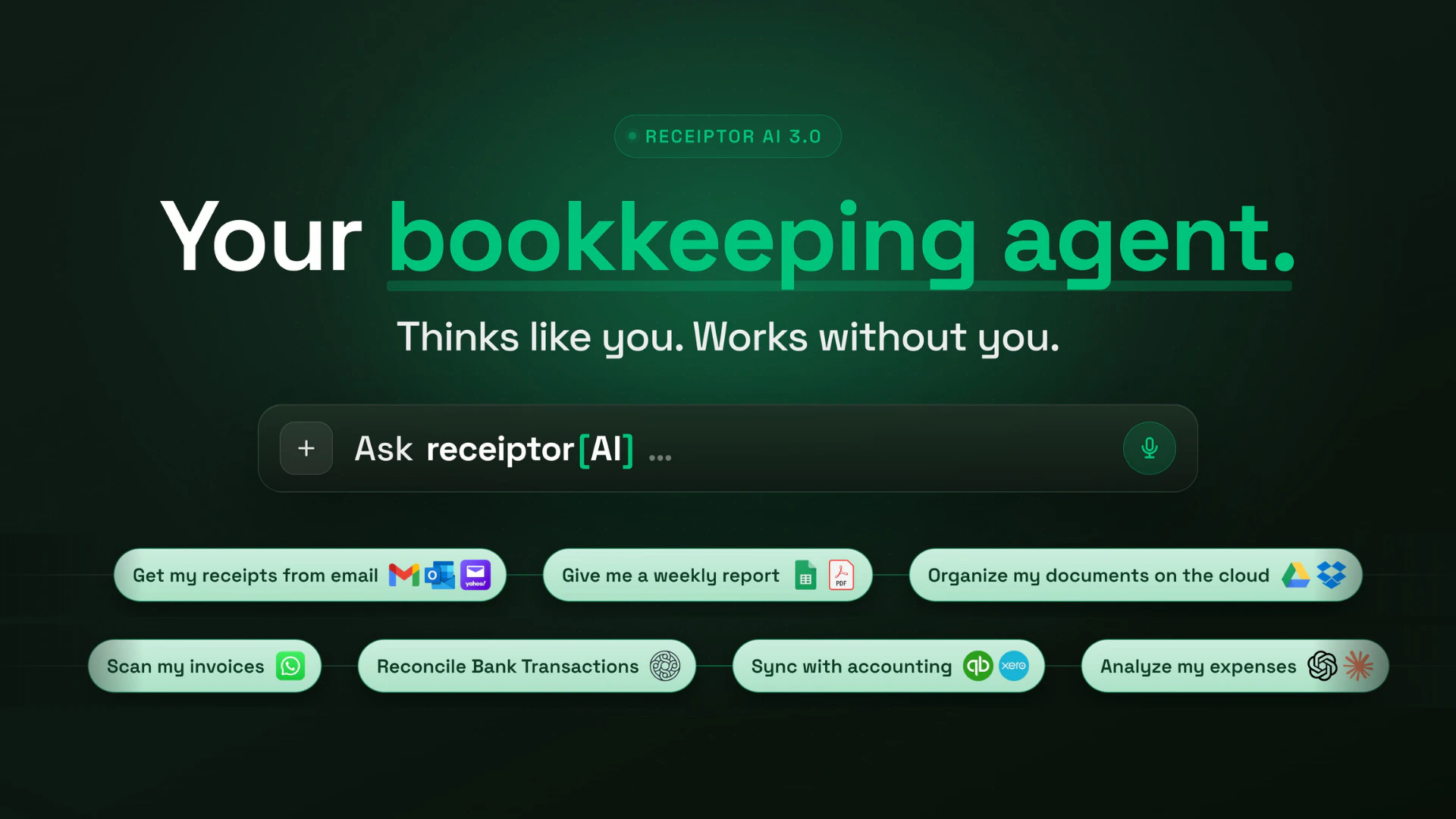
Receiptor AI is an agentic bookkeeping assistant that runs your receipt workflow end-to-end: it collects receipts from your inbox and your mobile, organizes them in your cloud or accounting software, and matches them to your bank transactions. It works quietly in the background with 99% accuracy, and only asks questions when it needs more context. The result: clean books and organized receipt data you can query from anywhere: the app, WhatsApp, or right inside Claude and ChatGPT.
AI Analysis
Receiptor AI is an agentic bookkeeping assistant that automates the full receipt workflow end-to-end. It collects receipts from inboxes and mobile devices, organizes them into cloud storage or accounting software, and matches them to bank transactions with 99% accuracy. Operating quietly in the background, it seeks user input only when more context is needed. Key features include querying organized data via app, WhatsApp, Claude, or ChatGPT. It solves major pain points like manual data entry, receipt disorganization, time-consuming reconciliation, and error-prone bookkeeping for professionals. The value proposition is effortless, always-on financial organization that delivers clean books and instant access, freeing users to focus on their core work.
The timing is favorable for 2025-2026 as AI agent technology is maturing rapidly with advanced LLMs enabling autonomous workflows. User demand for automated fintech tools is surging amid rising digital transactions, remote work, and the need for efficiency in a competitive economy. Integration with tools like ChatGPT and Claude aligns with growing AI adoption. Policy support for digital finance and economic pressures favoring cost-saving automation make this ideal. Excellent Timing.
Feasibility is High. Current AI/OCR and API integration technologies make core functions achievable, though maintaining 99% accuracy across varied receipt formats requires ongoing training. Development costs for AI agents and integrations are moderate; operational costs involve cloud compute and LLM calls. Compliance risks exist with financial data (privacy laws, accounting standards), but scalability is strong via cloud. Team fit likely good given the product's polish. Main risks are regulatory adherence and edge-case accuracy.
Main target segments: Solopreneurs, freelancers, small business owners (1-10 employees), and accountants/bookkeepers. Demographics: Tech-savvy professionals aged 25-50. Industries: Consulting, e-commerce, services, creative fields. Geographic focus: Primarily US, Europe, and English-speaking markets. Core pain points include time lost on manual receipt management, disorganized records leading to tax issues, and lack of instant financial insights. Estimated market size is substantial within the growing AI-powered accounting sector (specific TAM/SAM/SOM not detailed on sources but aligns with multi-billion fintech automation demand). Potential willingness to pay is strong for hands-off solutions that save hours weekly.
Medium. Direct competitors: 1. Veryfi (veryfi.com) - AI receipt automation; 2. Dext (dext.com) - receipt processing and bookkeeping; 3. Expensify (expensify.com) - expense management; 4. Hubdoc (hubdoc.com, now part of Xero); 5. Nanonets (nanonets.com) - document AI. Advantages: Unique agentic background operation with minimal intervention, seamless querying inside Claude/ChatGPT, end-to-end automation from collection to matching. Disadvantages: Newer player may lack established trust in financial data handling compared to incumbents; pricing transparency and depth of accounting integrations may need validation; relies heavily on AI accuracy which competitors also claim.
Upgrade Pro to unlock full AI analysis
Similar Products

Equitybee Benchmark
Compare your startup equity grant for free.
▲ 218 votes

Cohere Parse 5
Turn complex docs, tables & images into AI-ready data
▲ 158 votes

Opaline
PostHog for team Claude Code and Codex sessions.
▲ 141 votes

Adapt
The company brain that gets work done
▲ 124 votes

Tapfree for Chrome
Voice dictation that adapts to what’s on your screen
▲ 122 votes

Orus
Claude for investing in perpetuals
▲ 121 votes