
Refuse
Block vulnerable package installs for you and your AI
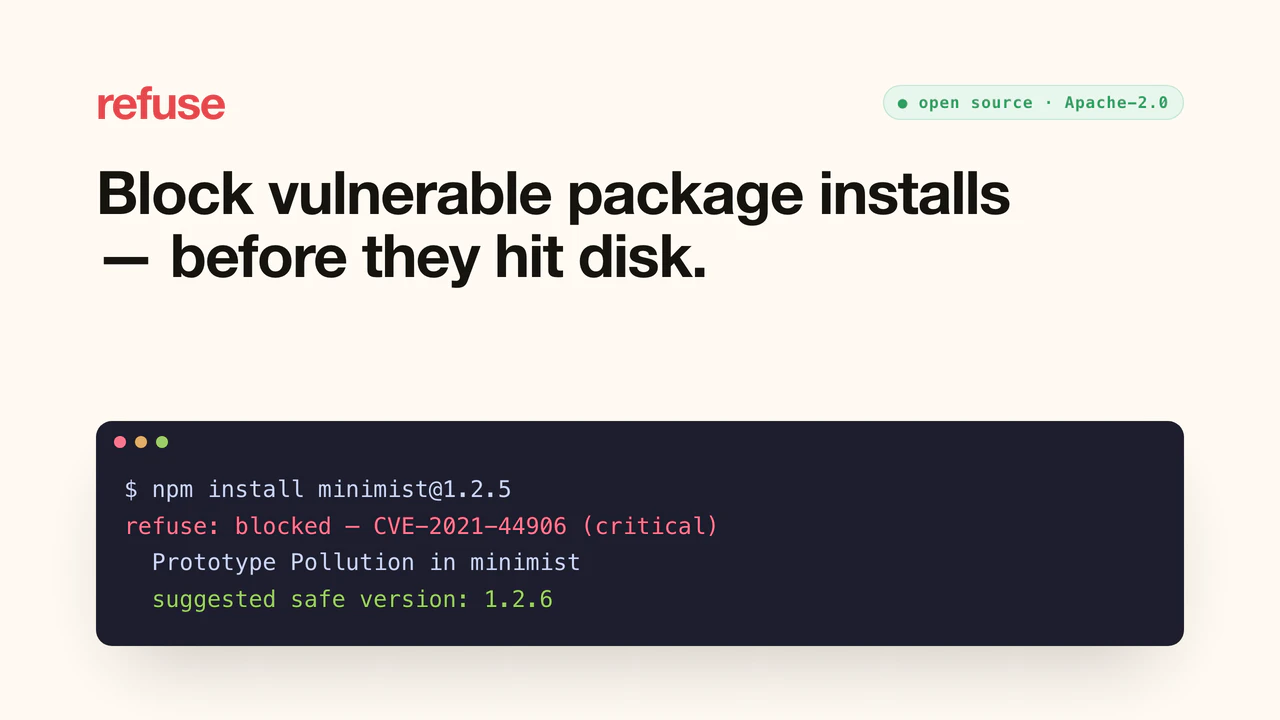
Refuse sits in front of npm, pip, cargo, gem, go + 13 more package managers and refuses known-vulnerable installs before they hit disk — the moment you (or your coding agent) run them. Also, Open-source, self-hostable, one Docker container.
AI Analysis
Refuse is a security gatekeeper that intercepts commands for npm, pip, cargo, gem, go and 13 other package managers. It blocks known-vulnerable or malicious packages before they are written to disk, protecting both human developers and autonomous AI coding agents from supply-chain attacks. Core features include real-time prevention, multi-language support, open-source code, and single-Docker self-hosting. It solves the pain of post-install discovery of dangerous dependencies and the new risk introduced by AI agents that indiscriminately pull packages. Value proposition: zero-friction, proactive security that stops threats at the earliest possible moment without altering developer or agent workflows.
In 2025-2026 the explosive growth of AI coding agents dramatically increases supply-chain risk because agents pull dependencies without human scrutiny. Software supply-chain security remains a regulatory and board-level priority after repeated high-profile attacks; dependency-scanning technology is mature while real-time blocking layers are still emerging. Economic tailwinds favor security tools that reduce breach exposure. Excellent Timing.
Technical difficulty is moderate: the product already exists as a lightweight proxy layer wrapped in a single Docker container, proving the interception approach is viable. Ongoing maintenance of a vulnerability database and support for new package managers represent the largest costs, but open-source community contributions can offset them. Minimal supply-chain or compliance risk for a self-hosted security tool. Scalability is high via simple container orchestration. Overall rating: High.
Primary segments: individual full-stack and backend developers, DevSecOps and platform engineering teams, organizations adopting AI coding assistants (GitHub Copilot, Cursor, etc.). Industries: software development, fintech, cloud infrastructure. Geographic focus: North America and Western Europe with global open-source adoption. TAM for DevSecOps tooling exceeds $15B by 2026; SAM for package-security solutions ~$1.5B; SOM for real-time AI-aware blockers estimated at $80-150M. Core pain: undetected vulnerable dependencies and AI-induced supply-chain exposure. Enterprises show strong willingness to pay for supported or on-prem versions; indie users favor the free open-source core.
Medium. Direct competitors: 1. Snyk (snyk.io), 2. Socket (socket.dev), 3. Phylum (phylum.io), 4. Sonatype Nexus Firewall (sonatype.com), 5. GitHub Dependabot + Advanced Security (github.com). Refuse's advantages: true pre-install blocking for 15+ managers, explicit AI-agent focus, fully self-hostable open-source Docker deployment with no vendor lock-in. Disadvantages: newer entrant with likely smaller vulnerability intelligence database, fewer enterprise-grade integrations and brand recognition than Snyk or Sonatype.
Upgrade Pro to unlock full AI analysis
Similar Products

Auriko
Trading desk for LLM calls
▲ 332 votes

Adapt
The company brain that gets work done
▲ 124 votes

React UI Kit V7
All the chat components you need. None of the complexity
▲ 115 votes

Replay QA Security Scan
Automated Penetration Testing for AI-Built Apps
▲ 102 votes

CodeBurn
See where your AI coding spend actually goes
▲ 101 votes

Saldor
Speed up procurement and AP.
▲ 78 votes