
Replay QA for Teams
Autonomous QA for teams who ship faster than they can verify
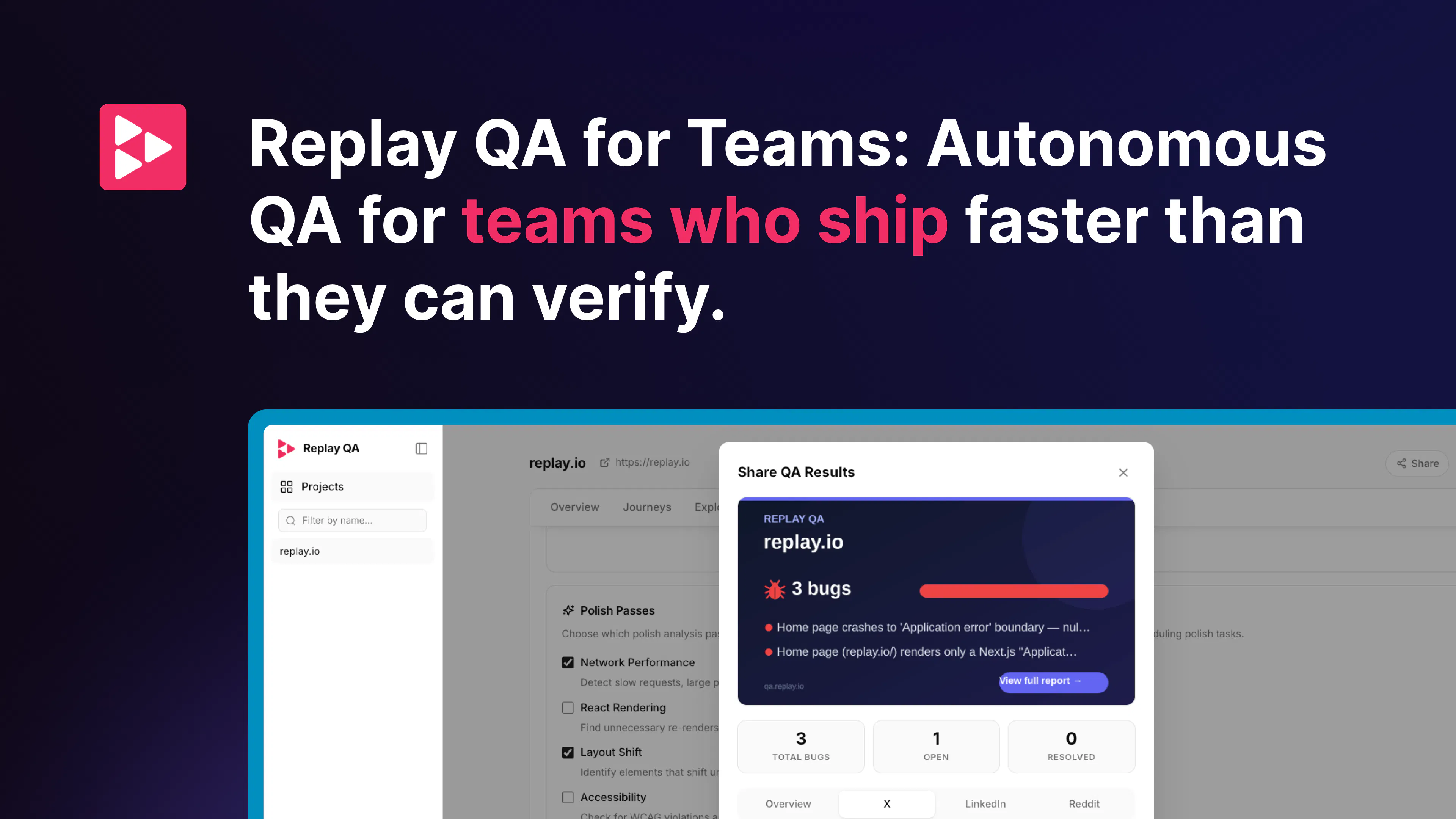
Replay QA tests your web app like a real user, uncovering broken flows, UI issues, and bugs before they reach customers. It gives you the context behind each issue, plus suggested fixes. What's new: With shared projects, teammate mentions, localhost testing, and QA checks on every pull request, your whole team can catch and fix problems before shipping.
AI Analysis
Replay QA is an autonomous testing tool that simulates real user interactions to detect broken flows, UI issues, and bugs in web apps before they reach customers. It delivers contextual insights and suggested fixes for each problem. Core features include team-shared projects, teammate mentions, localhost testing, and automated QA checks on every pull request. It solves the key pain point of development teams releasing code faster than manual verification allows, minimizing production bugs. The value proposition centers on enabling faster shipping with confidence through AI-driven, proactive QA integrated into collaborative dev workflows.
The market timing for 2025-2026 is favorable. AI integration in DevOps is maturing rapidly with advanced models enabling reliable autonomous testing. User demands are shifting toward faster CI/CD cycles and reduced manual QA amid economic pressures to optimize costs. Industry trends favor AI agents for software quality, supported by growing adoption of collaborative dev tools. No major negative policy or economic barriers apparent. Excellent Timing.
Overall feasibility is High. While technical challenges exist in accurate real-user simulation and AI-driven bug analysis across diverse web environments, established browser automation and LLM tech reduce barriers. Operational costs for AI compute are manageable in a SaaS model. Low supply chain or compliance risks for a dev tool. Strong scalability potential via cloud infrastructure and good fit for experienced dev tool teams. Key risks are AI accuracy consistency.
Primary targets are software development and QA teams at mid-sized to enterprise SaaS/web app companies, including frontend engineers and product teams. Demographics: tech professionals aged 25-45. Geographic focus: North America and Europe. TAM for automated testing tools exceeds $12B, SAM for AI QA ~$1.5B, SOM for team-oriented web QA ~$300M. Core pains: insufficient manual testing coverage and slow bug reproduction. High willingness to pay ($20-100+/user/mo) for time-saving, reliable automation.
Medium. Direct competitors: 1. Mabl (mabl.com), 2. Testim/Tricentis (testim.io), 3. Cypress (cypress.io), 4. Playwright (playwright.dev), 5. Applitools (applitools.com). Advantages vs competitors: deeper real-user simulation with contextual AI insights and suggested fixes, seamless team features like PR-integrated checks, mentions, and localhost support. Disadvantages: potentially higher learning curve than no-code tools like Mabl, less established brand than Cypress in the broader testing market, and may require more setup for non-Replay users.
Upgrade Pro to unlock full AI analysis
Similar Products

Auriko
Trading desk for LLM calls
▲ 332 votes

Opaline
PostHog for team Claude Code and Codex sessions.
▲ 141 votes

React UI Kit V7
All the chat components you need. None of the complexity
▲ 115 votes
Replay QA Security Scan
Automated Penetration Testing for AI-Built Apps
▲ 102 votes
CodeBurn
See where your AI coding spend actually goes
▲ 101 votes

Refoid
Automate App Store refund responses and track every outcome
▲ 68 votes