RepStandard
Computer vision counts your reps in real time
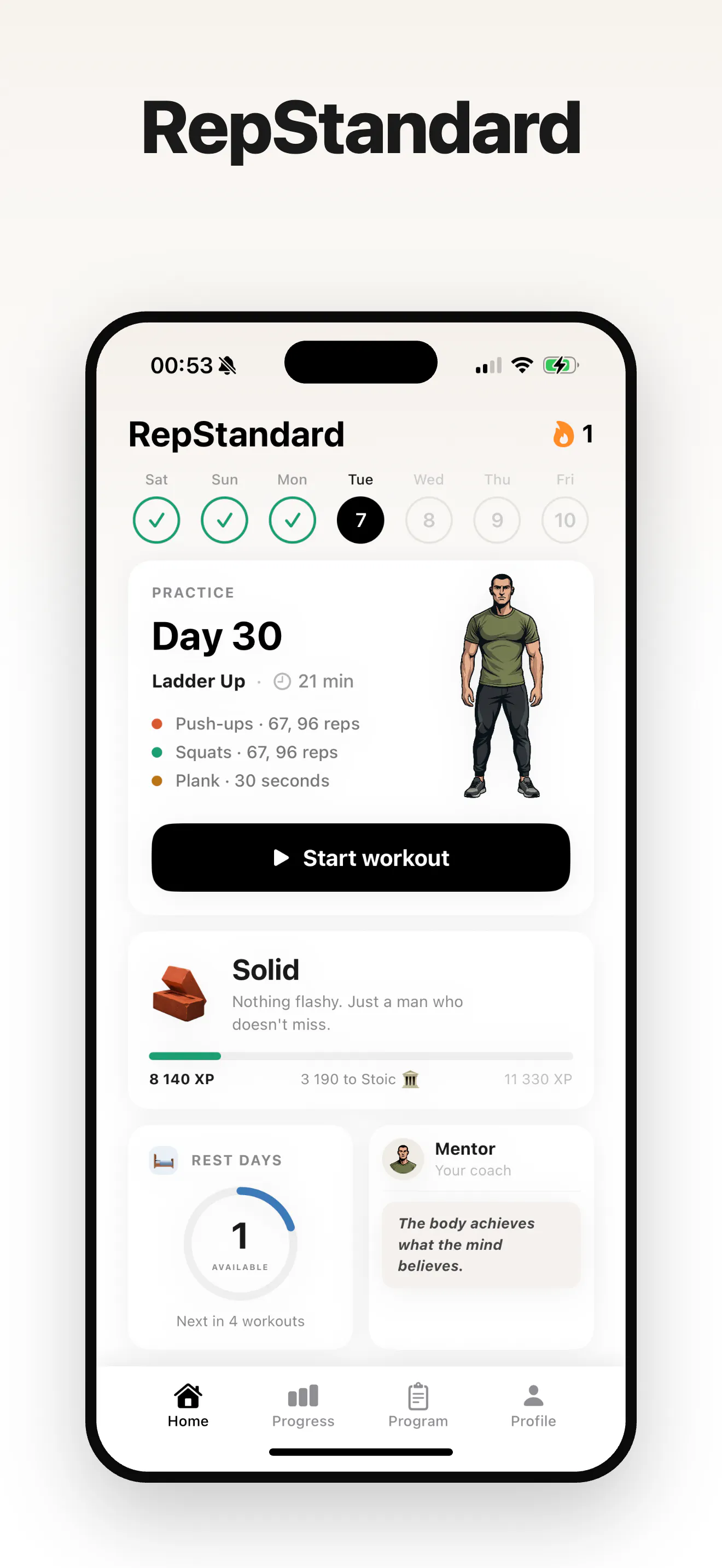
Most fitness apps make you manually log sets or need a wearable to guess your effort. RepStandard's camera does the counting for you - squats, push-ups, sit-ups, and plank, tracked in real time via on-device pose detection (nothing leaves your phone). It also builds an adaptive daily program that scales with your progress, and turns consistency into a game: ranks, XP, streaks, and shareable certificates.
AI Analysis
RepStandard is an iOS app that leverages the device's camera and on-device pose detection to automatically count reps for squats, push-ups, sit-ups, and planks in real time. No manual logging or wearables are needed, with all processing happening locally to protect user privacy. It generates adaptive daily workout programs that scale with progress and adds gamification through ranks, XP, streaks, and shareable certificates to boost consistency. It addresses key pain points like tedious tracking, guesswork from wearables, and lack of motivation, delivering a seamless, private, and engaging fitness experience focused on bodyweight exercises.
In 2025-2026, on-device AI and computer vision technologies are mature enough for reliable mobile deployment, aligning with rising demand for privacy-centric, equipment-free home fitness solutions. Post-pandemic health awareness and gamified engagement trends in wellness apps further support adoption. Economic interest in digital health remains strong with no major hindering policies. Excellent Timing.
Technical feasibility is solid using established iOS frameworks like Vision and Core ML for pose detection, though accuracy tuning across diverse users/angles adds complexity. Development and operation costs are moderate for a focused mobile app with minimal server needs. Low supply chain or compliance risks (privacy is a strength). Strong scalability potential via App Store distribution. Overall rating: High.
Primary segments: Tech-savvy fitness enthusiasts aged 18-40, male and female, focusing on home bodyweight training; mainly urban users in the US, Europe, and other English-speaking regions. Core pain points include inaccurate manual logging, lack of personalization, and waning motivation. Global digital fitness TAM exceeds $15B (2026 proj.), SAM for AI/computer-vision fitness apps ~$2-4B, SOM for this real-time rep counter niche ~$200-500M. Moderate-to-high willingness to pay via freemium/subscription for advanced adaptive features.
Medium. Direct competitors: 1. Fitbod (fitbod.me) - AI-generated plans but relies on manual input. 2. Hevy (hevyapp.com) - Robust tracking with community but no real-time camera counting. 3. Freeletics (freeletics.com) - Bodyweight coaching and gamification but manual logging. 4. Tempo (tempofitness.com) - Camera-based form feedback focused on weights with hardware. 5. Nike Training Club (nike.com/ntc) - Guided workouts without automatic rep detection. Advantages: Full on-device privacy, seamless real-time counting for key exercises, integrated adaptive programming and strong gamification. Disadvantages: Limited exercise variety, iOS-only, potential accuracy variability versus hardware-aided solutions.
Upgrade Pro to unlock full AI analysis
Similar Products

TouchGrass
Context-aware break reminders without invasive permissions
▲ 299 votes

Midjourney Scanner
60 second ultrasound-based full-body scanner that beats MRI
▲ 206 votes

Cercle
The bat signal for your closest friends.
▲ 121 votes

Loot
Collect your favorite things in real life
▲ 115 votes

Mirlo
Social media for real connections. No likes, no algorithm.
▲ 94 votes

Edit Mind × Strava
Every clip matched to the Strava activity it's from
▲ 92 votes