
Rezonant
Talk, spec, ship: get your product ideas into production
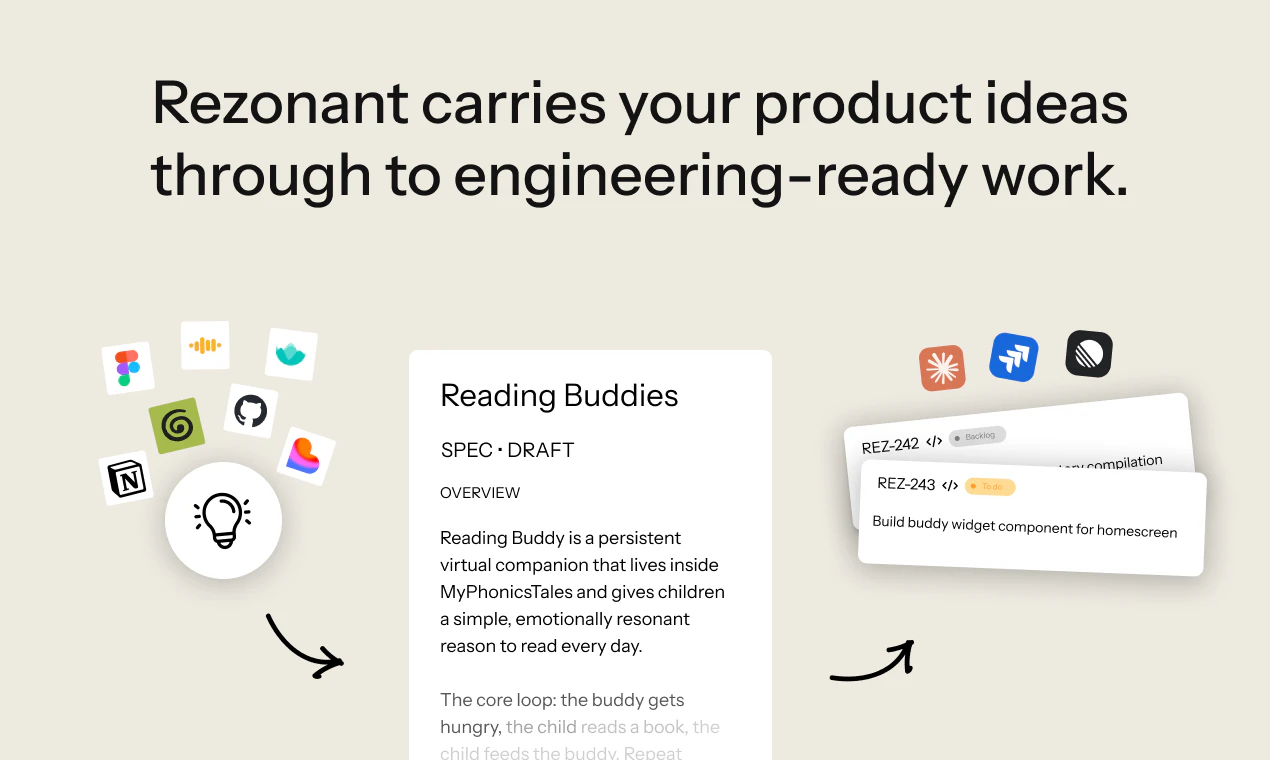
Rezonant helps product teams turn messy ideas into code-ready specs, tickets, and engineering tasks. Collaborate with PMs, engineers, designers, and AI agents in one shared workspace. Ground decisions in your actual codebase, keep everyone aligned on the same version, and create work that humans and coding agents can confidently ship.
AI Analysis
Rezonant is an AI-powered collaborative workspace that turns messy product ideas into code-ready specs, tickets, and engineering tasks. It enables seamless collaboration between PMs, engineers, designers, and AI agents within a shared environment grounded in the actual codebase. Key features include version alignment, informed decision-making from real code, and outputs suitable for both human and AI-driven execution. It solves major pain points like team misalignment, unclear specifications, inefficient handoffs from ideation to production, and lack of shared context. The value proposition is faster, more reliable product development cycles leading to confident shipping.
In 2025-2026, market timing is highly favorable. The rapid maturity of AI coding agents (e.g. similar to Devin or Copilot Workspace), exploding demand for AI-augmented productivity tools, and shift toward agentic workflows in software teams align perfectly with Rezonant's offering. Tech infrastructure for codebase RAG and multi-agent collaboration is ready, while economic pressures push teams to ship faster with fewer resources. Excellent Timing.
Overall feasibility is High. Current LLMs and embedding tech make codebase grounding and spec generation achievable, though integrating deeply with diverse codebases adds complexity. Development costs are elevated due to AI compute and training needs, with ongoing operational costs from inference. Data privacy and IP compliance are notable risks when handling proprietary code. Scalability is strong as a cloud SaaS. Success depends on a team experienced in AI and devtools. High.
Primary users are cross-functional product teams (PMs, engineers, designers) at software/SaaS companies and tech startups, often in fast-paced environments. Geographic focus is global with concentration in US and European tech hubs. The TAM for AI-powered dev productivity and task management tools exceeds several billion USD, with SAM for collaborative spec-to-ship platforms in the hundreds of millions and SOM depending on adoption in mid-market teams. Core pain points are disorganized ideas, cross-role misalignment and slow translation to shippable work. Willingness to pay is high for demonstrated time savings and quality improvements.
Medium. Direct competitors: 1. Linear (linear.app), 2. Jira (atlassian.com/software/jira), 3. Coda (coda.io), 4. Notion AI (notion.so), 5. GitHub Copilot Workspace (github.com/features/copilot). Rezonant advantages include deep codebase grounding, native support for AI agents as collaborators, and a unified talk-spec-ship flow. Disadvantages: newer entrant with potentially narrower feature set than established PM platforms, possible higher dependency on AI accuracy, and less brand recognition. Differentiation via AI-human hybrid workspace and version-controlled specs grounded in live code provides a competitive edge.
Upgrade Pro to unlock full AI analysis
Similar Products
Cohere Parse 5
Turn complex docs, tables & images into AI-ready data
▲ 158 votes

Opaline
PostHog for team Claude Code and Codex sessions.
▲ 141 votes

Adapt
The company brain that gets work done
▲ 124 votes
Kosshi
Simple, fast outliner for Mac and iPhone.
▲ 90 votes

WikiFix for Confluence
Find and fix issues in your knowledge base
▲ 86 votes
Refoid
Automate App Store refund responses and track every outcome
▲ 68 votes