
rhun
A small, fast code editor written in assembly
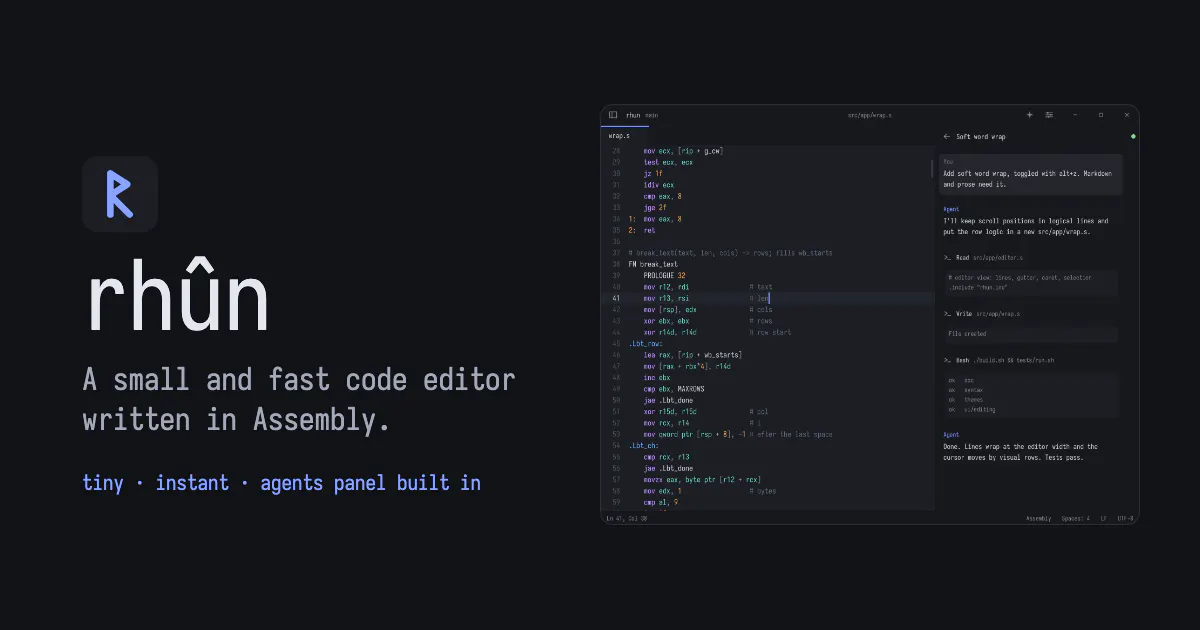
A small code editor for Windows, Linux and macOS. Written in assembly, with a built-in terminal, Git diffs, fuzzy search, Vim mode and a panel for Claude Code and Codex sessions. Free and open source.
AI Analysis
Rhun is a lightweight, high-performance code editor written in assembly for Windows, Linux, and macOS. Core features include built-in terminal, Git diffs, fuzzy search, Vim mode, and a dedicated panel for Claude Code and Codex AI sessions. As free open-source software, it solves pain points of bloated, resource-heavy IDEs like slow startup and high memory use. Its USP is exceptional speed and minimal size from assembly implementation combined with modern AI integration, delivering an efficient, minimalist coding experience for developers seeking both classic and cutting-edge tools.
In 2025-2026, market timing is favorable due to booming AI coding assistants (e.g., Claude), rising demand for lightweight performant alternatives to electron-based editors like VS Code, and trends toward open-source efficiency tools amid developer focus on productivity and lower resource usage. Technology maturity of AI APIs and cross-platform needs align well; economic pressures favor free tools. Excellent Timing.
Technical difficulty is high due to assembly language (error-prone, complex cross-platform maintenance). Development/operation costs are low as an open-source project with community potential. Minimal supply chain/compliance risks for software. Team fit assumes low-level expertise; scalability is strong for user growth. Overall Medium feasibility - challenged by maintenance but enabled by its completed open-source status.
Primary segments: Software developers, programmers, and engineers (ages 20-45) who prefer Vim-like efficiency, AI-assisted coding, and lightweight tools; strong in open-source communities. Industries: Software/IT development, tech startups. Geographic: Global, concentrated in US, Europe, China. Developer tools TAM exceeds $10B; SAM for code editors ~$500M; SOM for niche fast/AI editors ~$50M. Pain points: Slow/bloated editors. Willingness to pay: Moderate (donations, potential future premium AI features) as currently free.
Competition level: Medium. Direct competitors: 1. Zed (zed.dev), 2. Lapce (lapce.dev), 3. Neovim (neovim.io), 4. Visual Studio Code (code.visualstudio.com), 5. Helix (helix-editor.com). Advantages: Unique assembly for smaller/faster performance, seamless built-in AI panel for Claude/Codex, completely free OSS. Disadvantages: Smaller ecosystem and harder extensibility vs. plugin-rich competitors like VS Code/Neovim; less mature community than Rust-based Zed/Lapce. Strong differentiation in minimalism but faces pressure from established fast editors.
Upgrade Pro to unlock full AI analysis
Similar Products

Auriko
Trading desk for LLM calls
▲ 332 votes

Opaline
PostHog for team Claude Code and Codex sessions.
▲ 141 votes

React UI Kit V7
All the chat components you need. None of the complexity
▲ 115 votes

Replay QA Security Scan
Automated Penetration Testing for AI-Built Apps
▲ 102 votes

CodeBurn
See where your AI coding spend actually goes
▲ 101 votes

Refoid
Automate App Store refund responses and track every outcome
▲ 68 votes