
Robinhood Agentic Trading
Let your agent trade
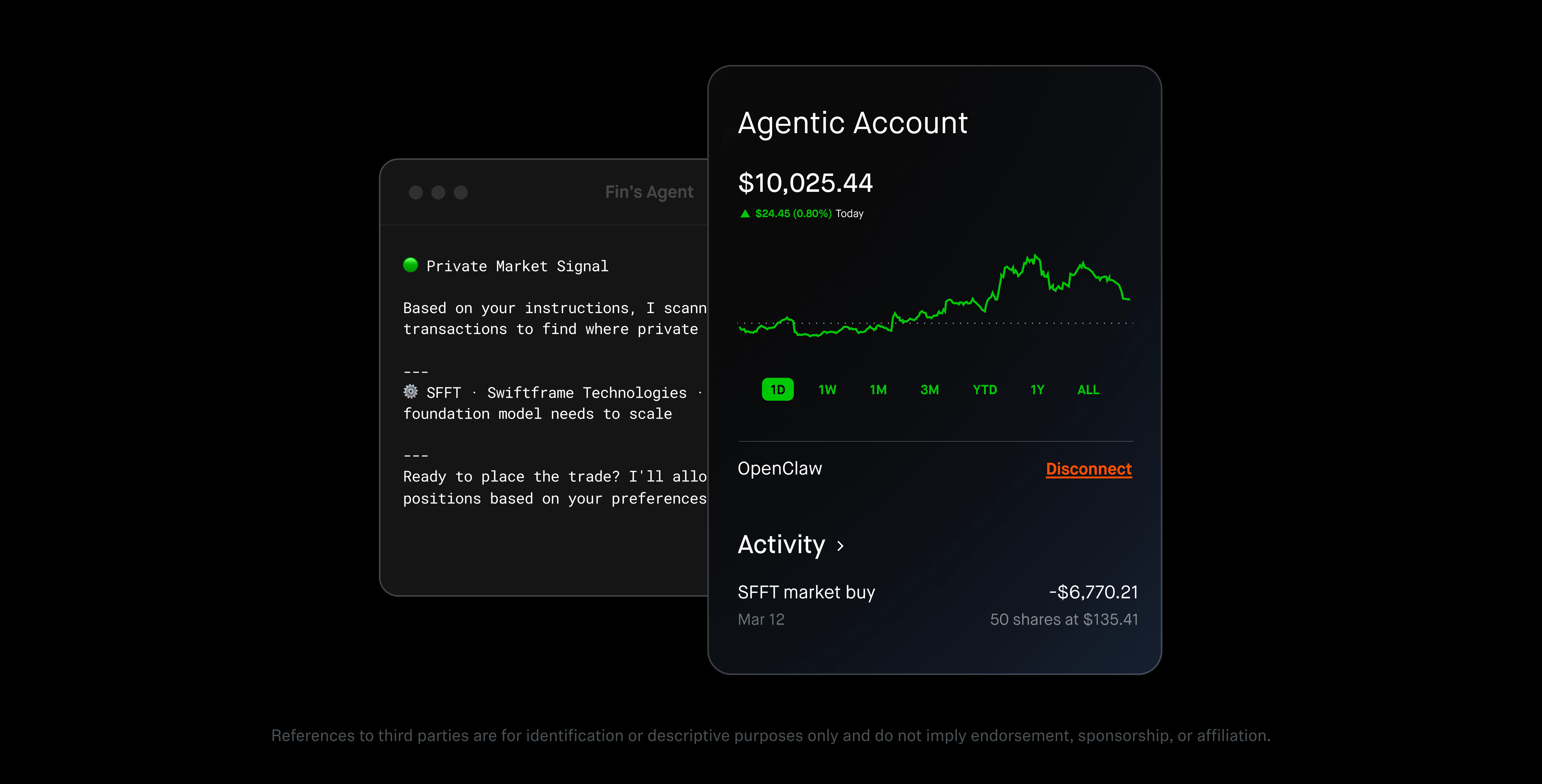
Customers can connect their own AI agents to Robinhood to help manage and automate trading and credit card purchases, with built-in safety controls and a real-time activity feed. Trade in a dedicated agentic account to stay in control of every trade your agent makes.
AI Analysis
Robinhood Agentic Trading allows users to connect their own AI agents to automate trading and credit card purchases on the Robinhood platform. Core features include built-in safety controls to mitigate risks, a real-time activity feed for transparency, and a dedicated agentic account ensuring users maintain oversight of every trade. It solves key pain points like time-intensive manual trading, emotional biases in decision-making, and the challenge of 24/7 market monitoring. The USP is blending customizable AI autonomy with robust guardrails and control, delivering a value proposition of intelligent, automated investing without surrendering user authority within a trusted fintech environment.
In 2025-2026, AI agent technology is reaching practical maturity with advanced models enabling autonomous decision-making, while retail demand for automated investing surges amid volatile markets and time-scarce users. Robinhood's established regulatory compliance positions it well as policy evolves around AI in finance. Economic interest in fintech innovation remains strong. This is an opportune moment for agentic trading tools. Excellent Timing.
Robinhood possesses the existing brokerage infrastructure, APIs, and regulatory licenses, making technical integration of AI agents feasible though safety controls for arbitrary agents add complexity. Compliance risks are notable in automated finance but mitigated by their established status. Development and operation costs are manageable for a large fintech; scalability is high across their user base. Overall rating: High. Key reasons: strong internal resources and platform maturity outweigh integration challenges.
Primary segments: Tech-savvy retail investors aged 25-45 in the US and select international markets, often existing Robinhood users with interest in AI, fintech, and passive or automated investing; includes both novice and intermediate traders. TAM for AI-powered fintech tools exceeds $40B by 2026; SAM for automated trading platforms around $12B; SOM tied to Robinhood's 20M+ users. Core pain points: insufficient time/expertise for optimal trading and fear of losses. High willingness to pay via platform subscriptions like Robinhood Gold for premium agent features.
Competition level: Medium. Direct competitors: 1. Wealthfront (wealthfront.com) - automated portfolio management; 2. Betterment (betterment.com) - robo-advisory with tax optimization; 3. Alpaca (alpaca.markets) - commission-free API for algo trading; 4. Interactive Brokers (interactivebrokers.com) - API-driven algorithmic trading tools; 5. Magnifi (magnifi.com) - AI-powered investment insights. Advantages: Native Robinhood integration, support for user-owned custom AI agents, explicit safety controls and segregated accounts for better control. Disadvantages: Ecosystem lock-in compared to open APIs, potentially steeper setup for non-technical users versus fully hands-off robo-advisors, and less established track record specifically in agentic AI versus general automation competitors.
Upgrade Pro to unlock full AI analysis
Similar Products

Equitybee Benchmark
Compare your startup equity grant for free.
▲ 218 votes

Cohere Parse 5
Turn complex docs, tables & images into AI-ready data
▲ 158 votes

Opaline
PostHog for team Claude Code and Codex sessions.
▲ 141 votes

Adapt
The company brain that gets work done
▲ 124 votes

Orus
Claude for investing in perpetuals
▲ 121 votes

WikiFix for Confluence
Find and fix issues in your knowledge base
▲ 86 votes