
Sai
The autonomous computer fleet at your command
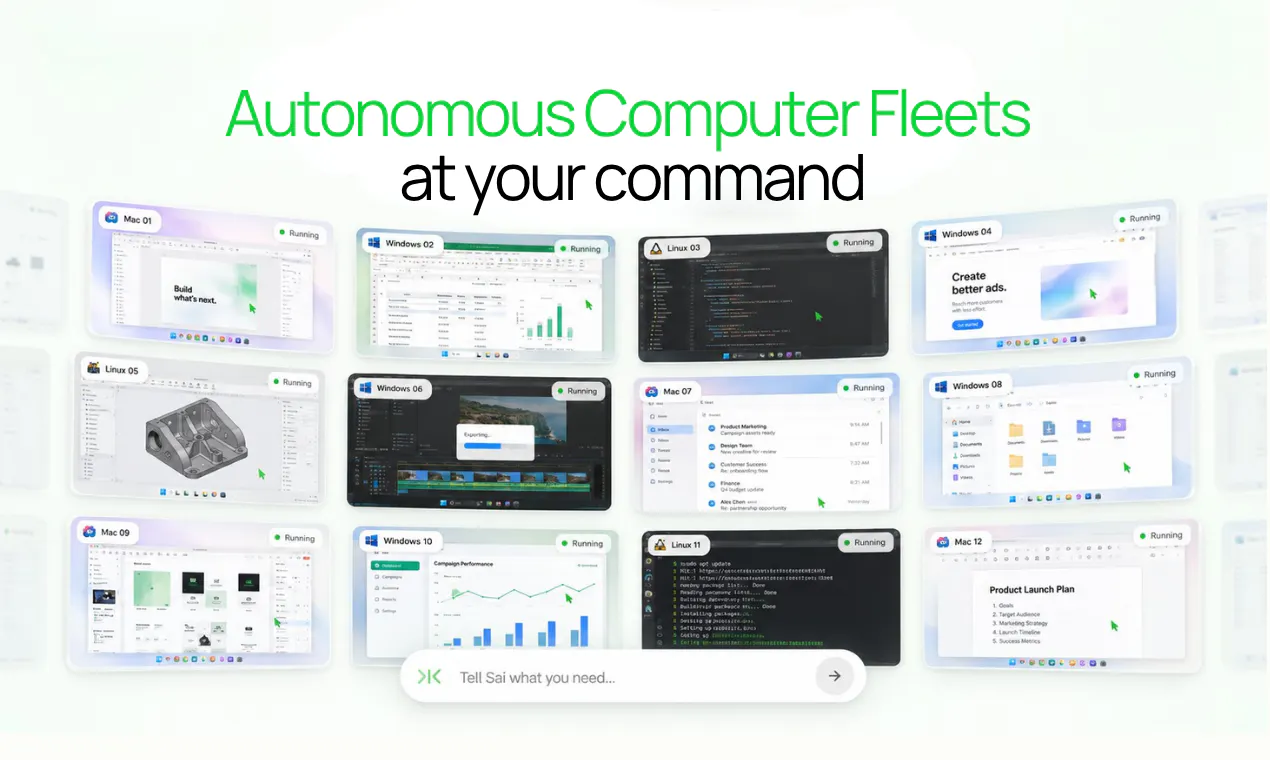
Sai is the world's first robosecretary that works with a fleet of autonomous computers, doing your endless screen work. Each computer navigates software the way you do: reads the screen, clicks the button, types in the form. Trained to interact with the computer interface, Sai automates software even when they lack APIs: legacy desktop apps, internal portals, anything behind a login. Sai supports Windows, macOS and Linux. 73% on OSWorld.
AI Analysis
Sai is the world's first robosecretary operating a fleet of autonomous computers to handle repetitive screen-based tasks. Core features include vision-based screen reading, button clicking, form filling, and interaction with any software interface - even without APIs - covering legacy desktop apps, internal portals, and login-protected systems. It supports Windows, macOS, and Linux, achieving 73% on the OSWorld benchmark. It solves key user pain points of endless manual digital drudgery and inability to automate non-API tools. The value proposition is delivering human-like automation at scale, boosting productivity by offloading mundane computer work to AI agents.
The timing is favorable for 2025-2026 as multimodal AI models and agentic systems mature rapidly, enabling reliable computer use. Industry trends show increasing adoption of AI for workflow automation beyond traditional RPA, driven by demands for efficiency amid economic pressures and remote work. Technology like vision-language models has reached viability, with growing policy support for AI productivity tools. Excellent Timing.
Technical difficulty is significant for robust cross-OS UI navigation and error handling, though the 73% OSWorld score demonstrates proof-of-concept. Development and operation costs are high due to compute-intensive vision models and fleet management. Supply chain risks are low but compliance (data privacy, security for internal apps) is a concern. Scalability is promising for cloud deployment. Overall Medium feasibility, viable for a well-resourced team.
Primary segments: Knowledge workers, virtual assistants, IT/operations teams in SMEs and enterprises using legacy or internal software. Industries include finance, healthcare, logistics, and admin services. Geographic focus: Global, with early adoption in US and Europe. Estimated TAM for AI-powered automation software exceeds $15B by 2026; SAM for desktop RPA agents ~$3-5B; SOM for early adopters ~$300-500M. Core pains: Time wasted on repetitive UI tasks and integration barriers. High willingness to pay for proven time savings via likely subscription pricing.
Medium. Direct competitors: 1. Anthropic Claude Computer Use (anthropic.com), 2. UiPath (uipath.com), 3. Automation Anywhere (automationanywhere.com), 4. MultiOn (multion.ai), 5. Adept (adept.ai). Advantages: True cross-OS desktop support for legacy apps (beyond web/browser focus of many), unique 'fleet' scaling for parallel tasks, strong benchmark claim. Disadvantages: Emerging player with potentially higher error rates than mature RPA suites; pricing unknown but must compete with established enterprise solutions; less brand recognition.
Upgrade Pro to unlock full AI analysis
Similar Products

Cohere Parse 5
Turn complex docs, tables & images into AI-ready data
▲ 158 votes

Adapt
The company brain that gets work done
▲ 124 votes

Tapfree for Chrome
Voice dictation that adapts to what’s on your screen
▲ 122 votes

Kosshi
Simple, fast outliner for Mac and iPhone.
▲ 90 votes

Thoughts for Mac
Capture notes from your menubar using text, images or voice
▲ 90 votes

Refoid
Automate App Store refund responses and track every outcome
▲ 0 votes