Salem Robotics
Deploy autonomous robots for surveys and manipulation tasks
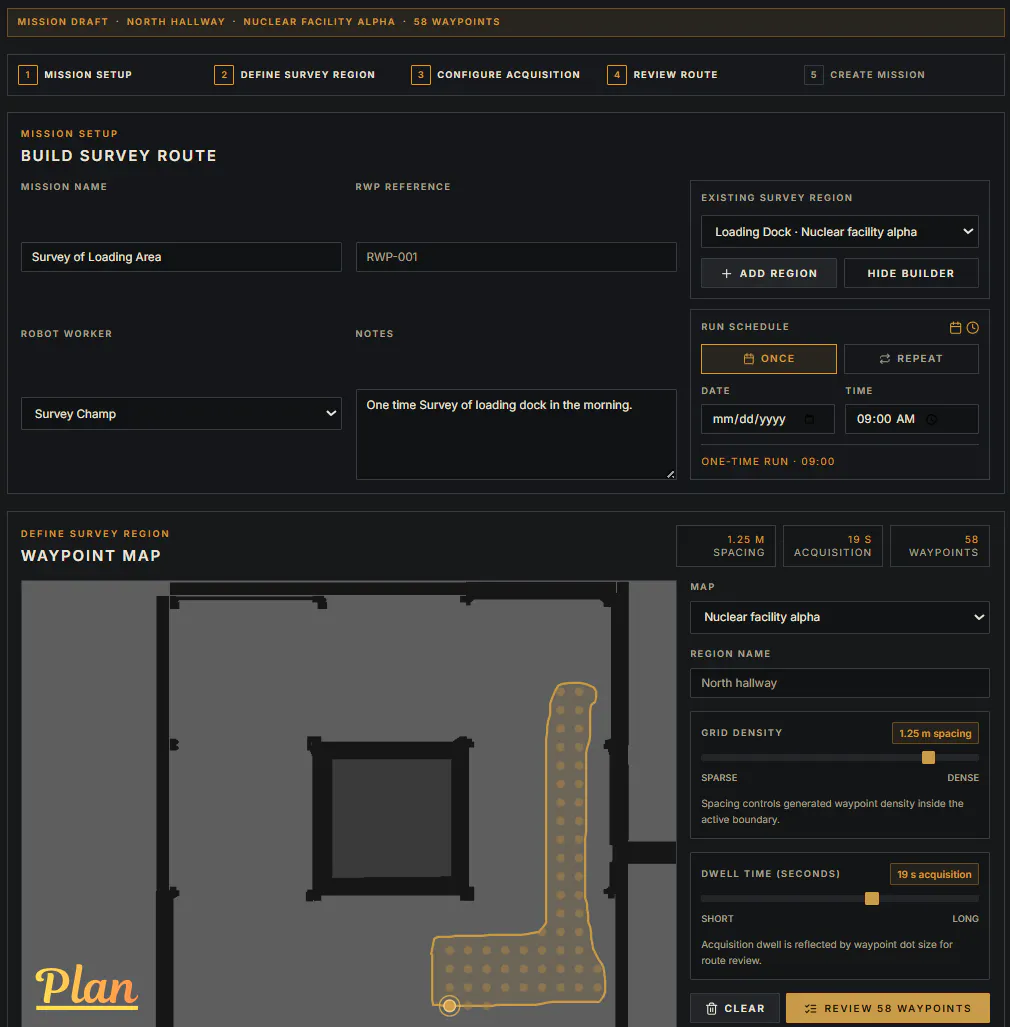
Robot software brain for autonomous surveys, inspections, and manipulation in hazardous facilities. Instead of sending technicians in with handheld detectors and clipboards, an operator draws the route on a dashboard. The robot navigates, opens doors, turns valves, takes measurements, and returns a compliance-ready report with heatmaps and flagged risks. Hardware-agnostic, built on published research by PhD roboticists with a decade at Los Alamos. Deploy on your robot, or we provide one with it.
AI Analysis
Salem Robotics provides a hardware-agnostic AI-powered software brain for autonomous robots conducting surveys, inspections, and manipulation in hazardous facilities. Operators draw routes on an intuitive dashboard; robots then navigate, open doors, turn valves, take measurements, and generate compliance reports featuring heatmaps and risk flags. It solves key pain points of exposing technicians to dangerous environments, inefficient manual data collection, and error-prone reporting. USP includes foundation in published Los Alamos PhD research. Value proposition: significantly improves safety, operational efficiency, accuracy, and regulatory compliance while cutting costs and risks.
The current market timing for 2025-2026 is highly favorable. AI and robotics technologies have reached sufficient maturity for real-world autonomy, coinciding with rising labor shortages, stringent safety regulations, growing climate tech investments in hazardous waste and energy infrastructure, and post-pandemic emphasis on remote operations. Economic pressures to reduce downtime and compliance costs further support adoption. Rating: Excellent Timing.
Overall feasibility is Medium. Technical challenges are high for robust autonomous manipulation and navigation in unstructured, hazardous, and variable environments. Leveraging established Los Alamos research helps, but real-world validation, integration, and edge-case handling remain complex. Development and testing costs are substantial with high compliance/safety certification risks in regulated industries. Hardware-agnostic design boosts scalability potential and lowers supply chain dependency. Experienced PhD team provides good fit. Requires significant capital and iterative field testing.
Main target segments: Operations, safety, and compliance managers in nuclear facilities, chemical plants, oil & gas refineries, and power utilities (primarily North America and Europe). TAM for industrial autonomous inspection robotics is multi-billion; SAM for hazardous environment software solutions in hundreds of millions; SOM depends on adoption rate in regulated sectors. Core pain points: human safety risks in hazardous entry, labor-intensive manual processes, inconsistent data, and regulatory reporting burdens. High willingness to pay due to liability reduction, efficiency gains, and compliance value.
Competition level: Medium. Direct competitors: 1. Boston Dynamics Spot (bostondynamics.com), 2. ANYbotics ANYmal (anybotics.com), 3. Gecko Robotics (geckorobotics.com), 4. Exyn Technologies (exyn.com). Advantages: hardware-agnostic flexibility, specialized manipulation tasks (doors/valves), Los Alamos research credibility for high-regulation sectors, simplified dashboard UX with automated heatmap reports. Disadvantages: likely less hardware integration and fewer proven large-scale deployments than integrated rivals; newer entrant may face trust barriers in conservative industries. Differentiation is strong in software focus and research pedigree.
Upgrade Pro to unlock full AI analysis
Similar Products
Auriko
Trading desk for LLM calls
▲ 332 votes

Cohere Parse 5
Turn complex docs, tables & images into AI-ready data
▲ 158 votes

Opaline
PostHog for team Claude Code and Codex sessions.
▲ 141 votes

Adapt
The company brain that gets work done
▲ 124 votes

Tapfree for Chrome
Voice dictation that adapts to what’s on your screen
▲ 122 votes

CodeBurn
See where your AI coding spend actually goes
▲ 101 votes