screenpipe
AI that records your computer work to power agents.
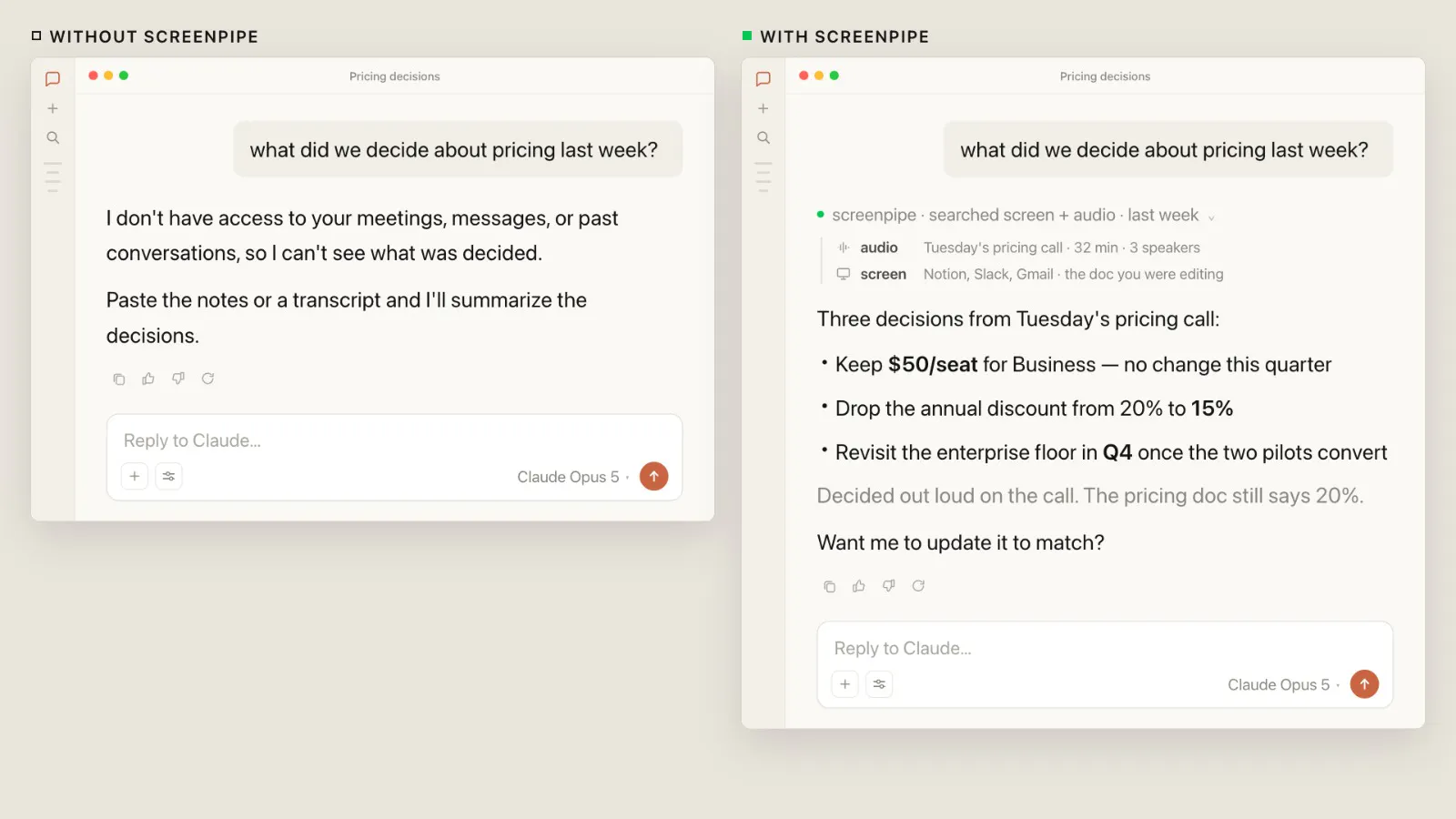
screenpipe records your screen, audio, and activity on your computer, then lets AI agents access that history through MCP. Ask about calls, bugs, or documents without reconstructing your day. Local-first and source-available for Mac, Windows, and Linux. Launch-day offer: use code BUSINESS20 for a discount on annual plans. Ends August 28 at 11:59pm PT.
AI Analysis
Screenpipe is a local-first, source-available tool for Mac, Windows, and Linux that continuously records screen, audio, and computer activity. It allows AI agents to access this history via MCP, enabling natural language queries about past calls, bugs, documents, or work without manual reconstruction. It solves key pain points of forgotten digital context and time wasted searching personal history. USPs include full on-device privacy (no cloud uploads), cross-platform support, and seamless integration with AI agents for productivity. Overall value proposition: Provides perfect recall of your computer work to empower both users and autonomous AI agents while prioritizing data ownership and privacy.
In 2025-2026, AI agents and multimodal models are maturing rapidly, with surging demand for personalized AI memory tools amid growing privacy regulations (e.g. GDPR expansions) and backlash against cloud data collection. On-device AI tech is becoming viable, and remote work trends increase need for digital recall. Economic focus on productivity tools aligns perfectly. This is an ideal window before mainstream adoption saturates the space. Excellent Timing.
Technical difficulty is moderate: leverages standard OS recording APIs, local STT models, and vector databases for indexing, but continuous recording poses battery/CPU challenges. Development and operation costs are low due to local-first design minimizing cloud infrastructure. Compliance risks are reduced by privacy focus, though data retention laws must be considered. Strong scalability for personal use with potential enterprise expansion. Team fit is good for AI/dev-focused creators. Overall rating: High.
Primary segments: Tech-savvy knowledge workers, software developers, AI enthusiasts, and productivity professionals (ages 25-45). Industries: Software engineering, content creation, consulting, and remote work. Geographic focus: North America, Europe, with global developer interest. TAM for AI productivity/memory tools estimated at $40-60B, SAM for local AI recording ~$4-6B, SOM for cross-platform desktop tools ~$200-500M. Core pain points: Inability to recall specific past digital interactions and context loss in agent workflows. High willingness to pay for annual subscriptions offering advanced features and support.
Medium. Direct competitors: 1. Rewind (rewind.ai) - Mac-focused AI memory assistant. 2. Limitless (limitless.ai) - AI wearable and desktop recorder. 3. Mem (getmem.com) - AI-powered note-taking with search. 4. Otter.ai (otter.ai) - AI meeting transcription and notes. 5. Microsoft Recall (built into Copilot+ PCs). Advantages: Superior privacy via fully local processing, source-available code, broader OS support, and specific MCP integration for AI agents. Disadvantages: Higher local resource demands, potentially steeper setup than cloud competitors, and less brand recognition. Strong differentiation through openness and agent-centric design reduces competitive pressure.
Upgrade Pro to unlock full AI analysis
Similar Products

Cohere Parse 5
Turn complex docs, tables & images into AI-ready data
▲ 158 votes

Adapt
The company brain that gets work done
▲ 124 votes

Kosshi
Simple, fast outliner for Mac and iPhone.
▲ 90 votes

WikiFix for Confluence
Find and fix issues in your knowledge base
▲ 86 votes

Audryo
Customer email your agent can operate.
▲ 68 votes

Refoid
Automate App Store refund responses and track every outcome
▲ 68 votes