scritty
Shared, searchable memory for every AI coding agent
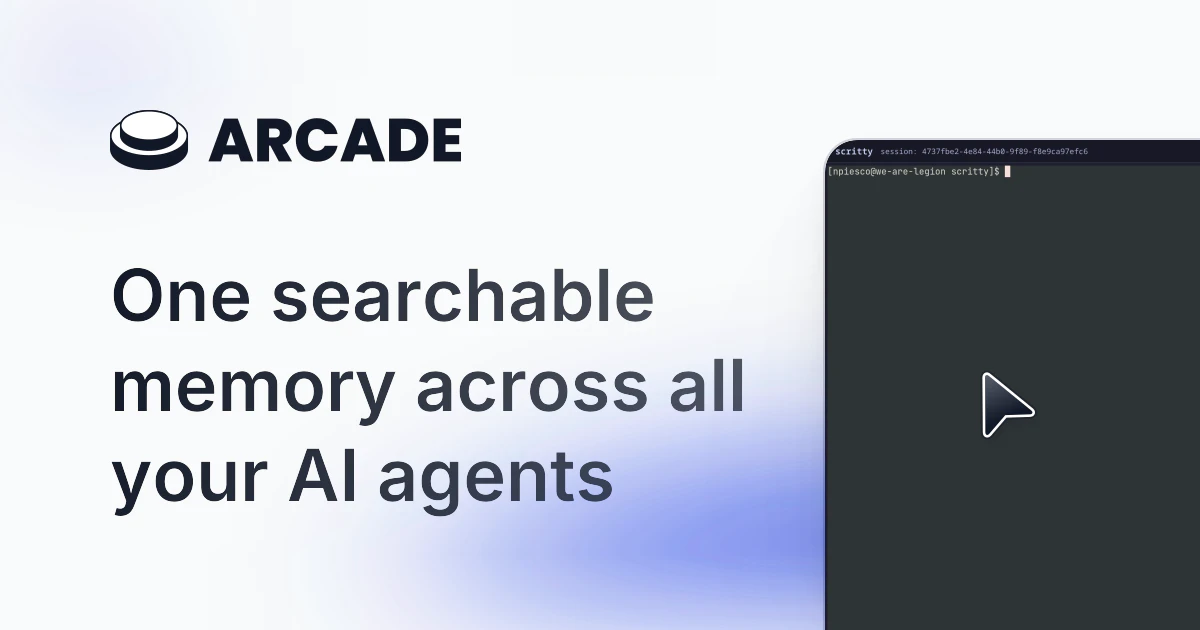
scritty is a terminal emulator that captures every CLI agent's conversation (Claude, Codex, Copilot, Antigravity, Ollama), indexes it into one searchable corpus you control, and serves it back to your agents over MCP and to you over the CLI. One session across desktop, browser, and mobile. Your captures stay on your machine.
AI Analysis
Scritty is a terminal emulator that captures every conversation from CLI AI coding agents (Claude, Codex, Copilot, Antigravity, Ollama), indexes them into a single searchable corpus fully controlled by the user, and feeds the memory back to agents via MCP and to users via CLI. It maintains one unified session across desktop, browser, and mobile while keeping all data local on the user's machine. Key USPs are persistent shared memory for agents, complete data ownership/privacy, and seamless cross-platform access. It solves critical pain points like fragmented AI interaction histories, lack of long-term context/memory for agents, time wasted searching old logs, and privacy risks of cloud-based tools. The value proposition is transforming AI coding workflows with a personal, intelligent, searchable memory layer that boosts agent performance and developer productivity.
The 2025-2026 period features explosive growth in autonomous AI coding agents and agentic workflows, with rising recognition that context windows are insufficient and dedicated memory systems are essential. Trends toward local-first, privacy-centric AI tools align perfectly with Scritty's on-device approach amid increasing data regulation concerns and developer frustration with cloud dependencies. User demand for productivity enhancements in AI-assisted coding is surging. This is an Excellent Timing.
Technical difficulty is moderate: building on established terminal tech while adding conversation capture, local indexing/search, MCP integration, and cross-device session support is challenging but feasible with current frameworks. Development and operation costs are manageable for a SaaS/dev tool with a local-first model reducing server burdens. Minimal compliance risks due to on-machine data storage; scalability is strong on a per-user distributed basis. High feasibility assuming a team experienced in developer tools and AI integrations.
Main target segments: Professional software developers, AI engineers, and indie hackers (ages 25-45, tech-savvy) who regularly use CLI-based AI coding assistants. Industries: Software development and technology companies. Geographic distribution: Global with heavy concentration in North America, Europe, and East Asia tech hubs. The AI developer tools market is large and rapidly growing (TAM in billions, SAM for agent infrastructure hundreds of millions). Core pain points include loss of context across agent sessions and inability to efficiently search or reuse past interactions. Potential willingness to pay is high for tools that meaningfully improve daily coding efficiency.
Low. Direct competitors: 1. Mem0 (mem0.ai), 2. Zep (getzep.com), 3. Letta (letta.ai, formerly MemGPT), 4. Warp (warp.dev). Scritty's advantages include its terminal-emulator focus specifically for CLI agents, fully local/user-controlled corpus (vs primarily cloud offerings), unified cross-agent memory indexing, and on-device privacy. Disadvantages: Newer product with potentially smaller ecosystem/community compared to established memory layers; may involve more local setup complexity than SaaS competitors.
Upgrade Pro to unlock full AI analysis
Similar Products

Cohere Parse 5
Turn complex docs, tables & images into AI-ready data
▲ 158 votes

Opaline
PostHog for team Claude Code and Codex sessions.
▲ 141 votes

Adapt
The company brain that gets work done
▲ 124 votes

Replay QA Security Scan
Automated Penetration Testing for AI-Built Apps
▲ 102 votes

Kosshi
Simple, fast outliner for Mac and iPhone.
▲ 90 votes

Refoid
Automate App Store refund responses and track every outcome
▲ 68 votes